Can You Tax Loss Harvest in a Roth IRA? What Investors Miss

Roth IRA investors often wonder whether they can use tax-loss harvesting to offset gains when their investments decline in value. This popular strategy works well in taxable accounts, but the rules change dramatically when dealing with tax-advantaged retirement accounts. Understanding these differences prevents costly mistakes and helps investors focus on strategies that actually work within their Roth IRAs.
The key lies in knowing which tax-saving techniques apply to different account types and how to maximize benefits across an entire investment portfolio. Rather than forcing inappropriate strategies into tax-advantaged accounts, successful investors focus on legitimate approaches that align with each account's unique tax treatment and work with professionals who specialize in retirement financial planning.
Table of Contents
Why Investors Get Confused About Tax Loss Harvesting in Roth IRAs
Where Tax Loss Harvesting Actually Fits Into a Portfolio Strategy
How Smart Financial Lifestyle Helps Investors Think Beyond Isolated Tax Tactics
Kickstart Your Retirement Financial Planning Journey | Subscribe to Our YouTube and Newsletter
Summary
Tax loss harvesting only applies to taxable brokerage accounts, where realized gains and losses result in reportable tax consequences. Roth IRAs operate under retirement account rules where internal transactions never appear on your tax return as capital gains or losses. The IRS doesn't allow you to claim losses while shielding gains, which means the entire mechanism that makes tax loss harvesting valuable disappears within tax-advantaged retirement accounts.
Most investing content treats tax loss harvesting as a standalone strategy without clarifying where it actually applies. The sheer volume of articles, videos, and forum threads creates an impression that the approach works everywhere. Investors naturally extend the logic to all their investments, assuming Roth IRAs, traditional IRAs, and taxable brokerage accounts follow similar rules because they all hold stocks, bonds, and funds.
Capital losses can offset capital gains dollar-for-dollar in taxable accounts, and investors can apply up to $3,000 against ordinary income each year, according to IRS Publication 550. Unused losses carry forward indefinitely, creating a strategic tax asset you can deploy over time. The strategy gained traction among higher-net-worth investors because it creates measurable after-tax value by reducing taxable gains, without changing overall market exposure if you reinvest the proceeds into similar assets.
Continuous tax-loss harvesting throughout the year matters more than year-end selloffs because market volatility creates harvesting opportunities unpredictably. According to J.P. Morgan Asset Management, ongoing tax-loss harvesting can help investors take advantage of investment losses throughout the year to reduce their tax bill. That continuous approach captures value during brief market dips when volatility creates narrow windows before prices recover.
Investors with balances exceeding $1 million in pre-tax retirement accounts face required minimum distributions that can push them into higher tax brackets than they experienced during their working years, according to a 2024 Vanguard study. These coordination problems require thinking about asset location, withdrawal sequencing, and managing taxable income levels year by year across multiple account types, rather than optimizing a single tactic in isolation.
Retirement financial planning addresses this by coordinating account-specific strategies, such as Roth conversions, required minimum distributions, and harvesting taxable accounts, to reduce your lifetime tax burden over decades rather than in individual tax years.
Why Investors Get Confused About Tax Loss Harvesting in Roth IRAs
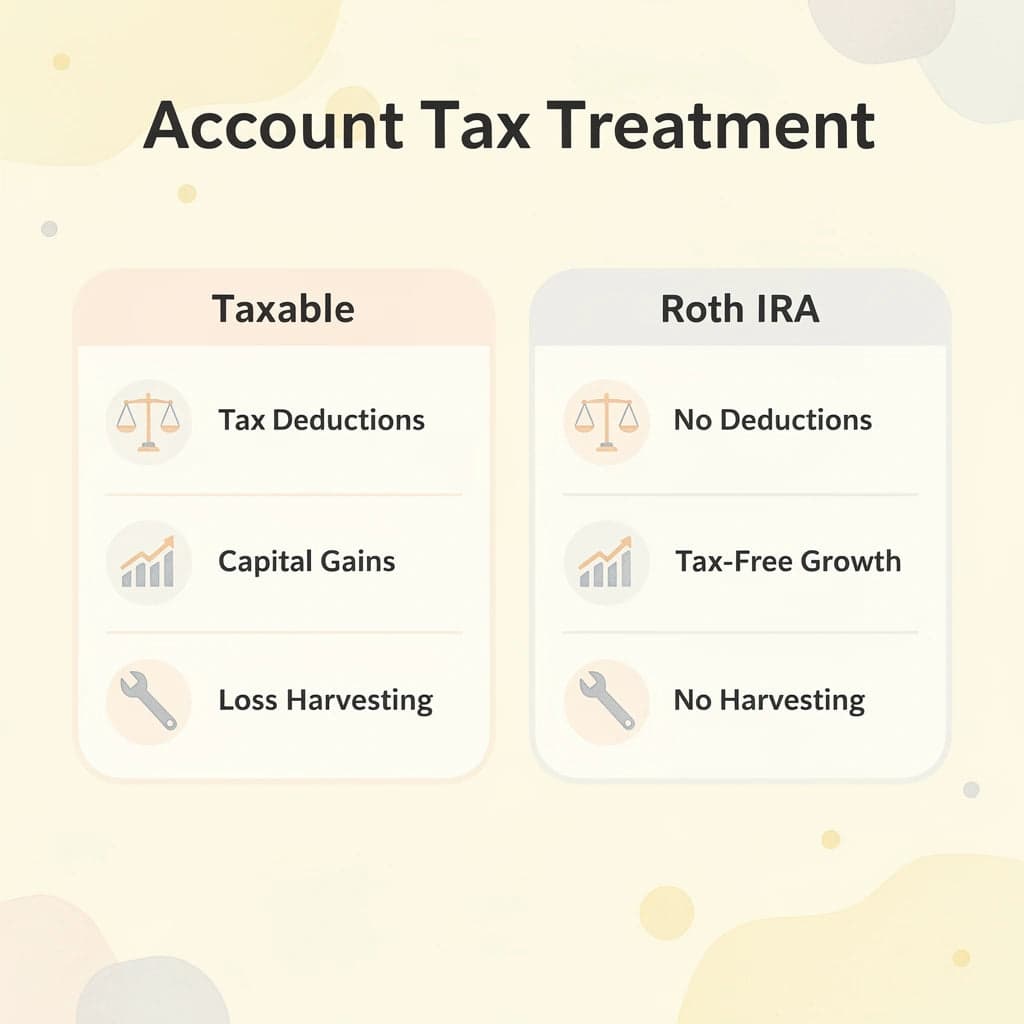
The confusion starts with a reasonable assumption. If you sell an investment at a loss in your brokerage account, you can use that loss to offset capital gains and reduce your tax bill. When that same investment loses value inside a Roth IRA, the logic feels identical. However, Roth IRAs don't work that way: different account types exist for fundamentally different tax purposes.

🎯 Key Point: The fundamental difference between taxable accounts and Roth IRAs creates this confusion—what works for tax reduction in one account type simply doesn't apply to tax-free growth accounts.
"Tax loss harvesting only makes sense in accounts where you actually pay taxes on gains and can deduct losses—Roth IRAs operate in a completely different tax universe." — Tax Planning Fundamentals
⚠️ Warning: Many investors waste valuable time trying to apply taxable account strategies to Roth IRAs, missing the real opportunities for tax-efficient investing within each account type.
Why does most investing advice ignore account type differences?
Most investing content treats tax-loss harvesting as a standalone strategy without addressing its practical applications. Vanguard's educational materials on tax-loss harvesting explain the mechanics clearly, but a critical detail often gets overlooked: this strategy creates value only when capital gains and losses are taxable events.
A Roth IRA doesn't generate taxable gains or deductible losses because qualified withdrawals are tax-free. The account was designed to eliminate taxes on growth and the tax consequences of losses.
How does universal advice create investor confusion?
When investors find tax loss harvesting advice online, the volume of content across articles, videos, and forums creates the impression that the approach works universally. Without clear information about how different account types function, people apply the same logic to all their investments, assuming Roth IRAs, traditional IRAs, and taxable brokerage accounts follow identical rules because they all hold stocks, bonds, and funds.
That assumption wastes time and creates frustration when the expected tax benefit never materializes.
How do tax rules differ between account types?
IRS guidance on capital gains and losses clarifies that capital gains and losses apply to taxable investment activity. Roth IRAs operate under separate retirement account rules, with qualified distributions being tax-free. Investors see "capital loss" in their Roth IRA account statement and assume it works the same way as in a brokerage account. It doesn't. The loss exists but carries no tax consequence, since any gain would have none either.
Why do taxable accounts create different opportunities?
Taxable brokerage accounts enable tax loss harvesting: when you sell investments at a gain, you owe taxes on that profit, but losses can offset those taxes. Roth IRAs grow tax-free and allow tax-free withdrawals in retirement. Since these accounts serve different purposes, they require different strategies. Retirement financial planning that accounts for these differences maximizes tax loss harvesting in taxable accounts while leveraging Roth IRAs for their core strength: building wealth without taxation on growth.
What makes retirement tax strategies most effective?
The most effective retirement tax strategies focus on understanding which tax rules apply to which accounts and coordinating them to reduce your lifetime tax burden. Our Smart Financial Lifestyle platform helps you coordinate these strategies across all your accounts to optimize your tax efficiency in retirement.
What Tax Loss Harvesting Actually Means
Tax loss harvesting is a strategy in which investors deliberately sell investments that have declined in value to realize capital losses that offset taxable capital gains. These losses reduce your taxable income from investment gains and can offset up to $3,000 of ordinary income annually. Excess losses carry forward to future tax years.

🎯 Key Point: Tax loss harvesting transforms your investment losses into valuable tax deductions that can reduce your overall tax burden for years to come.
"Tax loss harvesting can offset up to $3,000 of ordinary income annually, with unlimited carryforward potential for future tax years." — IRS Tax Code

💡 Tip: The $3,000 annual limit only applies to ordinary income offset - there's no limit on how much capital losses can offset capital gains in the same tax year.
How does tax loss harvesting work in practice?
Taxable brokerage accounts create taxable events when you sell holdings. If you sell a stock for a $20,000 gain but also sell another holding for a $15,000 loss in the same year, you've reduced your taxable gain to $5,000. According to IRS Publication 550, capital losses first offset capital gains of the same type, then gains of the other type, and finally reduce ordinary income by up to $3,000 per year, with remaining losses carried forward indefinitely.
The Mechanics Are Straightforward
You sell an investment at a loss, creating a realized capital loss that offsets realized capital gains dollar-for-dollar. If losses exceed gains, you can apply up to $3,000 against ordinary income each year. Unused losses carry forward to offset future gains or reduce ordinary income in $3,000 increments.
Consider an investor who realizes $40,000 in capital gains but harvests $25,000 in losses, reducing taxable gains to $15,000. Without harvesting, they would owe taxes on the full $40,000. The benefit increases for higher tax brackets where capital gains rates reach 15% or 20%, plus potential net investment income tax.
Why did tax loss harvesting become so popular among investors?
The strategy gained traction among higher-net-worth investors and taxable account holders because it creates measurable after-tax value. Reducing taxable gains improves portfolio efficiency without changing your overall market exposure when you reinvest proceeds into similar assets, and tax benefits compound over time.
Many investors struggle to time these opportunities during brief market dips, when volatility creates narrow windows to capture losses before prices recover. This pressure intensifies when managing multiple positions across different asset classes, each with its own cost basis and tax lot history.
How does tax loss harvesting actually work in practice?
The strategy works because taxable brokerage accounts report gains and losses to the IRS. Tax loss harvesting lets you control when and how much of those taxable events occur, converting market changes into tax planning opportunities.
That difference becomes important when considering different account types. Tax loss harvesting rules connect directly to taxable investment activity. If gains and losses aren't taxed within the account structure, the value of tax-loss harvesting disappears.
Related Reading
Can You Tax Loss Harvest in a Roth IRA?
How does the Roth IRA structure prevent tax loss harvesting?
Roth IRAs eliminate the tax reporting structure on which tax loss harvesting depends. When you sell an investment inside a Roth IRA, that transaction never appears on your tax return as a capital gain or loss. The IRS doesn't track individual trades inside the account because it operates under retirement account rules, not capital gains rules. Without taxable events to report, there's nothing to harvest.
Why can't you claim losses while shielding gains?
Tax loss harvesting requires real losses you can claim and taxable gains to offset. Roth IRAs provide neither. Gains grow without taxes, and qualified withdrawals come out tax-free, but losses cannot be deducted. The IRS doesn't permit selective tax treatment: you cannot claim losses while protecting gains.
Why the Account Type Determines the Strategy
Many investors assume tax strategies work the same way across all investment accounts. This confusion stems from treating all accounts identically when each account type has distinct tax rules that either permit or prohibit certain strategies.
How do capital loss limitations differ between account types?
According to Emerald Asset Management, investors can deduct capital losses up to $3,000 per year against ordinary income in taxable accounts, with remaining losses carried forward. This limitation applies only to taxable accounts, which report gains and losses for tax purposes. Roth IRAs operate outside this framework: losses are never recognized as deductible and cannot be carried forward.
Taxable brokerage accounts offer flexibility and tax loss harvesting, but tax all realized gains. Roth IRAs sacrifice certain tax maneuvers in exchange for potentially tax-free compounding over decades. Neither structure is inherently superior; the choice depends on which tax advantages matter most for your specific financial situation and timeline.
Where can you get help navigating these account-specific rules?
Platforms like Smart Financial Lifestyle help people over 50, whether retired or nearing retirement, understand account-specific rules through personalized consultations. This proves especially helpful when coordinating Roth conversions with your overall tax strategy. The goal is understanding which tools belong where and how they work together across your entire portfolio.
The more useful question is where tax loss harvesting delivers measurable value and how to build it into a coherent strategy.
Related Reading
How to Reduce Taxes on RMDs
Where Tax Loss Harvesting Actually Fits Into a Portfolio Strategy
Tax loss harvesting only works in taxable brokerage accounts where you realize gains and losses that the IRS recognizes for tax purposes. Traditional IRAs, 401(k)s, and Roth IRAs operate under different tax rules where internal transactions don't trigger reportable capital gains or losses.

🎯 Key Point: Tax loss harvesting is exclusively a taxable account strategy - your retirement accounts operate under completely different tax frameworks that make this technique irrelevant.
"Tax loss harvesting strategies can only be implemented in taxable investment accounts where capital gains and losses have immediate tax implications." — Brookings Institution
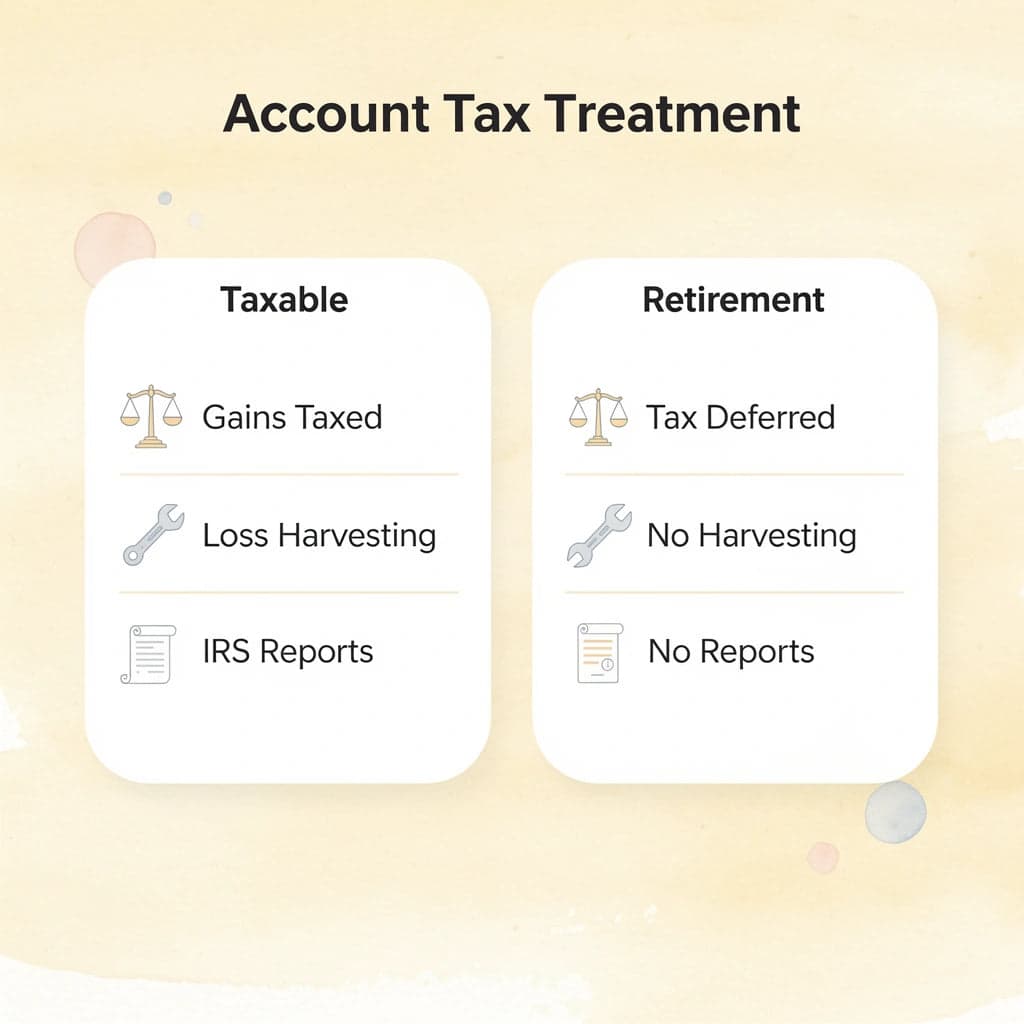
⚠️ Warning: Many investors mistakenly think they can apply tax loss harvesting across all their accounts, but retirement accounts have tax-deferred or tax-free status that makes realized losses meaningless for current tax planning.
Account Types Serve Different Tax Purposes
Taxable brokerage accounts are subject to annual taxes on every gain you realize, dividend, and interest payment to annual taxes. When your investments decline in value, you can sell them, use the loss to reduce your taxes, and immediately reinvest in similar positions to keep your money in the market.
According to J.P. Morgan Asset Management, ongoing tax-loss harvesting helps investors reduce their tax bill by capitalizing on investment losses throughout the year. Market changes create harvesting opportunities at unpredictable times, beyond December selloffs.
What makes retirement accounts different from taxable accounts?
Traditional IRAs and 401(k)s defer taxes completely. Contributions may lower your current tax bill, and your investments grow without yearly capital gains taxes. You pay regular income tax when you withdraw funds during retirement.
Roth IRAs flip this around: you contribute after-tax money, but qualified withdrawals aren't taxed. Each account type offers different financial planning advantages.
Tax Strategy Depends on Account Location
High-growth stocks belong in Roth accounts where future gains grow tax-free. Tax-inefficient investments like bonds fit better in traditional retirement accounts, where regular interest income is taxed only once per year. Taxable accounts serve for active tax management, including loss harvesting, strategic gain recognition, and flexible rebalancing.
When you hold dividend-paying stocks in a Roth IRA, those dividends never get taxed. In a taxable account, every dividend creates a taxable event. The investment performs identically, but the after-tax result differs significantly over decades. Sophisticated investors ask which account type maximizes after-tax efficiency, not whether an investment is good.
Coordinating Multiple Tax Variables Simultaneously
Tax-efficient investing means balancing asset placement across account types, timing investment sales for gains in regular accounts, sequencing withdrawals during retirement, and managing annual taxable income. Many investors focus on isolated strategies, such as selling losing investments in December or maximizing Roth contributions, without considering how these choices affect their overall portfolio.
How do different account types work together for tax optimization?
An investor who collects $15,000 in losses inside a taxable account while keeping Roth assets for tax-free growth leverages different accounts for different tax benefits. The taxable account handles short-term tax management, while the Roth account handles long-term tax-free growth. Both strategies work together.
Platforms like retirement financial planning help investors coordinate account-specific strategies through personalized consultations, particularly when timing Roth conversions alongside harvesting taxable accounts. The goal is understanding which tools belong where and how they amplify each other across your entire financial structure.
What makes timing and sequencing decisions so challenging?
Understanding where strategies fit addresses only half the challenge. The harder question is knowing when to use them and how to sequence decisions across decades, not just tax years.
How Smart Financial Lifestyle Helps Investors Think Beyond Isolated Tax Tactics
Treating tax-loss harvesting as a standalone solution misses the bigger coordination challenge most investors face. The complexity emerges when managing taxable accounts, Roth IRAs, traditional retirement accounts, future withdrawals, and changing tax exposure across decades. You're managing a long-term tax and retirement system, not investments alone.

🎯 Key Point: Tax strategies work best when coordinated across your entire financial ecosystem, not applied in isolation.
"The most successful investors think in terms of tax-efficient systems rather than individual tactics, coordinating moves across multiple account types and time horizons." — Financial Planning Research, 2023
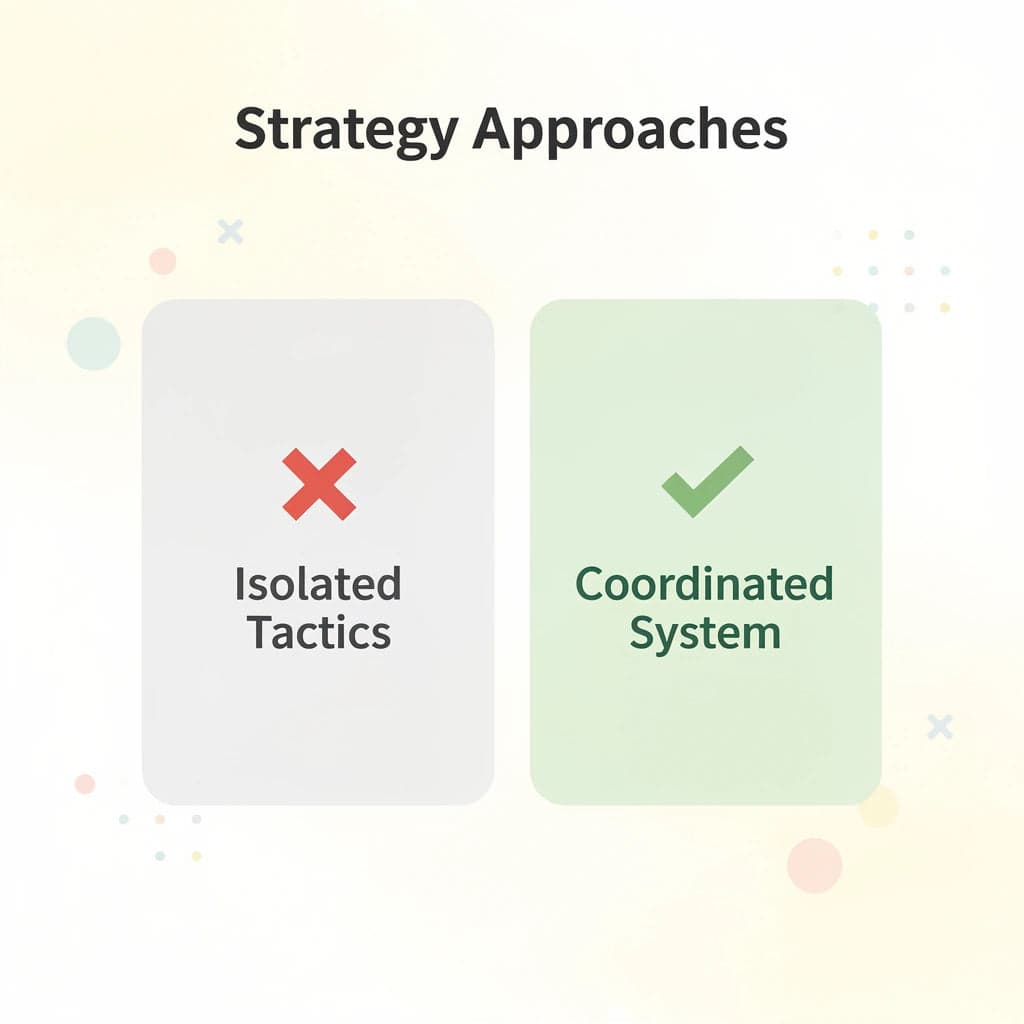
💡 Tip: Before implementing any tax strategy, map out how it affects your overall retirement timeline and withdrawal sequence across all account types.
How do individual tactics create system-wide problems?
Which assets should go in taxable accounts versus Roth accounts? When should you start taking money out of retirement accounts? How does future taxable income affect retirement planning? These questions become interconnected, and answering one without considering the others creates gaps in your overall strategy. An investor focusing only on tax-loss harvesting opportunities may miss that all account structures work together efficiently over time.
Why does coordination matter more than individual decisions?
One investor might benefit from harvesting losses strategically in taxable accounts while preserving Roth IRA assets for future tax-free retirement flexibility. Another may need to consider how traditional IRA withdrawals could affect future tax brackets or retirement income sequencing.
According to a 2024 Vanguard study, investors with balances exceeding $1 million in pre-tax retirement accounts face RMDs that can push them into higher tax brackets than they experienced during their working years, undermining the original tax-saving strategy. These are coordination problems, not isolated investing decisions.
What makes wealth management systems effective over the decades?
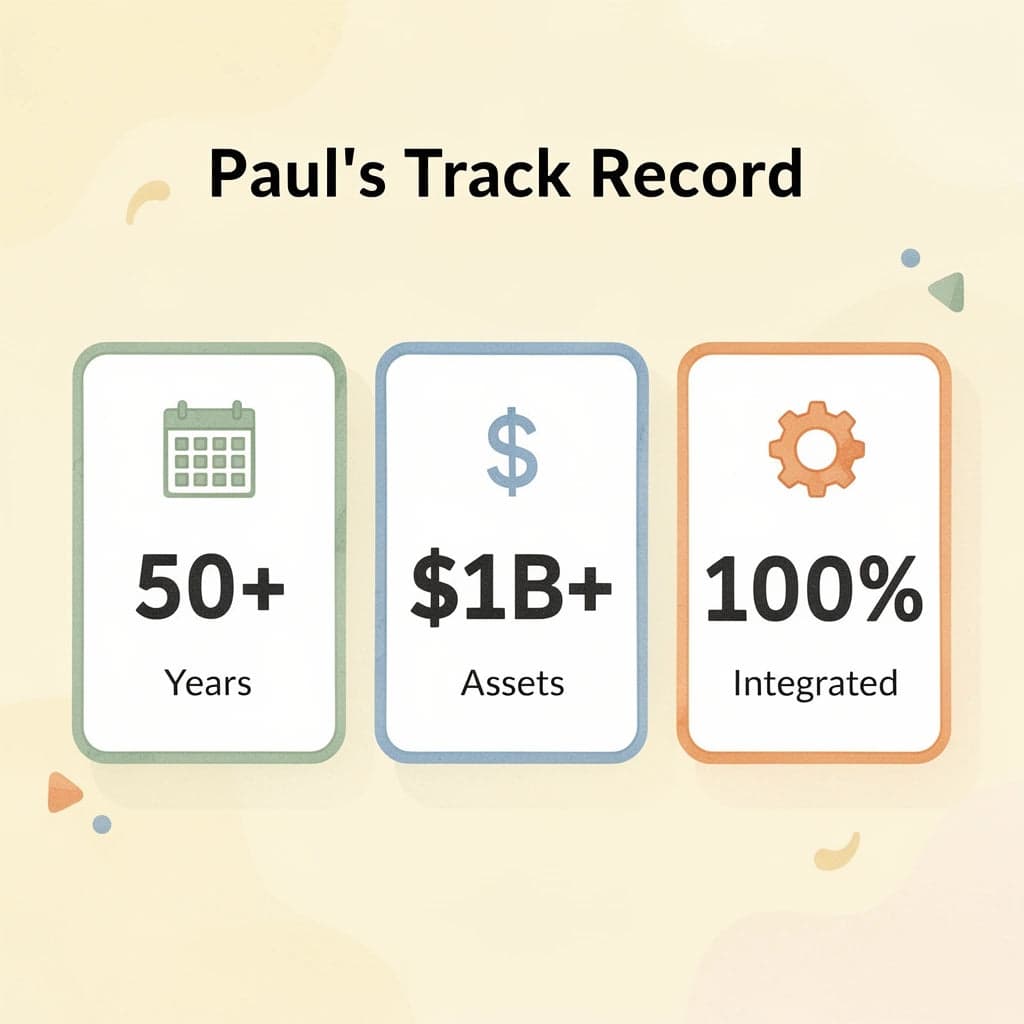
Smart Financial Lifestyle helps investors think strategically about building wealth, coordinating retirement, and reducing taxes. This perspective comes from Paul Mauro's 50-year career in wealth management, during which he built over $1 billion in assets under management while working with clients on retirement income planning, tax-efficient investing, withdrawal coordination, portfolio structure, and long-term wealth preservation.
Many planning principles previously available only through high-cost advisory relationships are now shared through his books, free educational content, and personalized Roth IRA conversion consultations.
How should investment decisions fit within your financial plan?
Investment decisions only make sense within your whole financial plan. Good wealth management focuses less on finding one perfect strategy and more on building systems that remain tax-efficient, flexible, and sustainable over many years.
Understanding these systems is valuable only if you apply them to your specific situation and act on what matters most.
Related Reading
Kickstart Your Retirement Financial Planning Journey | Subscribe to Our YouTube and Newsletter
If understanding tax loss harvesting raises questions about retirement taxes, portfolio structure, and long-term wealth preservation, you're asking the right questions. Build a framework that coordinates every piece of your financial picture across decades. This requires understanding how Roth conversions, required minimum distributions, Social Security timing, and asset location decisions work together to shape your after-tax retirement income.

🎯 Key Point: Smart Financial Lifestyle offers Paul Mauro's books and free educational content explaining how experienced wealth managers approach these connected strategies. With over 50 years of managing more than $1 billion in assets, Paul addresses the specific, nuanced situations retirees face. Subscribe to our YouTube channel and newsletter at Smart Financial Lifestyle for practical guidance on Roth IRA conversions, retirement tax planning, and wealth-building decisions that help families preserve what they've built for generations.
💡 Tip: A coordinated strategy often determines whether your retirement income lasts or gets eroded by avoidable taxes. The difference between a fragmented approach and an integrated financial plan can mean thousands of dollars in tax savings over your retirement years.