Do Retirees Need to File Taxes? What Most Get Wrong
Retirement brings freedom from the daily grind, but tax obligations don't automatically disappear with your last paycheck. Many retirees wonder whether their Social Security benefits, pension income, IRA distributions, or investment earnings trigger filing requirements with the IRS. Understanding these requirements isn't just about compliance—it's about building a tax-efficient retirement that protects hard-earned savings. The right approach keeps more money available for what matters most.
Income thresholds, deductions, and credits specific to retirees create layers of complexity that affect both filing requirements and tax liability. Smart withdrawal strategies and proper income structuring can significantly reduce the tax burden throughout retirement years. Professional guidance helps retirees navigate these decisions and optimize their financial position through strategic retirement financial planning.
Table of Contents
Most Retirees Get This Question Wrong
What Actually Determines If You Need to File
When Retirees Do NOT Need to File
When Retirees DO Need to File
Why Many Retirees Pay More Than Expected
How Smart Financial Lifestyle Helps You Plan for Taxes in Retirement
Kickstart Your Retirement Financial Planning Journey | Subscribe to Our YouTube and Newsletter
Summary
The belief that retirement eliminates tax obligations is one of the most common and costly misunderstandings in financial planning. Retirement changes the form of income, not the tax burden. Instead of wages, retirees receive withdrawals from retirement accounts, Social Security benefits, pension income, or investment earnings, many of which remain fully taxable and can combine in ways that push total income above filing thresholds.
Only 28% of Americans have a long-term financial plan, according to Ramsey Solutions, meaning most people enter retirement without understanding how their income sources will be taxed or how to structure withdrawals to minimize their tax burden. This lack of planning exposes individuals to unnecessary tax liability that compounds over decades, turning what could have been strategic decisions into reactive responses to unexpected bills.
Social Security benefits are not automatically tax-free. Up to 85% of Social Security benefits can become taxable when combined income exceeds $25,000 for single filers or $32,000 for married couples filing jointly. This stacking effect catches retirees off guard because they assume Social Security benefits are protected, but additional income from IRA withdrawals or investments triggers taxation of benefits that would otherwise remain exempt.
Required minimum distributions force withdrawals starting at age 73, whether retirees need the money or not. These mandatory withdrawals increase as you age, pushing taxable income higher over time even if spending remains constant. The result is predictable: rising taxable income in later retirement years, often pushing retirees into higher tax brackets despite lower overall cash flow needs.
The difference between filing correctly and filing strategically is not knowledge; it's structure. Timing withdrawals, balancing income across different tax brackets, and recognizing income in lower-tax years can significantly reduce lifetime tax exposure. Most retirees treat taxes as something that happens to them annually, but by the time forms are filled out, every decision determining tax liability has already been made, often without realizing those choices were being locked in.
Retirement financial planning helps you structure withdrawals and income sources to minimize your tax burden throughout retirement, not just optimize a single return.
Most Retirees Get This Question Wrong
Many retirees believe they stop filing taxes when they retire—a common misunderstanding. Retirement doesn't eliminate income; it changes its form. Instead of wages, you may have withdrawals from retirement accounts, Social Security benefits, pension income, or investment income. These can be taxable and, when combined, push your total income above filing thresholds. According to the Internal Revenue Service, filing requirements are based on your total income, filing status, and age, not whether you are employed.

⚠️ Warning: Assuming retirement means no tax obligations can lead to missed filing deadlines and potential penalties from the IRS.
"Filing requirements are based on your total income, filing status, and age, not whether you are employed." — Internal Revenue Service

🔑 Takeaway: Retirement income comes in many forms, and most sources are subject to federal income tax just like your pre-retirement wages were.
Why does this assumption become costly?
Some retirees skip filing taxes completely, while others underestimate how their different income sources work together: withdrawals, Social Security, and investments. Failing to file when required causes penalties, interest, and reporting problems that compound in future years.
The main problem is assuming that no paycheck means no taxable income. For many retirees, this assumption leads to mistakes that could have been planned for earlier.
The planning gap nobody talks about
According to Ramsey Solutions, only 28% of Americans have a long-term financial plan. Most people enter retirement without understanding how their income sources will be taxed or how to structure withdrawals to minimize tax liability, a risk that compounds over decades.
Retirement financial planning clarifies income thresholds, deductions, and credits for retirees. It helps you structure withdrawals and income sources to minimize your tax burden throughout retirement, not just file correctly once.
Knowing you need to file is only the beginning. What triggers that requirement is where most people get confused.
What Actually Determines If You Need to File
The IRS cares about three things: your total income, your filing status, and your age. Each combination sets a specific threshold. Cross it, and filing becomes mandatory, regardless of employment status.

🎯 Key Point: The IRS doesn't look at individual income sources—they care about your total combined income from all sources.
A retiree collecting Social Security, taking small IRA withdrawals, and earning modest investment income might assume each source is too small to matter. The IRS adds them all together, and once the sum crosses your threshold, you must file.

"The IRS combines all income sources to determine filing requirements—even small amounts from multiple sources can push you over the threshold." — IRS Publication 501
⚠️ Warning: Many retirees mistakenly think small individual income streams don't count, but the IRS looks at your total combined income to determine filing requirements.
What types of income trigger tax filing requirements?
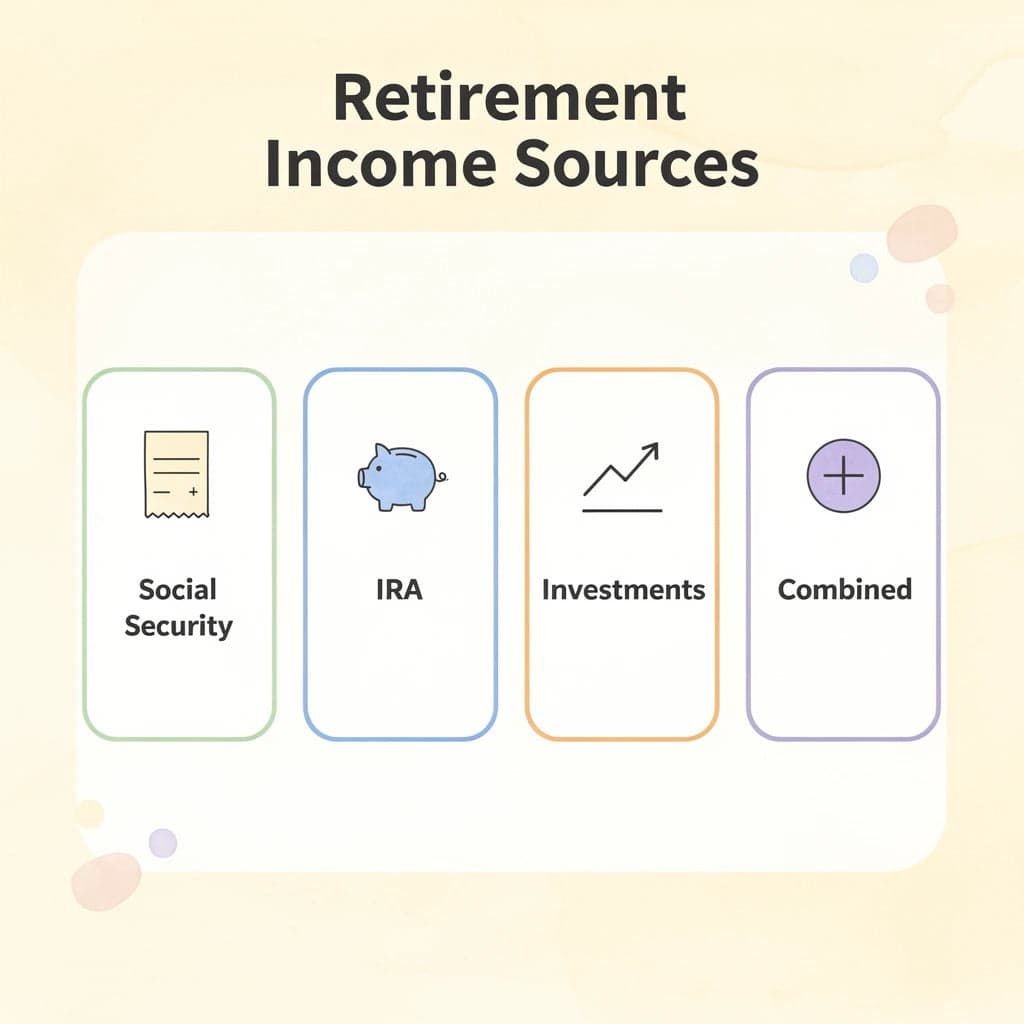
Income is the trigger, and retirement income takes many forms: withdrawals from traditional IRAs and 401(k)s, pensions, annuities, interest and dividend income, and capital gains. Even part of your Social Security benefits can become taxable depending on your total income from other sources.
How do different income sources combine to affect filing thresholds?
Each type of income is treated differently for tax purposes, but all count toward whether you exceed the filing threshold. The confusion arises from how they combine. A $15,000 IRA withdrawal or $8,000 in dividends may seem modest individually, but when combined with Social Security, they can push you well above the required filing level.
How does income stacking affect your tax obligations?
IRA withdrawals are taxed as regular income. Social Security taxation is more complicated: up to 85% of your benefits become taxable if your combined income exceeds certain limits.
Combined income is defined as your adjusted gross income, plus nontaxable interest, plus half of your Social Security benefits. Once that amount exceeds $25,000 for single filers or $32,000 for married couples filing jointly, part of your Social Security becomes taxable.
Why do many retirees accidentally trigger filing requirements?
Many retirees cross this threshold without realizing it, viewing each income source separately rather than as a combined total. A retiree with no job can still be required to file, while someone earning a small paycheck but little else might not.
The difference is how much taxable income appears on your return, not employment. Crossing the threshold, however, is not always the end of the story. Sometimes you do not need to file at all.
Related Reading
Do Retirees Need To File Taxes
When Retirees Do NOT Need to File
If your total income falls below the IRS filing threshold for your specific filing status and age, you're not required to file a return. The threshold shifts higher at age 65, which can benefit those with modest incomes. However, situations where you can skip filing are narrower than most expect and depend on specific income levels rather than retirement status.

🎯 Key Point: Your retirement status doesn't automatically exempt you from filing - it's all about whether your income exceeds the IRS thresholds for your age and filing status.
"The filing threshold increases at age 65, providing additional breathing room for retirees with limited income, but this benefit applies regardless of actual retirement status." — IRS Publication 501
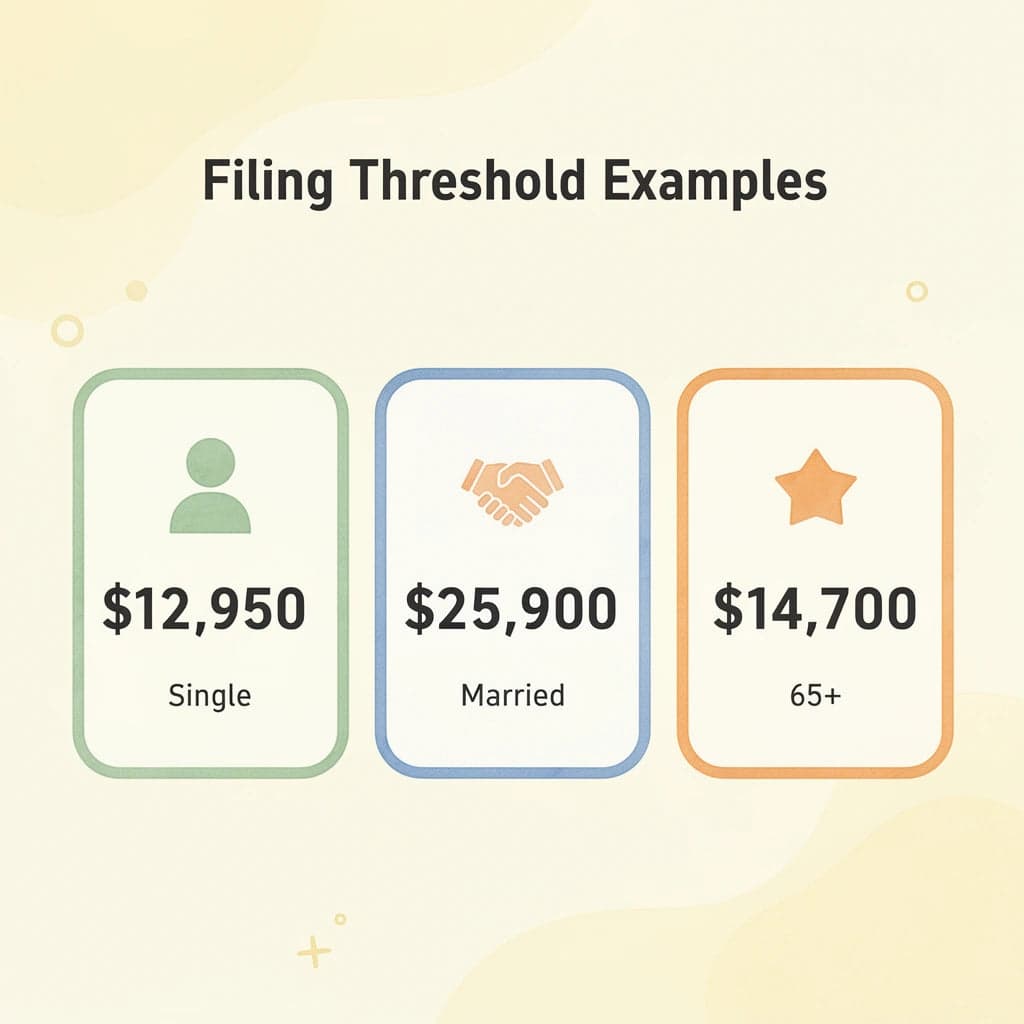
Filing Status | Under 65 | 65 or Older |
|---|---|---|
Single | $12,950 | $14,700 |
Married Filing Jointly | $25,900 | $27,650 (one spouse 65+) |
Married Filing Separately | $5 | $5 |
⚠️ Warning: Even if your income falls below these thresholds, you may still need to file if you have self-employment income over $400 or owe special taxes like Social Security tax on unreported tips.

Income Below IRS Thresholds
The main consideration is whether your total income exceeds the IRS limit for your filing status and age. Limits vary by filing status (single, married filing jointly, married filing separately, head of household) and increase at age 65.
For 2025, according to Publication 554, a single filer under 65 must file if total income exceeds $14,600; those 65 and older face a $16,550 threshold. Married couples filing jointly have a $29,200 limit if both spouses are under 65, $31,100 if one is 65 or older, and $32,800 if both are. These limits adjust annually for inflation.
Social Security as Your Only Income
If Social Security is your only source of income, you may not need to file because Social Security benefits are not always taxable. Whether they become taxable depends on your combined income: your adjusted gross income, plus nontaxable interest, plus half of your Social Security benefits. If that total stays below $25,000 for single filers or $32,000 for married couples filing jointly, none of your benefits are taxable, and you likely fall below the filing threshold.
How can other income sources affect your filing requirements?
This only works when you have no other income. Even a small IRA withdrawal, dividend payments, or savings account interest can push you over the limit.
Why does retirement status create tax filing confusion?
The confusion stems from thinking that retirement eliminates the need to file taxes. Some retirees correctly skip filing because their income falls below the threshold, while others assume the same applies without checking their own numbers.
The key difference is how much money you make, not whether you're retired. Even small amounts of extra money, such as withdrawals from retirement accounts, interest, dividends, or part-time work income, can push you over the limit and require you to file taxes.
How does retirement financial planning affect your filing requirements?
Retirement financial planning shows how each income source affects your total and whether you're approaching the filing threshold. It's about understanding how your income sources work together and whether you're positioning them to stay below the threshold or, when necessary, to minimize taxes. Our retirement financial planning tools help you visualize these scenarios and make informed decisions about your income strategy.
Staying below the threshold is not always the goal; sometimes you must file even when you think you shouldn't.
Related Reading
How to Reduce Taxes on RMDs
When Retirees DO Need to File
You have to file taxes when your combined income exceeds IRS limits. Withdrawals from traditional IRAs, Social Security benefits, investment earnings, and pension distributions all count toward your total, and they often push you above the line.

🎯 Key Point: Even if you're retired, multiple income streams can quickly push you over the filing threshold - it's not just about your pension or Social Security alone.
"Many retirees are surprised to learn that their combined income from various sources requires them to file taxes, even when individual income streams seem modest." — IRS Publication 554

⚠️ Warning: Don't assume you're exempt from filing just because you're retired - calculate your total income from all sources to determine your filing requirements.
Withdrawals From Retirement Accounts
Money withdrawn from a Traditional IRA or 401(k) is taxed as regular income. A $30,000 withdrawal gets added to your taxable income and could push you over the filing threshold when combined with other income sources. Once you turn 73, you must take required minimum distributions from these accounts annually, even if you don't need the money.
Part-Time or Supplemental Income
Some retirees earn money through consulting, part-time work, or side projects. Even small amounts of earned income can trigger filing requirements when combined with withdrawals and Social Security. A retiree earning $8,000 from freelance work might overlook it, but when added to IRA withdrawals and investment income, that $8,000 can push the total above the threshold.
Taxable Social Security Benefits
Social Security is not always tax-free. According to the Internal Revenue Service, up to 85 percent of Social Security benefits can become taxable depending on your combined income. When combined income (adjusted gross income plus nontaxable interest plus half of Social Security benefits) exceeds $25,000 for single filers or $32,000 for married couples filing jointly, a portion of those benefits becomes taxable.
Investment Income
Interest, dividends, and capital gains count toward taxable income. A retiree with $6,000 in dividends and $3,000 in interest may not realize that this $9,000 adds to IRA withdrawals and Social Security, potentially exceeding the filing threshold. Investment income accumulates quietly and is often underestimated.
How It Adds Up
The key issue is not any single source, but how they combine. A retiree might have $20,000 in IRA withdrawals, $18,000 in Social Security, and $7,000 in investment income. Individually, each seems manageable; together, they exceed filing thresholds and trigger a filing requirement. Retirement financial planning with Smart Financial Lifestyle helps you see how each income source works together and whether you are structuring withdrawals to minimize your tax burden or unknowingly pushing yourself into higher tax brackets.
The problem is how much you pay when you file.
Why Many Retirees Pay More Than Expected
The idea that taxes go down in retirement doesn't hold up under scrutiny. While earning less money should mean paying lower taxes, retirement income is taxed differently than job income and compounds in unexpected ways. Many retirees find that their tax bill stays the same or goes up because different types of income interact, not because they earned more money.

🎯 Key Point: Retirement income taxation operates under completely different rules than employment income, creating unexpected tax burdens for unprepared retirees.
"Many retirees discover their effective tax rate remains unchanged or increases despite lower total income due to the complex interaction of multiple income streams." — Tax Planning Research, 2024

⚠️ Warning: Don't assume lower income automatically means lower taxes - the type of income matters just as much as the amount when calculating your retirement tax liability.
Social Security Is Not Always Tax-Free
Many people enter retirement believing Social Security benefits are protected from taxation. They are not. According to the Internal Revenue Service, up to 85 percent of Social Security benefits can become taxable depending on your combined income. Combined income includes your adjusted gross income, nontaxable interest, and half of your Social Security benefits. When that total exceeds $25,000 for single filers or $32,000 for married couples filing jointly, a portion of your benefits becomes taxable.
Retirement Withdrawals Are Fully Taxable
When you withdraw money from traditional IRAs and 401(k)s, the government taxes it as regular income. The money won't be automatically withheld for taxes unless you request it. Required minimum distributions complicate this: once you turn 73, the IRS mandates annual withdrawals of a set amount, regardless of whether you need the funds. These withdrawals increase your reported income and grow larger as you age, raising your tax liability over time even if your spending remains unchanged.
Income Sources Stack Together
The real issue is not any single income stream, but how they combine. A retiree might have $20,000 in Social Security, $25,000 in IRA withdrawals, and $8,000 in investment income. Together, they total $53,000—well above filing thresholds and into higher tax brackets. Most people miss this stacking effect because they view each source individually rather than as a cumulative total to the IRS. Retirement financial planning with Smart Financial Lifestyle reveals how each income source interacts and whether your withdrawal strategy minimizes taxes or pushes you into higher brackets.
The Result
Instead of a lower tax bill, retirees often face higher taxable income, increased taxation of Social Security, and less control over when income is recognized. The result is unexpected tax bills and reduced retirement cash flow. The main issue is assuming that taxes automatically decrease once work income stops. Without planning, retirement income can be as taxable, and sometimes more so, than the income it replaces.
But knowing how much you owe is only half the problem.
How Smart Financial Lifestyle Helps You Plan for Taxes in Retirement
Most retirees treat taxes like something that happens to them once a year. They file, they pay, and they move on. But by the time you're filling out forms, every decision determining how much you owe has already been made: the withdrawals you took, when you took them, and how your income sources stacked up. Filing amounts to documenting choices you made months earlier, often without realizing you were making them.

🎯 Key Point: Tax planning in retirement isn't about April 15th—it's about the strategic decisions you make throughout the year that determine your final tax bill.
"The biggest mistake retirees make is treating tax filing as tax planning. Real tax strategy happens with every withdrawal decision you make." — Financial Planning Association, 2023

💡 Tip: Start thinking of every retirement account withdrawal as a tax decision that impacts your overall financial strategy, not just a way to access your money.
How does Smart Financial Lifestyle change your tax planning approach?
Smart Financial Lifestyle changes that dynamic. Instead of reacting to last year's tax bill, our platform helps you build a structure that shapes how your income is taxed throughout retirement. This means understanding how each income source is treated, how they interact, and how to time withdrawals so you control your taxable income year by year rather than letting it control you.
How do different income sources combine for tax purposes?
Money withdrawn from a traditional IRA is taxed as regular income. Social Security benefits become taxable depending on your combined income from all sources. Investment income from dividends and capital gains adds another layer, with each type subject to different rules and consequences. Understanding how they work together allows you to reduce your total tax burden rather than accept whatever amount appears on your tax return.
What happens when large withdrawals trigger additional taxes?
A retired person who withdraws a large amount from an IRA to cover a major expense may trigger taxes on otherwise untaxed Social Security benefits, resulting in tax on both the withdrawal and the previously protected income. Timing the withdrawal differently, or spreading it over two years, could have avoided this spike entirely.
Why does withdrawal timing matter for tax planning?
The goal is to avoid unnecessary taxes. Required minimum distributions force you to withdraw from traditional accounts starting at age 73, and those amounts increase with age. If you wait until RMDs begin to consider a withdrawal strategy, you've lost years of planning opportunity. Our retirement financial planning approach helps you map out a strategic withdrawal timeline in advance, minimizing tax impact across your lifetime.
According to Yardley Wealth Management, individuals under 50 can contribute up to $23,500 to their 401(k) in 2025, while those 50 and older can contribute up to $31,000 with catch-up contributions. What matters most is how you withdraw those funds to reduce lifetime tax exposure. Smart Financial Lifestyle can help you coordinate these contributions with a comprehensive withdrawal strategy tailored to your situation.
How should you structure withdrawals to minimize taxes?
Structuring withdrawals means deciding which accounts to tap first, how much to take each year, and whether to recognize income in lower-tax years to reduce pressure in higher-tax years. A $30,000 withdrawal might cost less in taxes than two $15,000 withdrawals if the timing pushes you across a threshold that triggers Social Security taxation. These decisions directly affect how much money you keep. Our Smart Financial Lifestyle platform helps you model these scenarios and optimize your withdrawal strategy to minimize taxes throughout retirement.
Building control over your tax outcome
Most retirees react to their tax bill rather than control it. The difference between reactive and strategic planning is structure. When you understand how income sources work together, how timing affects your total tax bill, and plan for required distributions years ahead, you stop reacting and start deciding: when to recognize income, how to balance withdrawals across tax buckets, and how to reduce exposure to spikes that compound over decades.
That separates filing strategically from filing correctly: the difference between managing taxes and letting them manage you.
Related Reading
Kickstart Your Retirement Financial Planning Journey | Subscribe to Our YouTube and Newsletter
Understanding how your different income sources interact with taxes is critical to avoiding unexpected retirement bills. Withdrawals, Social Security, and investment income create tax results that most people don't anticipate until filing. You need to see how these parts interact before making decisions that lock in years of higher taxes.

💡 Tip: Don't wait until tax season to understand how your retirement income sources affect each other—plan ahead to avoid costly surprises.
Smart Financial Lifestyle's free content gives you that essential view. The YouTube channel walks through real withdrawal scenarios, showing how timing and sequencing change your tax liability. The newsletter delivers actionable guidance on structuring income, managing required distributions, and reducing tax spikes that compound over decades.
"The difference between a good retirement plan and a great one often comes down to tax efficiency—understanding how your income sources interact can save thousands annually." — Smart Financial Lifestyle
🎯 Key Point: Map out your retirement income sources and their tax treatment. Subscribe to the channel and newsletter to build a plan that reduces what you pay year after year, rather than reacting to your tax bill. The difference is structure, and structure begins with understanding how the system works.