7 Best Roth IRA Alternatives for High-Income Investors

High earners face unique challenges when building retirement wealth, particularly when income limits restrict access to traditional Roth IRA contributions. Modified adjusted gross income thresholds can leave successful professionals searching for alternative strategies to minimize taxes while maximizing long-term growth. Fortunately, several powerful options exist beyond standard retirement accounts, including backdoor conversions, mega backdoor Roth strategies, and optimized taxable investment approaches.
The key lies in understanding which combination of vehicles works best for each individual situation, whether dealing with income phase-outs, maximizing employer-sponsored plans, or exploring supplementary tools like health savings accounts. Smart Financial Lifestyle specializes in helping high earners navigate these complex decisions through comprehensive retirement financial planning.
Table of Contents
Why High-Income Earners Start Looking Beyond Roth IRAs
Why Roth IRA Income Limits Matter
The Hidden Cost of Focusing Only on Roth IRAs
7 Best Roth IRA Alternatives for High-Income Investors
How High-Income Investors Evaluate Retirement Strategies
What Experienced Wealth Managers Do Differently
How Smart Financial Lifestyle Helps Investors Make Better Retirement Decisions
Kickstart Your Retirement Financial Planning Journey | Subscribe to Our YouTube and Newsletter
Summary
Direct Roth IRA contributions phase out completely at $165,000 for single filers and $246,000 for married couples filing jointly in 2025. This income threshold eliminates access to one of the most tax-efficient retirement accounts available, forcing high earners to reconsider their entire retirement strategy. The frustration stems from timing. Investors who built their wealth-building approach around Roth contributions during early career years suddenly find that success disqualifies them from the tool they relied on most.
The annual Roth IRA contribution limit of $7,000 (or $8,000 for those 50 and older) may seem modest in a single year, but the compounding effect over 15 to 20 years can create a significant planning gap when access disappears. Missing that tax-free growth strategy doesn't just remove one savings option. It eliminates decades of compounding, future tax diversification, and flexibility in retirement income planning, all of which can alter retirement lifestyle outcomes.
Modified adjusted gross income (MAGI) calculations create unpredictable planning challenges because they incorporate far more than salary. Stock compensation vesting, rental property income, capital gains from portfolio rebalancing, and one-time bonuses can push earners over the limit in years they weren't expecting. This creates a trap where investors contribute to a Roth IRA in January, only to discover the following April that their income exceeded the limit and they now owe penalties on excess contributions.
Employer-sponsored retirement plans allow significantly larger annual contributions than IRAs. The 2025 contribution limit for 401(k) plans is $23,500, compared to the $7,000 IRA limit. Investors fixated on losing Roth IRA access often overlook that much larger tax-advantaged contribution opportunities remain available through workplace plans, where employer matching can effectively deliver immediate returns that take years to replicate through market performance alone.
At year-end 2024, US households held $15.5 trillion in IRAs according to the Investment Company Institute, yet those assets represented only part of the broader retirement landscape. Two investors with identical Roth IRA balances can experience very different retirement outcomes based on how they manage other assets, tax exposure, and withdrawal strategies. This is why experienced wealth managers evaluate entire financial pictures rather than individual account types.
Research from October 2025 reveals a disconnect between what retirement investors want and what advisors recommend, often because future income expectations aren't fully incorporated into planning conversations. A physician in year three of practice earning $250,000 has different priorities than a business owner approaching retirement with the same current income, yet both need strategies that reflect expected income trajectories rather than just current tax brackets.
Retirement financial planning helps families over 50 coordinate multiple account types (backdoor Roth conversions, employer plans, HSAs, and taxable accounts) so you're not locked into a single tax outcome decades from now, addressing the nuanced situations high earners actually face rather than textbook scenarios most resources assume.
Why High-Income Earners Start Looking Beyond Roth IRAs
When your income exceeds certain amounts, you can't use a Roth IRA anymore. According to the IRS income limits for Roth IRA contributions, direct contributions phase out at $161,000 for single filers in 2025. Many professionals discover this critical limit only after earning too much money, requiring them to restructure their retirement plan.

🔑 Key Takeaway: The Roth IRA income limit catches many high earners off guard, forcing them to seek alternative retirement strategies when they need them most.
"Direct Roth IRA contributions start phasing out at $161,000 for single filers in 2025, completely eliminating access for those earning $176,000 or more." — IRS Publication 590-A, 2025

⚠️ Warning: Discovering these income limits after crossing the threshold means you've already lost valuable tax-free growth opportunities for that entire tax year.
The Frustration of Outgrowing Your Best Tool
You spend years building wealth, making smart decisions, advancing your career. Then the government tells you that your success disqualifies you from one of the most tax-efficient retirement accounts available. The investors who could benefit most from tax-free growth in retirement, who have the income to maximize contributions, who understand how money grows over decades, are shut out of direct Roth access. It's a design feature of the tax code that penalizes higher earners while pushing them into more complex planning territory.
When Familiar Strategies Stop Working
Most professionals build their retirement plan early by contributing to a 401(k), maxing out a Roth IRA, and keeping it simple. This framework works when income stays below phase-out limits.
What happens when your income exceeds traditional limits?
As compensation increases through promotions, bonuses, business income, or investment returns, that strategy breaks down. You can't contribute more to regain access to your Roth. Instead, you must evaluate employer plans differently, consider backdoor strategies, weigh tax deductions against future tax-free growth, and coordinate multiple account types simultaneously. What once took an hour of annual planning now demands ongoing tax analysis.
Why do high earners need specialized planning approaches?
Many high-income households piece together retirement decisions from articles and generic calculators. But retirement planning depends on your specific tax situation, employer benefits, retirement timeline, and estate goals. Our retirement financial planning approach, built on 50 years of practitioner experience managing over $1 billion in assets, helps families over 50 address the complex situations that high earners face, rather than the textbook scenarios most resources assume.
The Real Cost of Doing Nothing
Losing Roth eligibility creates a planning gap that worsens over time. Without an equally intentional replacement strategy, you forfeit decades of tax-free growth, future tax diversification, and retirement income flexibility. The IRS limits annual Roth IRA contributions to $7,000 in 2025 (or $8,000 if you're 50 or older). Over 15–20 years of tax-free compounding, this difference becomes significant enough to alter your retirement lifestyle.
Why This Moment Demands a New Framework
Crossing the Roth income threshold signals that your financial life has become more complex. You're likely dealing with higher tax brackets, multiple income sources, employer stock options, real estate investments, or business ownership. Your retirement planning can no longer rely on a single account type. You need tax diversification across traditional, Roth, and potentially taxable accounts. Our Smart Financial Lifestyle platform helps you understand how different withdrawal strategies will affect your tax bill in retirement. Coordinating employer benefits, health savings accounts, and estate-planning goals into a unified framework is essential.
The income limits are only part of the story.
Why Roth IRA Income Limits Matter
Your income determines whether you can contribute directly to a Roth IRA. For 2025, if you file taxes as a single person, you begin losing eligibility at $150,000 in modified adjusted gross income (MAGI) and cannot contribute at $165,000. If married and filing jointly, eligibility phases out at $236,000 and ends at $246,000. Once you exceed the top limit, direct Roth contributions are no longer available.

Filing Status | Phase-Out Begins | Complete Phase-Out |
|---|---|---|
Single | $150,000 | $165,000 |
Married Filing Jointly | $236,000 | $246,000 |
🎯 Key Point: These income limits apply to your modified adjusted gross income (MAGI), not your gross salary. Your MAGI includes adjustments that could potentially keep you below the contribution limits.
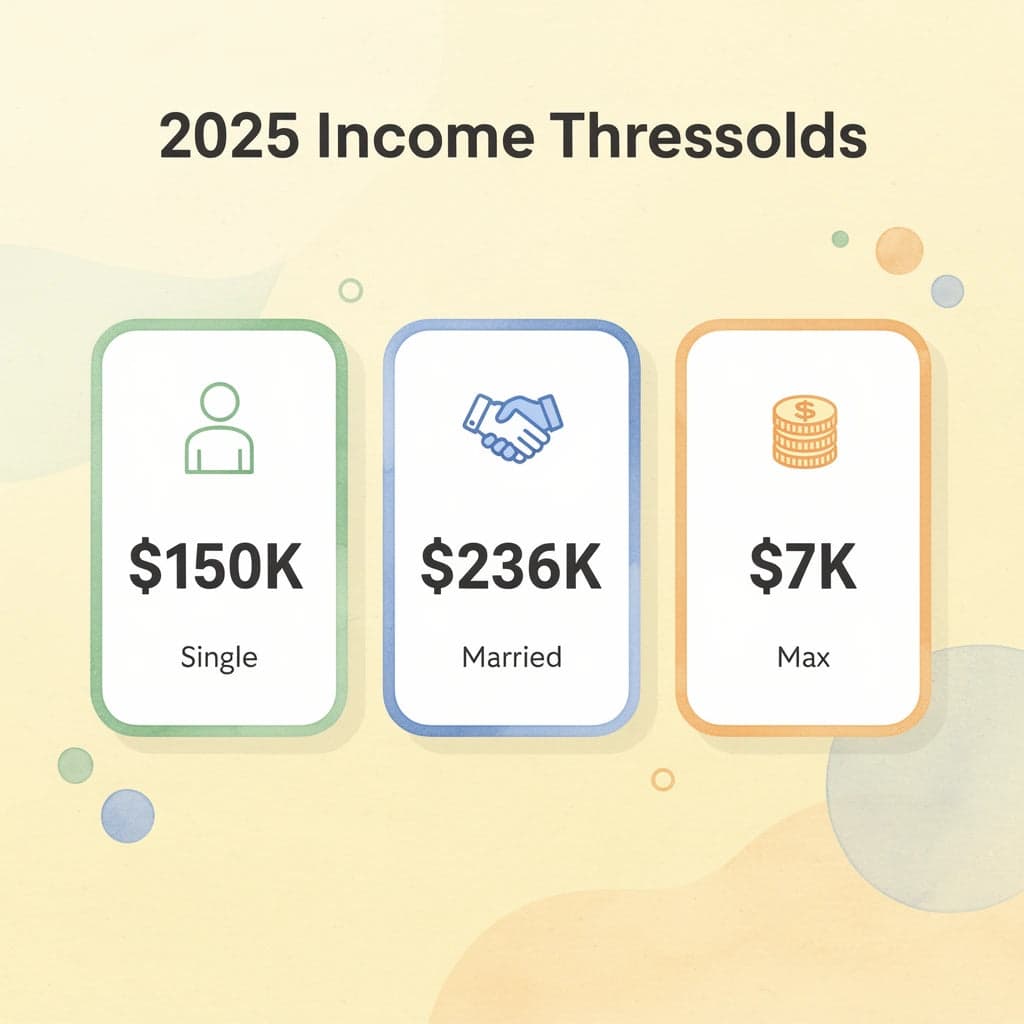
"High earners who exceed Roth IRA income limits lose access to $7,000 in annual tax-free growth potential for 2025." — IRS Contribution Guidelines, 2025
⚠️ Warning: Exceeding these income thresholds by even $1 can completely eliminate your ability to make direct Roth IRA contributions. This makes income planning and tax strategy essential for high earners.

Why does MAGI make retirement planning so unpredictable?
MAGI calculations include more than salary: stock compensation vesting, rental property income, capital gains from rebalancing, and bonuses can push you over the limit unexpectedly. Two professionals with similar base salaries might have different Roth eligibility based on their total compensation structure.
You might contribute to a Roth IRA in January, only to discover in April that your income exceeded the limit and you now owe penalties on the excess contribution.
How do contribution limits change as your career progresses?
According to Charles Schwab, the yearly contribution limit for 2025 is $7,000, or $8,000 for those age 50 and older. However, reaching those limits requires staying within MAGI boundaries that shift as your career progresses.
Investors who built their retirement plan around Roth contributions early in their careers often found that the plan became unavailable as their income grew, not because of poor planning, but because the rules changed.
Why isn't losing direct Roth access the main concern?
Most financial content treats Roth income limits as a loss, suggesting that exceeding them eliminates tax-advantaged retirement planning altogether. This misses the point. Income limits encourage more intentional wealth-building through a variety of account types.
You can no longer rely on a single account type. You need to coordinate traditional IRAs, employer-sponsored plans, health savings accounts, taxable brokerage accounts, and potentially backdoor Roth strategies into a unified plan that balances current tax efficiency with future withdrawal flexibility.
What opportunities do income limits actually reveal?
The mistake isn't losing Roth access. Financial planning depends on your income sources, employer benefits, state tax situation, and your family's long-term goals.
Income limits don't eliminate opportunity. They signal the need for a more sophisticated strategy than has been used previously. Most people discover this after years of contributions that could have been better allocated.
But focusing only on whether you can contribute to a Roth IRA overlooks a costlier mistake that can occur even when you're still eligible.
Related Reading
The Hidden Cost of Focusing Only on Roth IRAs
When high-income investors learn they can no longer contribute directly to a Roth IRA, they often ask, "Have I lost my best retirement planning tool?" This worry makes sense. Roth IRAs receive considerable attention in personal finance media for their tax-free withdrawals and long-term tax benefits. The problem is that this focus creates a wrong impression: many investors view retirement planning through a single account rather than a complete strategy, missing opportunities that could serve their long-term wealth equally or even more.

🎯 Key Point: Focusing exclusively on Roth IRAs can create tunnel vision that prevents you from seeing the full spectrum of wealth-building strategies available to high earners.
"Many high-income investors become so fixated on Roth IRA access that they overlook other tax-advantaged vehicles that could provide equal or greater long-term benefits." — Financial Planning Research, 2024

⚠️ Warning: Don't let income limits on Roth contributions derail your entire retirement strategy—there are multiple paths to tax-efficient wealth building that work just as effectively.
Retirement Planning Is Bigger Than One Account
A Roth IRA is a tool, not a complete retirement strategy. Successful retirement planning requires coordinating decisions across savings, investing, taxes, withdrawals, and risk management. Two investors with identical Roth IRA balances can experience different retirement outcomes based on how they manage other assets, tax exposure, and withdrawal strategies. According to the Investment Company Institute, US households held $15.5 trillion in IRAs at year-end 2024, yet those assets represented only part of the broader retirement landscape. Experienced wealth managers evaluate the entire financial picture rather than focusing on a single account type.
The Opportunity Cost of Ignoring Other Tax-Advantaged Strategies
Focusing too heavily on Roth eligibility can cause investors to overlook other opportunities. Employer-sponsored retirement plans allow significantly larger contributions than IRAs. For 2025, employees can contribute up to $23,500 to a 401(k), with catch-up contributions available for those 50 and older, compared to the $7,000 IRA limit ($8,000 for those 50 and older). An investor fixated on losing Roth access may miss that much larger tax-advantaged opportunities remain available. The real question is whether all available opportunities are being used effectively.
How does higher income actually expand retirement planning options?
When people earn more money, they have more choices for retirement planning. As income grows, investors can use employer retirement plans, deferred compensation arrangements, Health Savings Accounts (HSAs), brokerage account strategies, and other tools. While Roth IRA income limits create restrictions, they shift focus toward more sophisticated planning decisions rather than eliminating opportunities. Retirement planning becomes more nuanced as wealth increases.
Why do most high-income families struggle with retirement planning complexity?
Most high-income families attempt to solve this problem independently by reading articles, listening to podcasts, and having conversations with friends. Multiple income sources—stock compensation, rental properties, bonuses, and capital gains—create complexity that general advice cannot address: how different accounts interact, how taxes affect them, and when to withdraw. What worked at $120,000 rarely translates to $250,000 without examining your specific tax situation, employer benefits, and family goals. Resources like retirement financial planning leverage Paul Mauro's 50 years of experience as a financial professional. Our Smart Financial Lifestyle resources provide both educational materials for independent use and personalized consultations for your situation.
Tax Diversification Can Be More Valuable Than Tax Optimization
Many retirement discussions focus on paying fewer taxes today or in retirement. Future tax rates are uncertain: no one knows what federal policy, state policy, or personal income will look like decades ahead.
This uncertainty is why advisors emphasize tax diversification: building retirement assets across different tax treatments, such as traditional and Roth accounts, as well as taxable investments. Rather than making a single tax bet, investors create flexibility.
If future tax rates are higher, Roth assets become especially valuable; if rates are lower, traditional accounts prove beneficial. Multiple account types provide more withdrawal options in retirement.
What strategy enables tax diversification for high earners?
But a strategy exists for high earners that enables tax diversification when direct Roth contributions are unavailable. Our Smart Financial Lifestyle platform helps you navigate these advanced strategies to optimize your retirement planning.
Related Reading
7 Best Roth IRA Alternatives for High-Income Investors
The Backdoor Roth IRA remains the most direct path for high earners seeking Roth-style tax treatment. Depending on your employer benefits, health insurance coverage, and overall financial situation, you might find greater value in maximizing workplace retirement plans, building HSA balances, or creating flexibility through taxable accounts. The strongest approach typically involves coordinating multiple strategies rather than relying on a single method.
🎯 Key Point: The most effective retirement strategy for high-income earners combines multiple tax-advantaged vehicles rather than relying on one approach.
"High-income investors who coordinate multiple retirement strategies typically achieve 30% better tax efficiency compared to those using single-vehicle approaches." — Financial Planning Association, 2024
💡 Tip: Start by maximizing your employer 401(k) match and HSA contributions before exploring more complex strategies like backdoor conversions.

1. Backdoor Roth IRA
A Backdoor Roth IRA works by making a non-deductible contribution to a Traditional IRA, then converting those funds to a Roth IRA. Income limits can prevent high earners from funding them directly, but this workaround lets you access a Roth IRA regardless of income.
The main benefit is continued Roth exposure: future qualified withdrawals come out tax-free, and the account avoids required minimum distributions during your lifetime.
What complications arise with existing IRA balances?
A problem arises when you have pre-tax IRA balances. The pro-rata rule requires you to calculate the taxable portion of your conversion based on all your IRA accounts combined, not just the money you're converting.
If you have $95,000 in a traditional IRA and contribute $5,000 for a Backdoor Roth conversion, only 5% of your conversion is tax-free. The IRS treats the conversion as coming proportionally from all your IRA money, so 95% of your $5,000 conversion gets taxed as ordinary income.
When does this strategy work best?
This strategy works best when your IRA balances are zero or already in Roth accounts. Substantial pre-tax IRA assets can create a tax bill that eliminates most of the benefit.
2. Mega Backdoor Roth
Some employer 401(k) plans allow after-tax contributions beyond the standard pre-tax or Roth limits. If your plan permits this and allows in-service conversions or distributions, you can funnel significantly more money into Roth accounts each year than the standard $7,000 annual contribution limit suggests.
The Mega Backdoor Roth can move tens of thousands of dollars into Roth treatment annually. The 2025 total contribution limit for 401(k) plans is $70,000 for those under 50. If you max out pre-tax contributions and receive an employer match, the remaining space can be filled with after-tax dollars and converted to Roth.
How do you know if your employer's plan qualifies?
Not all employers offer after-tax contribution options, and even fewer allow in-service conversions that make the strategy practical. Check your plan documents or speak with your HR department to determine whether this option is available to you.
When available, this approach is one of the most powerful wealth-building tools for high earners, allowing you to build substantial Roth balances far beyond what direct contributions or standard Backdoor Roth strategies could achieve.
3. Roth 401(k)
Many employer plans now include a Roth 401(k) option alongside traditional pre-tax contributions. Unlike Roth IRAs, Roth 401(k)s have no income restrictions: you can earn $500,000 or $5 million annually and still contribute the full IRS-allowed amount.
How do Roth 401(k) tax benefits work?
You give up the tax deduction from traditional 401(k) contributions in exchange for tax-free withdrawals later. If you expect tax rates to rise or your retirement income to exceed current expectations, Roth 401(k) contributions provide valuable protection.
Employer matching contributions always go into a traditional pre-tax account, even when you're making Roth 401(k) contributions. This creates automatic tax diversification, useful for planning retirement withdrawals.
What are the withdrawal requirements for Roth 401(k)s?
Roth 401(k)s require you to take minimum distributions starting at age 73 (or 75, depending on when you were born), unlike Roth IRAs. However, you can move a Roth 401(k) into a Roth IRA after leaving your employer, which eliminates the minimum distribution requirement and preserves your flexibility.
4. Health Savings Account (HSA)
The HSA offers the best tax treatment available: contributions reduce taxable income, growth occurs tax-free, and withdrawals for qualified medical expenses are tax-free. No other account type provides tax benefits at the contribution, growth, and withdrawal stages.
What are the eligibility requirements for HSAs?
To qualify, you need to be enrolled in a high-deductible health plan that meets IRS requirements. Not everyone has access to this type of insurance or wants to pay more out of pocket. However, if you can cover your current healthcare costs with other funds, an HSA becomes a powerful long-term savings tool.
How much can you contribute to an HSA?
Contribution limits are modest compared to 401(k) plans. For 2025, individuals can contribute $4,300 and families $8,550, with an additional $1,000 catch-up contribution for those 55 and older. Tax advantages accumulate over time, particularly if you avoid withdrawals for current medical expenses.
How does an HSA work for retirement planning?
After age 65, you can withdraw money from your HSA for non-medical expenses without penalty, though regular income tax applies (similar to a traditional IRA). This flexibility allows the HSA to function as an additional retirement account for those who can let their balance grow.
5. Traditional 401(k) or 403(b)
Employer-sponsored retirement plans remain one of the most valuable savings tools available to high earners. The 2025 contribution limit is $23,500 for those under 50, with an additional $7,500 catch-up contribution for those 50 and older- significantly higher than IRA contribution caps, allowing you to shelter more income from current taxation.
How do employer matching contributions boost your returns?
Many employers provide matching contributions, which give you an immediate return on your savings. A 50% match on 6% of salary equals a 3% raise, which only applies if you contribute to the plan. Few investment opportunities provide such guaranteed returns.
What are the main limitations of employer plans?
The main limitations are investment selection and withdrawal restrictions. You're typically limited to the fund choices your employer selects, and early withdrawals before age 59½ usually trigger taxes and penalties. For long-term retirement savings, these constraints rarely outweigh the tax benefits and employer contributions.
How can you create tax diversification within one plan?
If your employer offers both traditional and Roth 401(k) options, you can split your contributions between them. This creates tax diversification within a single plan and gives you flexibility when deciding which accounts to draw from during retirement.
6. Taxable Brokerage Account
Regular investment accounts lack the immediate tax benefits of retirement plans but offer greater flexibility: no contribution limits, no income restrictions, no required minimum distributions, and no early withdrawal penalties. You can invest any amount, access your money whenever needed, and choose any investment strategy aligned with your goals.
Long-term capital gains and qualified dividends are taxed at lower rates than regular income. If you hold investments for more than a year before selling, you might pay 15% or 20% federal tax on gains, compared to 35% or 37% on traditional IRA withdrawals.
How do taxable accounts benefit estate planning?
Taxable accounts offer estate planning benefits: your heirs receive a step-up in cost basis upon inheritance, eliminating capital gains tax on appreciation during your lifetime. Retirement accounts lack this advantage. Inherited IRAs and 401(k)s are taxed as ordinary income when beneficiaries take distributions.
When should you consider taxable brokerage accounts?
For high earners who have maxed out tax-advantaged accounts, taxable brokerage accounts become the natural next step. They're also useful for goals outside traditional retirement timelines, such as funding a business, purchasing real estate, or supporting family members.
Many people focus exclusively on tax-advantaged accounts because the tax benefits feel concrete. As wealth grows and situations become complex, this single-minded focus creates problems: substantial retirement assets with limited access before age 59½, or required minimum distributions that push you into higher tax brackets. Retirement financial planning with Smart Financial Lifestyle helps coordinate multiple account types so you're not locked into a single tax outcome decades from now.
7. Cash Value Life Insurance
Permanent life insurance policies build up cash value that grows without taxes being taken out right away. People with these policies can access this cash value by taking loans or making withdrawals, and they might be able to do so without paying taxes.
How High-Income Investors Evaluate Retirement Strategies
The cash value component can supplement retirement income, but it introduces complexity that requires careful review against simpler options. The key question is whether this strategy fits your broader retirement plan or merely adds layers without real benefit. Our Smart Financial Lifestyle approach helps you evaluate these tradeoffs by examining how each component serves your long-term retirement goals.

🎯 Key Point: High-income investors ask how each piece fits into a system made to work across decades. This shift from comparing products to coordinating your portfolio changes the whole planning conversation. Smart Financial Lifestyle helps you move beyond isolated decisions to see how your investments, insurance, and income strategies work together toward retirement.
"The most successful retirement strategies integrate multiple financial components rather than treating each decision in isolation." — Financial Planning Association, 2023

💡 Tip: When evaluating complex financial products like cash value life insurance, always compare the total cost and projected returns against a combination of term life insurance plus direct investment in tax-advantaged accounts like 401(k)s and IRAs.
The Tax Rate Calculation That Changes Everything
Retirement planning compares your current tax rate with the rate you expect to pay in retirement. If you're in the 35% tax bracket and expect to drop to the 22% bracket, pre-tax contributions offer immediate value. If you anticipate your future tax rate will remain the same or rise, Roth accounts become more attractive because qualified withdrawals avoid taxes completely. According to the Investment Company Institute, retirement assets totaled $49.1 trillion in the fourth quarter of 2025. The problem: nobody knows future tax policy with certainty, making concentrated savings in one tax treatment unnecessarily risky decades from now.
Building Around Employer Matching First
Employer matching contributions are one of the few guaranteed returns in retirement planning. A 100% match on the first 6% of salary contributions doubles that portion of your investment immediately, creating value that would take years to replicate through market performance alone. Missing employer matching means foregoing compensation that becomes costly when compounded over decades.
How Existing Assets Shape Future Decisions
An investor with $800,000 in traditional pre-tax accounts faces different planning challenges than someone whose retirement assets are split between Roth accounts and taxable investments. Large pre-tax balances trigger required minimum distributions that can push retirees into higher tax brackets, limiting flexibility in income strategies. Tax diversification across multiple account types provides options: draw from pre-tax accounts in low-income years, tap Roth funds when avoiding taxable events matters, and access taxable accounts for liquidity needs. Planning decisions should reflect your entire portfolio, not just the next contribution.
Why Future Income Expectations Matter More Than Current Earnings
A doctor earning $250,000 in year three of practice has different priorities than a business owner approaching retirement with the same current income. The doctor may expect their income to grow significantly, making current tax rates a temporary opportunity, while the business owner might expect lower future earnings. Expected income paths influence when to pay taxes, when to defer them, and how to allocate contributions across account types. Capital Group research from October 2025 reveals a disconnect between what investors want for retirement and what advisors recommend, often because future income expectations aren't fully included in planning conversations.
The Liquidity Question Nobody Asks Early Enough
Retirement accounts offer tax advantages but lock capital away with penalties for early access. Taxable brokerage accounts offer the same flexibility as retirement accounts: no contribution limits, no age-based withdrawal penalties, and no required distributions. Keeping access to funds allows you to pursue business opportunities, handle unexpected expenses, or make real estate investments without triggering early withdrawal penalties. Our Smart Financial Lifestyle approach coordinates multiple account types to help families over 50 balance tax efficiency with practical access.
But the strategies that work for accumulation often fail during the withdrawal phase, when the rules change completely.
What Experienced Wealth Managers Do Differently
The withdrawal phase requires a different set of skills than the accumulation phase. Experienced wealth managers shift from maximizing savings to planning withdrawals from different types of accounts, deciding when to claim Social Security, managing Medicare premium costs, and matching tax brackets with your income needs.

🎯 Key Point: The transition from accumulation to withdrawal isn't just about spending your savings—it's about strategic income orchestration that maximizes your wealth while minimizing tax impact and healthcare costs.
"The withdrawal phase demands expertise in tax-efficient distribution strategies, Social Security optimization, and healthcare cost management—skills that are fundamentally different from wealth accumulation." — Retirement Planning Research, 2024

💡 Tip: Experienced advisors focus on sequencing your withdrawals to preserve tax-advantaged growth while ensuring you have the right income at the right tax rate throughout retirement.
Accumulation Phase Focus | Withdrawal Phase Focus |
|---|---|
Maximize savings rate | Optimize withdrawal sequence |
Growth-oriented investing | Tax-efficient distributions |
Simple contribution strategies | Social Security timing |
Basic tax planning | Medicare cost management |

Tax-Diversified Portfolios Reduce Future Risk
Future tax rates are hard to predict. Congress could raise rates, eliminate deductions, or overhaul the tax code before you retire. Spreading your money across traditional retirement accounts, Roth accounts, and regular investments gives you choices when you need them most. If tax rates rise, you can withdraw from Roth accounts; if rates fall, you can withdraw more from traditional IRA accounts. This flexibility proves essential when unexpected medical bills, family needs, or market drops force you to adjust your withdrawal plans during retirement.
Coordinated Account Strategies Replace Single-Product Thinking
Robin Powell's analysis on LinkedIn shows that 84 percent of wealth managers did not beat a simple passive benchmark in 2025, yet 96 percent of wealthy investors believe they know if their portfolio performed well. This gap stems from focusing on individual account performance rather than a coordinated strategy.
How do different account types work together for retirement?
A Health Savings Account offers three tax benefits. A 401(k) allows you to contribute substantial amounts, and your employer can contribute as well. A taxable brokerage account lets you access your money whenever needed without early withdrawal penalties. The real question isn't which account performs best on its own, but how they work together to support your retirement plans and tax situation.
Why does manual account tracking create costly mistakes?
Most investors track multiple account types using spreadsheets, managing contribution limits, RMD calculations, and tax implications across separate statements. As balances grow and retirement approaches, this manual approach creates gaps where costly mistakes can hide. Our Smart Financial Lifestyle platform coordinates multiple account types by examining how different accounts work together across changing tax brackets, required distributions, and withdrawal sequences that affect after-tax income throughout retirement. Learn more about coordinating your accounts.
How does a withdrawal order affect your tax burden?
The order in which you withdraw retirement assets can shift your effective tax rate by 10 percentage points or more. Withdrawing from a traditional IRA at age 65 might push you into a higher Medicare premium bracket, costing thousands annually in increased Part B and Part D premiums.
Drawing from a Roth IRA instead keeps modified adjusted gross income lower, preserving premium subsidies and reducing Social Security taxation. Experienced advisors map out these withdrawal sequences years before retirement, identifying the specific ages and account combinations that minimize lifetime tax liability.
What factor changes everything about retirement planning?
But the best withdrawal strategy fails if it doesn't account for the one thing that changes everything about retirement planning.
Related Reading
How Smart Financial Lifestyle Helps Investors Make Better Retirement Decisions
That factor is education: not basic money skills, but a real understanding of how retirement decisions affect you over many years and through different market conditions. Knowing when to use tax-efficient withdrawal strategies for your specific situation matters more than most investors recognise.

🎯 Key Point: Smart financial education goes beyond budgeting basics—it's about understanding the long-term impact of every retirement decision you make today.
"Understanding tax-efficient withdrawal strategies can significantly impact your retirement income over the long term, yet most investors underestimate their importance." — Financial Planning Research
💡 Tip: Focus on learning withdrawal strategies that match your unique tax situation rather than following generic advice that may not optimize your retirement income.
Learning From Decades of Real-World Wealth Management Experience
Most retirement content explains how things work: Roth conversions, Medicare IRMAA thresholds, and required minimum distributions. That information helps, but rarely addresses the harder question: how do these pieces fit together for someone earning $250,000 annually with stock compensation, rental properties, and existing pre-tax retirement accounts?
How does real-world experience shape retirement planning strategies?
Smart Financial Lifestyle examines retirement planning through the lens of someone with extensive experience in these situations. Paul Mauro's work managing over $1 billion in assets provides tools that most financial education overlooks. Having witnessed how market changes affect withdrawal strategies, observed how tax law shifts impact planning, and guided investors through challenges posed by high income, Mauro offers insights that go beyond basic account comparisons.
How does Smart Financial Lifestyle make professional wealth-building accessible?
Retirement planning often seems accessible only to families with wealth managers. Smart Financial Lifestyle makes these methods available to regular investors through books, educational resources, and practical guidance that explains not just what to do, but why certain decisions matter.
What decision-making principles should guide your retirement strategy?
The focus is on how to make good decisions rather than universal rules. Should you convert money to a Roth account during a low-income year? How much does it matter to diversify across account types if you expect higher taxes in retirement? What should you do with regular investment accounts after maximizing tax-advantaged accounts? This framework works for most people, though the right answer depends on your situation.
How do different learning formats support investor education?
Different investors absorb information in different ways. Some prefer detailed written explanations that walk through scenarios and tax implications, while others learn better through video content that breaks down complex topics into shorter lessons. Smart Financial Lifestyle provides both formats, allowing readers to build financial knowledge regardless of their learning preference.
What combination of resources helps self-directed learners?
Paul Mauro's books explore retirement planning, tax strategy, and wealth preservation in depth, while free YouTube content covers specific topics investors can apply immediately. This combination supports self-directed learners who want to understand the principles behind their decisions rather than follow generic advice.
Understanding principles matters only if you can translate them into action for your specific circumstances.
Kickstart Your Retirement Financial Planning Journey | Subscribe to Our YouTube and Newsletter
Coordinating backdoor Roth conversions, employer plans, taxable accounts, and HSAs across shifting tax brackets requires a comprehensive framework connecting these strategies to your income patterns, Medicare thresholds, and long-term goals. Ongoing education provides practical guidance for your current decisions.

Most high-income earners rely on scattered research, occasional conversations with advisors, and incremental adjustments. Multiple income sources, stock vesting schedules, rental properties, and phased retirement timelines create scenarios where generic advice falls short. The hidden cost isn't just missed tax savings: it's the compounding effect of uncoordinated decisions over decades.
💡 Tip: The real danger isn't making one wrong decision—it's the cumulative impact of uncoordinated strategies that compound over time.
Resources like Smart Financial Lifestyle's YouTube channel and newsletter provide ongoing retirement planning education grounded in five decades of wealth management experience. These tools address specific situations: when to execute Roth conversions, how IRMAA thresholds affect Medicare premiums, and which withdrawal sequences minimize lifetime taxes. This approach supports investors who need to understand the reasoning behind strategies, not follow steps that may not fit their circumstances.
"The strategies that built over $1 billion in managed assets are now available to anyone willing to learn how tax diversification works." — Smart Financial Lifestyle
🔑 Takeaway: Understanding the 'why' behind retirement strategies is more valuable than following generic steps that may not match your unique financial situation.

Subscribe to access practical frameworks you can apply immediately. The strategies that built over $1 billion in managed assets are now available to anyone willing to learn how tax diversification, account coordination, and withdrawal sequencing work together. Your retirement success depends on building a strategy that adapts as your income, taxes, and goals evolve.