Annuity vs Roth IRA: Which Builds More Retirement Security?

Choosing between an annuity and a Roth IRA for tax-efficient retirement requires understanding how each handles taxes, investment control, and withdrawal flexibility. Annuities provide guaranteed payments through insurance contracts, while Roth IRAs offer tax-free growth through strategic contributions. Each vehicle serves different retirement security goals and works in completely opposite ways. The decision determines whether retirees feel financially confident or spend their golden years questioning past choices.
Both options promise income security but differ significantly in contribution limits, distribution rules, and beneficiary options. Annuities excel at providing guaranteed income streams, while Roth IRAs offer superior flexibility for tax-free withdrawals and estate planning. Understanding when each strategy fits into a broader income approach helps retirees make informed decisions based on their specific financial situations and long-term wealth-building objectives, rather than getting lost in complex financial jargon about qualified accounts and surrender charges. Smart Financial Lifestyle provides comprehensive guidance through professional retirement financial planning.
Summary
Many investors treat annuities and Roth IRAs as competing investments when they are fundamentally different tools designed to solve distinct retirement problems. A Roth IRA is a tax-advantaged account that offers flexibility and tax-free growth but provides no income guarantees or protection from market volatility. An annuity is an insurance contract that converts capital into guaranteed payments you cannot outlive, trading liquidity and control for longevity protection. The strongest retirement plans typically don't choose one over the other but instead coordinate multiple income sources and tax treatments based on specific circumstances.
Tax diversification across different account types gives retirees significant control over their annual tax bills throughout retirement. A retiree with assets spread across traditional IRAs, Roth accounts, and taxable investments can strategically choose which source to withdraw from each year to stay below Medicare surcharge thresholds or avoid higher tax brackets. Research from a Goldman Sachs Asset Management survey of 5,102 Americans found that many investors focus heavily on accumulation strategies but spend far less time planning withdrawal sequences that could reduce lifetime taxes by tens of thousands of dollars.
Longevity risk has become increasingly critical as retirement timelines extend. According to the Social Security Administration, a 65-year-old today has roughly a one-in-three chance of living past age 90 and about a one-in-seven chance of living past age 95. A portfolio strategy that appears sustainable for a 15-year retirement may behave very differently over 25 or 30 years, especially during periods of inflation, market volatility, or rising healthcare costs. This extended timeline makes coordinated planning across multiple income sources and tax treatments essential rather than optional.
Annuity sales approached the half-trillion-dollar mark in 2025, according to Retirement Income Journal, driven largely by retirees seeking predictable cash flow in volatile markets. While guaranteed income offers psychological relief that portfolio withdrawal strategies cannot match, the contracts are typically irrevocable and don't adapt if circumstances change or unexpected capital needs arise. The product works best when sized correctly and layered with other tools rather than treated as a universal solution to retirement income.
Withdrawal sequencing determines which accounts you tap first, second, and third as retirement progresses and can significantly impact lifetime tax exposure. A retiree at age 62 with substantial traditional IRA balances might benefit from converting amounts to Roth accounts before Social Security begins, intentionally filling lower tax brackets rather than facing forced distributions in higher brackets later. These coordination decisions require understanding how income sources, tax brackets, Medicare premiums, and Social Security taxation interact across time rather than focusing on isolated product features.
Retirement financial planning addresses this by helping investors model how Roth conversions, annuity allocations, and withdrawal sequencing interact across different market and longevity scenarios, rather than defaulting to whichever product they heard about most recently.
Why Many Investors Compare the Wrong Things
Many investors frame the "annuity vs Roth IRA" debate as a choice between competing investments, creating immediate confusion. A Roth IRA is a tax-advantaged retirement account structure. An annuity is an insurance contract that may include income guarantees, tax deferral, or principal protection features, depending on its structure. They solve different retirement planning problems and are not interchangeable.

🎯 Key Point: Roth IRAs and annuities serve fundamentally different purposes in retirement planning - comparing them directly is like comparing a savings account structure to an insurance product.
Yet many retirement discussions compare them as though one must automatically be "better" than the other, leading investors into costly planning mistakes.
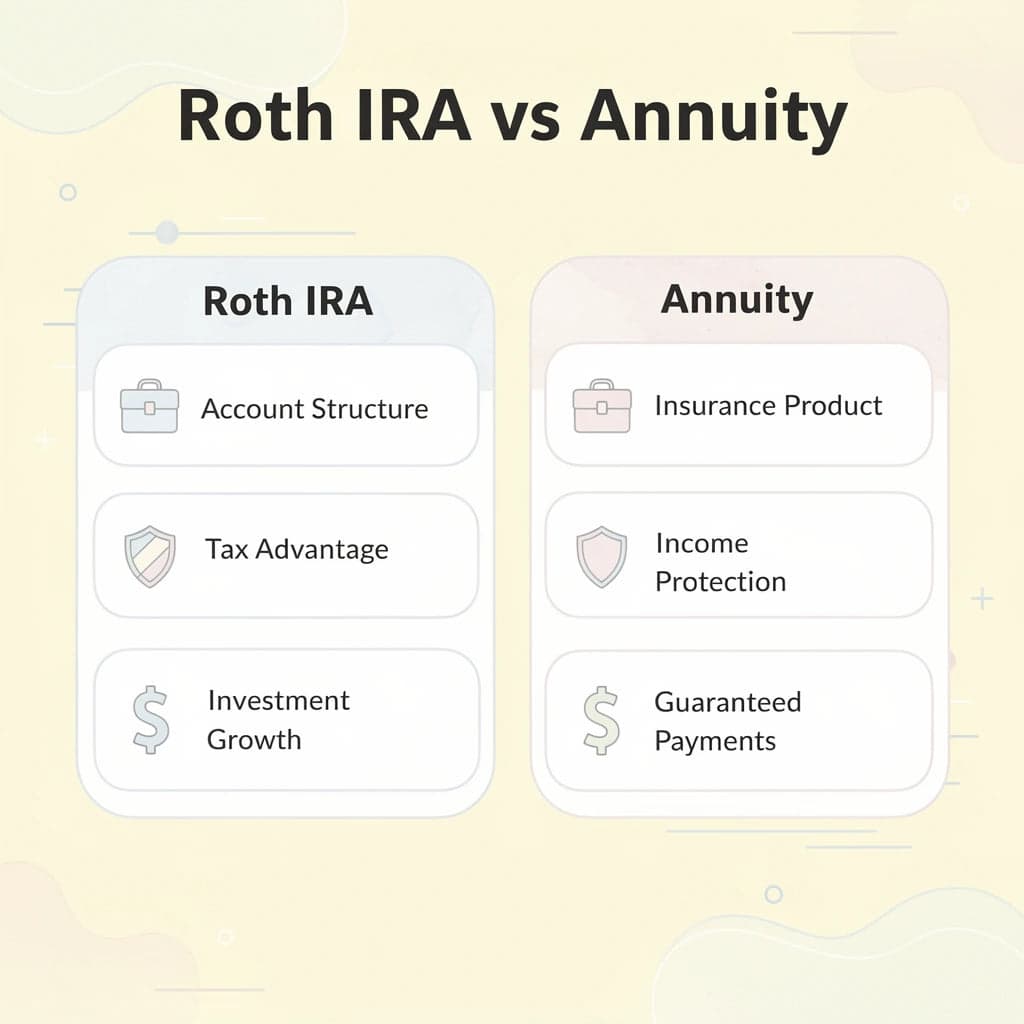
"The biggest mistake investors make is treating fundamentally different financial tools as direct competitors, leading to suboptimal retirement strategies." — Financial Planning Research
⚠️ Warning: This apples-to-oranges comparison prevents investors from understanding how these tools might actually work together in a comprehensive retirement strategy.

The Product-Focused Trap
Some people chase tax-free growth without understanding how to access or withdraw their money strategically. Others buy high-fee annuities for "safety" without understanding surrender charges, income limits, or opportunity costs. Many retirees also underestimate how much money they'll need during their retirement.
This challenge intensifies as people live longer in retirement. According to the Social Security Administration, a 65-year-old has roughly a 1-in-3 chance of living past age 90 and a 1-in-7 chance of living past age 95. A portfolio strategy that works for 15 years may not work over 25 or 30 years, particularly with inflation, market volatility, and rising healthcare costs.
When Account Labels Replace Strategy
Many investors focus heavily on account labels—Roth IRA, annuity, 401(k), brokerage account—without understanding how withdrawals, taxes, guaranteed income, and portfolio risk work together across their entire retirement plan. This creates a fragmented strategy built around isolated financial products rather than coordinated retirement outcomes.
What happens when investors focus on single products?
An investor may prioritize Roth contributions for tax-free growth while overlooking steady retirement income during market downturns. Another may allocate too much to annuity guarantees, sacrificing liquidity and portfolio flexibility. Both decisions create planning problems, even if the individual products work as designed.
How should retirement tools work together strategically?
The "annuity vs Roth IRA" debate often asks the wrong question. The real issue is how different tools fit together within a broader retirement strategy. The strongest retirement plans evaluate future tax exposure, retirement income stability, withdrawal timing, market risk tolerance, longevity expectations, and long-term portfolio flexibility before determining whether a Roth IRA, annuity, taxable account, or other structure suits the investor's goals.
Understanding how these pieces work starts with something simpler than most people expect.
What a Roth IRA Actually Does
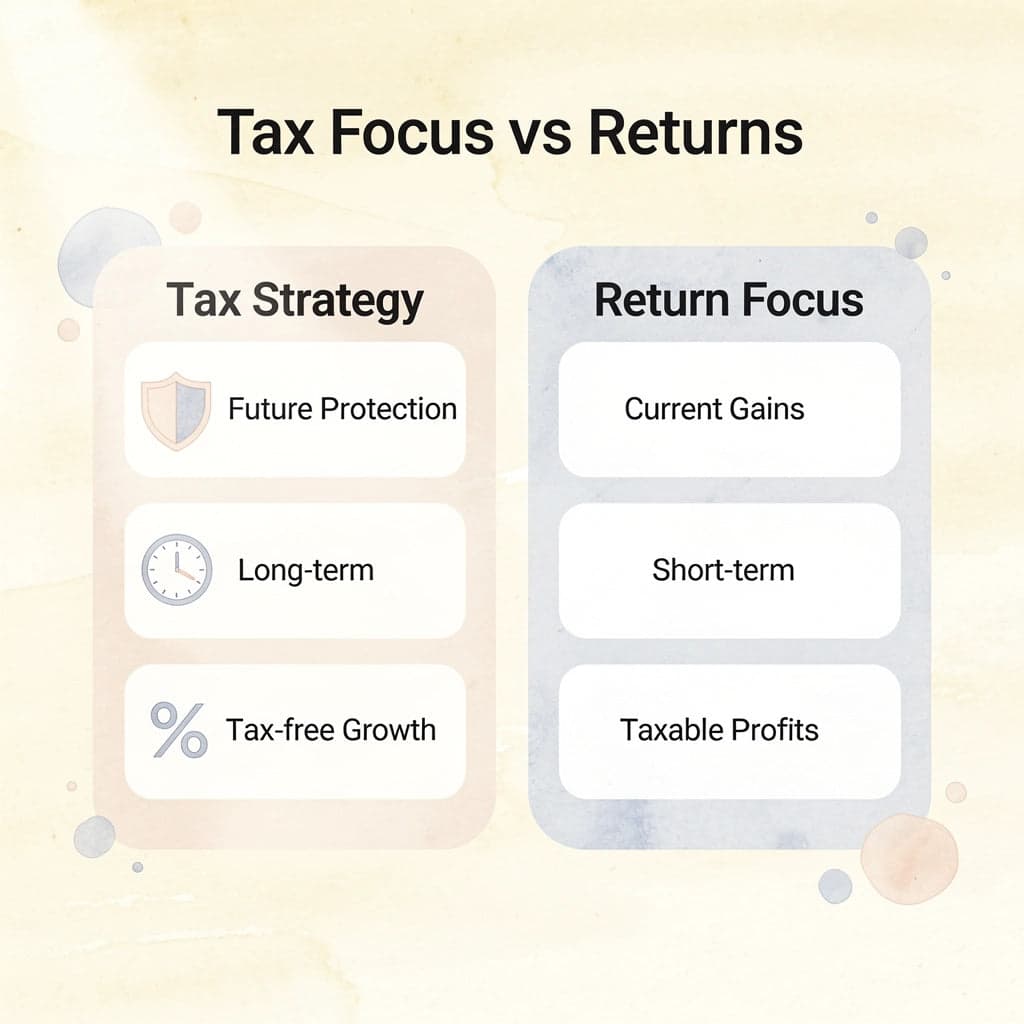
A Roth IRA is a tax-advantaged account where you contribute after-tax dollars, choose your own investments, and withdraw earnings tax-free in retirement if you meet the rules. The benefit comes from never paying taxes on the growth, not from what you buy inside it.

🎯 Key Point: The Roth IRA is a tax wrapper, not an investment itself - your returns depend entirely on what you choose to invest in within the account.
"The power of tax-free growth becomes exponential over decades, but only if your underlying investments actually perform."

This difference matters because most retirement conversations focus on returns when they should start with tax exposure. A Roth IRA protects future gains from taxation, but it doesn't guarantee those gains will materialize or that you'll have income when needed.
⚠️ Warning: Many people assume opening a Roth IRA automatically means good returns - but your account performance depends entirely on your investment choices, not the account type itself.
What returns can you expect from Roth IRA investments?
According to SmartAsset, Roth IRAs have historically delivered average annual returns of 7% to 10%, depending on asset allocation and market conditions. Those returns depend entirely on what you hold inside the account: stocks, bonds, ETFs, or mutual funds. If your selections underperform or you panic-sell during a downturn, the tax-free wrapper cannot compensate.
Does tax-free growth guarantee investment safety?
Investors often see "tax-free" and assume safety. But a Roth IRA exposes you to full market volatility with no floor, guaranteed payout, or protection if you retire into a bear market and need to withdraw from a depleted portfolio. The account solves tax efficiency well. It does nothing for longevity risk or sequence-of-returns risk.
What flexibility do Roth IRAs offer retirees?
Roth IRAs give you control. You don't have to take out money at any specific time during your life—you decide when to withdraw, how much, and whether to leave the balance to heirs. For retirees who expect higher tax rates later or want to manage taxable income strategically, this flexibility is powerful. However, contribution limits and income phase-outs restrict how much you can add each year.
Why can't Roth IRAs solve every tax problem?
Families managing larger portfolios or higher incomes often find that Roth IRAs cannot hold enough money to address their entire tax situation. The account works best as one piece of a larger plan, not as the sole repository for retirement savings.
Understanding what fills those gaps means examining what annuities promise and why that promise involves tradeoffs most investors don't anticipate.
Related Reading
What an Annuity Actually Does
An annuity is an insurance contract that converts a large amount of money into payments you cannot outlive. You give money to an insurance company in exchange for regular checks for either a set period or your whole life. The purpose is longevity insurance: transferring the risk of running out of money to the insurance company.
🎯 Key Point: Annuities are fundamentally about transferring longevity risk—you pay upfront to guarantee you'll never run out of income, no matter how long you live.
"The main purpose of an annuity is longevity insurance: moving the risk of running out of money to the insurance company."

💡 Tip: Think of annuities as the opposite of life insurance—instead of protecting against dying too early, they protect against living too long and exhausting your savings.
How does the annuity purchase process work?
When you buy an annuity, you're purchasing a payout formula determined by your age, gender, interest rates at the time of purchase, and contract structure. Retirees in their mid-60s to mid-80s can lock in payout rates between about 6.5% and 10.5%, according to CBS News, with older buyers receiving higher rates due to shorter life expectancy.
The payout gradually returns your principal, plus the earnings generated by the insurance company. By spreading risk across thousands of contracts, the insurance company bets that overall mortality patterns will enable it to profit while meeting all payments.
What are the tradeoffs of annuity contracts?
In most cases, the contract cannot be changed or canceled. Once the money is funded, it is no longer yours to withdraw, redirect, or leave to your family members in full. You've traded access to your money and the ability to make changes for predictable income and protection against outliving your savings: a tradeoff that creates tension for those seeking flexibility or intending to build wealth for the next generation.
What the guarantee actually covers
The insurance company guarantees the payment schedule, not purchasing power. A fixed annuity pays $500 per month, sending the same $500 in year one and year twenty, even though inflation halves the money's value over two decades.
Inflation riders reduce the initial payout significantly because the insurer must price in decades of cost-of-living adjustments. Variable annuities tie payments to underlying investment performance, reintroducing market risk into a product designed to eliminate it. Each variation solves one problem while creating another.
How strong is the insurance company backing your payments?
The guarantee is only as strong as the insurance company that issues it. State guaranty associations provide a safety net if an insurer fails, but coverage caps vary by state and typically cap out at $250,000 to $500,000 in present-value terms.
If you put a significant portion of retirement assets into a single contract, you're taking on counterparty risk that doesn't exist with diversified investments in your own name. That risk is small but not zero, and often overlooked in the emotional appeal of "guaranteed income for life."
What happens when your circumstances change?
Gross annuity sales approached the half-trillion-dollar mark in 2025, according to the Retirement Income Journal, driven largely by retirees seeking predictable cash flow amid volatile markets. A guaranteed baseline income provides peace of mind that no portfolio withdrawal strategy can match.
But the contract doesn't change if circumstances shift, health deteriorates faster than expected, or you need money for long-term care or family emergencies. The product works best when sized correctly and combined with other tools, not treated as a catch-all for retirement income needs. Figuring out how it fits requires asking a different question.
Why “Annuity vs Roth IRA” Is Often the Wrong Question
The question assumes you're choosing between two competing investments when they're fundamentally different tools. A Roth IRA is a tax-advantaged account structure you fill with investments. An annuity is an insurance contract that exchanges capital for guaranteed income or principal protection. Comparing them directly is like asking whether you need a savings account or homeowner's insurance.

🔑 Key Point: You're not choosing between Roth IRAs and annuities — you're deciding whether you need tax-advantaged growth or guaranteed income protection in your retirement strategy.
"The fundamental difference between Roth IRAs and annuities lies in their purpose: one is a tax shelter for investments, the other is insurance for income." — Financial Planning Association

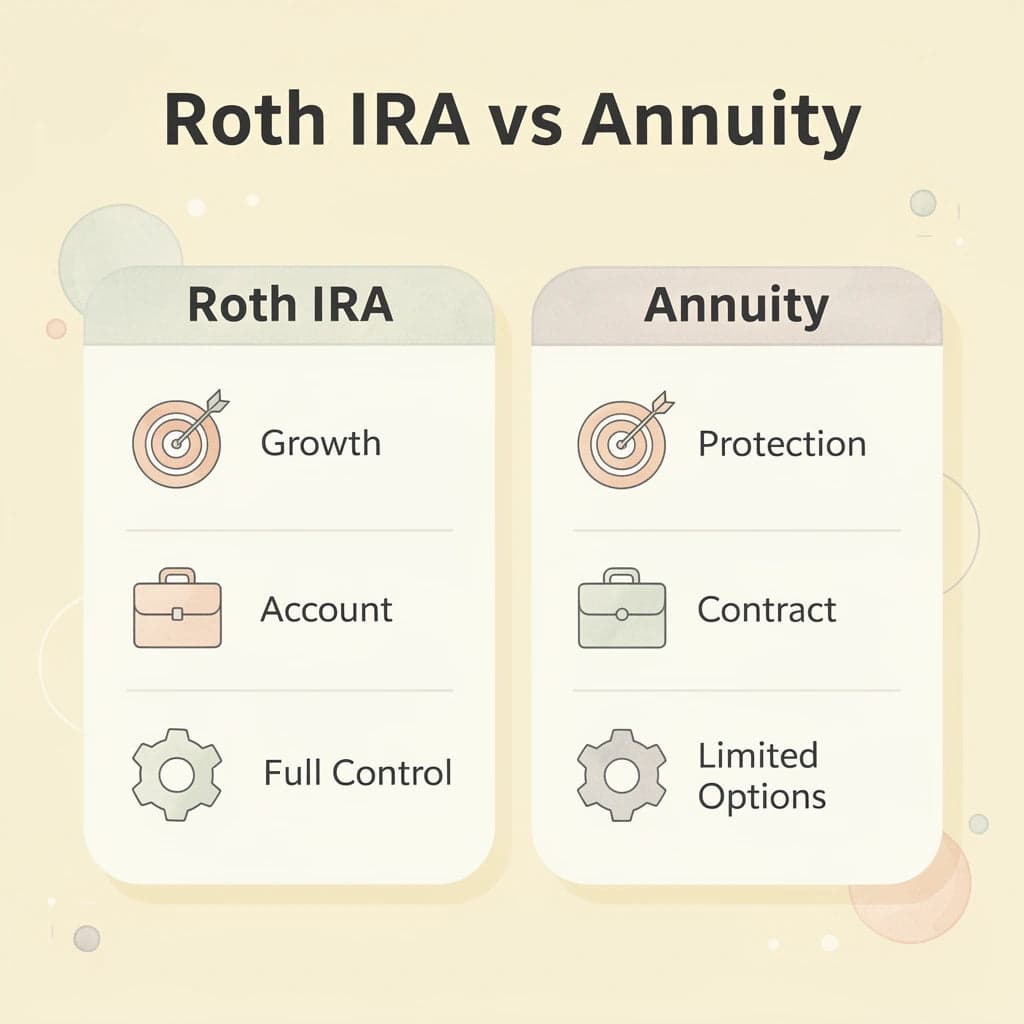
Aspect | Roth IRA | Annuity |
|---|---|---|
Primary Purpose | Tax-advantaged growth | Guaranteed income/protection |
What It Is | Account structure | Insurance contract |
Investment Control | Full control over investments | Limited to annuity options |
Risk Level | Varies by the investments chosen | Low (guaranteed products) |
Liquidity | High (after age 59½) | Often limited by surrender periods |
⚠️ Warning: Many investors get trapped in either/or thinking when they actually need both tools working together — Roth IRAs for growth potential and annuities for income security.
What do people actually want to know about this comparison?
What people want to know is whether they should focus on tax-free growth or guaranteed income in retirement. If you're 55 with $400,000 in traditional IRAs and worried about future tax rates, a Roth conversion strategy can help with tax diversification. If you're 68 with $800,000 saved and worried about running out of money before you die, you're solving for longevity risk and income predictability. These aren't the same problem, and they don't have the same answer.
Why does the annuity category create confusion?
Annuities come in so many different forms that the category itself becomes meaningless without specifics. A single-premium immediate annuity that starts payments within a year is nothing like a variable annuity with market exposure and optional income riders. One converts wealth into cash flow immediately; the other delays growth while adding insurance guarantees that may or may not activate depending on market performance and contract terms. Grouping them as "annuities" and comparing that entire category to Roth IRAs creates a false choice that obscures what you actually need.
Why the Framing Matters More Than the Product
According to research from the Employee Benefit Research Institute, worker confidence in retirement fluctuates with market conditions, inflation, and healthcare costs. This emotional volatility drives people toward annuities during downturns and away during bull markets. Retirement planning based on quarterly sentiment rarely produces sound outcomes. The decision to use an annuity, Roth IRA, or both should stem from your actual income needs, tax situation, and risk capacity, not recent market performance.
How do long-term planning horizons affect your choice?
According to Social Security Administration longevity data, many retirees spend two or three decades in retirement, requiring plans for 20 to 30 years. A Roth IRA offers tax-free flexibility and control over withdrawals during retirement. An immediate annuity locks in today's payout rate, which may prove insufficient 15 years later as inflation erodes purchasing power. Neither choice suits everyone. The real question is which risks you want to manage yourself and which ones you want to transfer to an insurance company.
What tools help you model these tradeoffs effectively?
Platforms like retirement financial planning help retirees navigate these tradeoffs by calculating family tax rates and projecting how Roth conversions, annuity allocations, and withdrawal sequencing interact across different scenarios. Our Smart Financial Lifestyle approach replaces guesswork with actual numbers tied to your tax brackets, income sources, and time horizon.
The mistake isn't choosing one over the other. The strongest retirement plans coordinate tax-efficient growth and guaranteed income streams, sized appropriately and timed deliberately. Understanding how those pieces fit together requires stepping back from product comparisons and examining the system you're building.
How Strong Retirement Plans Coordinate Multiple Income and Tax Strategies
Good retirement plans bring together multiple income sources and tax treatments by building withdrawal sequences that reduce lifetime tax exposure while maintaining flexibility across decades of changing circumstances. This means layering taxable accounts, traditional retirement assets, Roth structures, Social Security timing, and guaranteed-income contracts so that each dollar withdrawn comes from the tax-efficient source available. The goal is to create a system where taxes, liquidity, and income stability work together sustainably.

🎯 Key Point: The most effective retirement strategies don't rely on a single income source—they create a coordinated withdrawal hierarchy that minimizes taxes while maintaining financial flexibility throughout retirement.
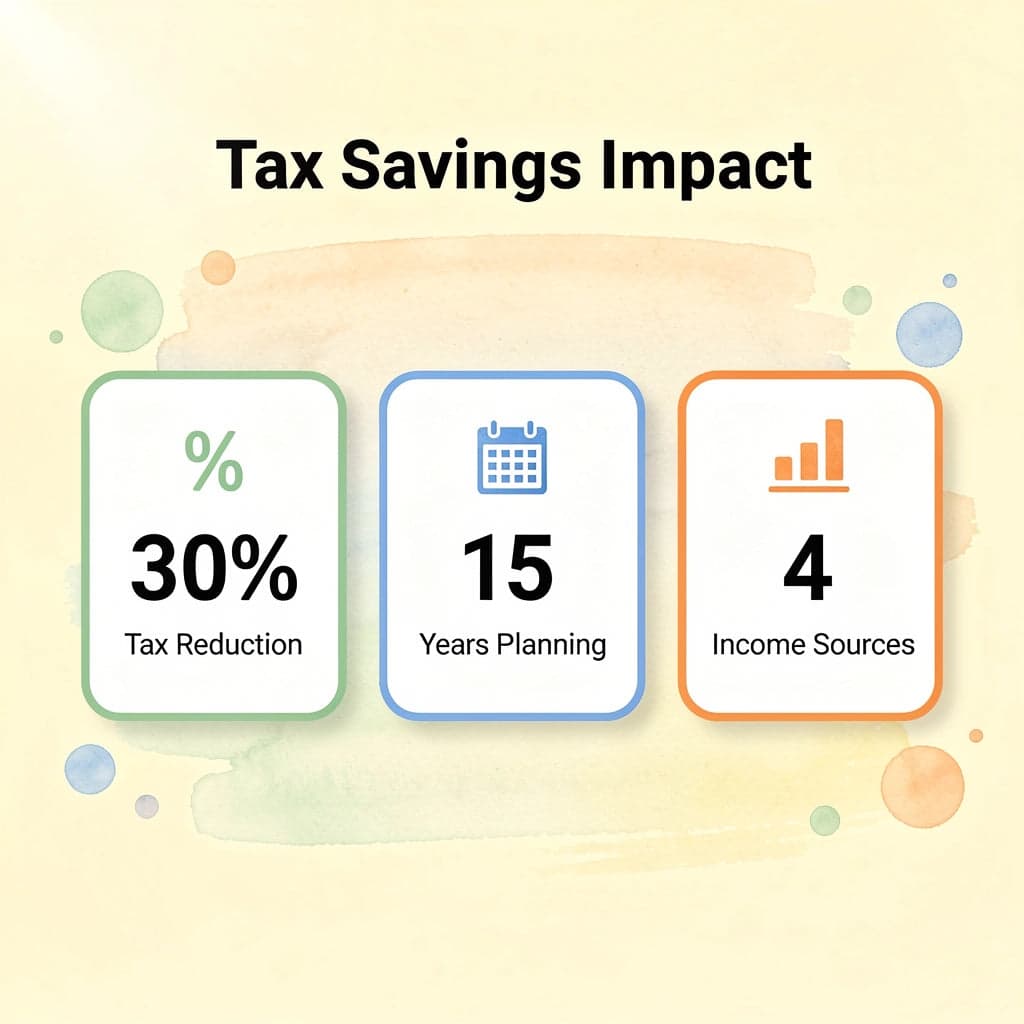
"Retirees who coordinate multiple income sources can reduce their lifetime tax burden by up to 30% compared to those using single-source withdrawal strategies." — Financial Planning Association, 2023
💡 Tip: Start building your multi-layered retirement strategy at least 10-15 years before retirement to maximize the tax advantages and ensure each income source is properly positioned for optimal withdrawal sequencing.
Income Source | Tax Treatment | Best Withdrawal Timing |
|---|---|---|
Taxable Accounts | Capital gains rates | Early retirement years |
Traditional 401(k)/IRA | Ordinary income | Mid-retirement (post-59½) |
Roth IRA | Tax-free | Later retirement years |
Social Security | Partially taxable | Delayed until age 70 for maximum benefit |
What does tax diversification mean for retirement planning?
Tax diversification means owning assets across different tax treatments so you can control which tax bucket you draw from each year. A retiree with $800,000 entirely in traditional IRAs faces required withdrawals that push them into higher tax brackets regardless of income needs.
A retiree with $400,000 in traditional IRAs, $250,000 in Roth assets, and $150,000 in taxable accounts can pull from whichever source keeps their taxable income below critical thresholds. Our Smart Financial Lifestyle platform helps you model these scenarios across your entire portfolio, making tax-efficient withdrawal strategies clear and actionable.
This flexibility becomes especially valuable when Medicare premium surcharges, capital gains brackets, or state tax rates vary by income level.
How much control do retirees have over their tax bills?
Most retired people underestimate their control over their tax bill. According to research from a Goldman Sachs Asset Management survey of 5,102 working and retired Americans, many investors focus on building savings but spend far less time planning withdrawals that could reduce lifetime taxes by tens of thousands of dollars. Our Smart Financial Lifestyle approach helps you strategically plan these withdrawals to minimize your tax burden.
Withdrawing $60,000 from a traditional IRA versus pulling $30,000 from a Roth and $30,000 from taxable accounts can shift your tax bracket, affect how much of your Social Security is taxed, and determine whether you owe Medicare surcharges.
What determines the optimal withdrawal sequence for retirement accounts?
Withdrawal sequencing determines which accounts you use first as retirement progresses. Some planners suggest spending taxable accounts first to allow tax-deferred accounts more time to grow. Others prioritize Roth conversions early in retirement when income drops but before required minimum distributions begin, layering in partial conversions each year to fill lower tax brackets while keeping overall income below Medicare surcharge thresholds. The right sequence depends on your tax brackets, income sources, legacy goals, and retirement duration.
How do income sources interact to affect withdrawal timing decisions?
A retiree at age 62 with $700,000 in traditional IRAs might benefit from converting $50,000 annually to Roth accounts before Social Security begins, filling the 12% and 22% tax brackets intentionally rather than facing forced distributions in higher brackets later. Someone with a pension covering most expenses might prioritize spending taxable accounts for flexibility while allowing Roth assets to grow tax-free for legacy purposes. These coordination decisions require understanding how income sources interact across time.
How can annuities coordinate with portfolio growth strategies?
A retiree who uses an annuity to cover fixed expenses like housing, healthcare, and utilities can maintain more portfolio risk in remaining assets because essential spending is protected. This approach allows the portfolio to focus on growth and inflation protection rather than short-term stability.
The annuity handles longevity risk; the portfolio handles purchasing power risk. Each tool addresses a specific problem rather than competing for the same role.
Does every retiree need an annuity for guaranteed income?
This does not mean every retired person needs an annuity. Someone with strong Social Security benefits and a pension may already have sufficient guaranteed income and benefit more from tax diversification and liquidity.
Someone without pension income facing 30 years of retirement may value additional income certainty differently. The decision depends on your existing income sources, risk tolerance, legacy priorities, and emotional capacity to handle portfolio volatility during market downturns.
Why do retirement plans often lack coordination?
Retirement planning is shaped by changing circumstances and household-specific situations. The Investment Company Institute reports that Americans held $49.1 trillion in retirement assets as of late 2025, yet many of those assets are held in separate structures without intentional coordination of tax treatment, withdrawal timing, or income stability. Our Smart Financial Lifestyle approach bridges this gap by coordinating these elements into a cohesive strategy.
The difference between a strong retirement plan and a fragmented one often comes down to whether the system was designed or simply accumulated accounts. Knowing these principles and applying them to your specific situation are two different challenges: that's why Smart Financial Lifestyle is designed to help you move from understanding to action.
Related Reading
How to Reduce Taxes on RMDs
How Smart Financial Lifestyle Helps Investors Think Beyond Product Comparisons
The shift happens when you stop asking "which product is better?" and start asking "how does my entire retirement system work together?" Smart Financial Lifestyle approaches retirement planning from that coordinated perspective, helping investors see how tax structures, withdrawal timing, income stability, and portfolio risk interact across decades. Retirement mistakes rarely come from choosing the wrong annuity or Roth IRA—they come from treating those tools as standalone solutions rather than as coordinated parts of a larger plan.
🎯 Key Point: The most successful retirement strategies focus on system coordination rather than individual product performance.
"Retirement mistakes rarely come from choosing the wrong financial product—they come from treating those tools as standalone solutions instead of coordinated parts of a larger plan." — Smart Financial Lifestyle Analysis
Traditional Product-Focused Approach | Smart Financial Lifestyle System Approach |
|---|---|
❌ Compares individual products in isolation | ✅ Evaluates how all components work together |
❌ Focuses on "best" single solution | ✅ Optimizes tax structures and withdrawal timing |
❌ Treats annuities, IRAs as separate decisions | ✅ Coordinates income stability and portfolio risk |
❌ Short-term performance metrics | ✅ Decades-long strategic planning |
🔑 Takeaway: Smart Financial Lifestyle transforms retirement planning from a product comparison exercise into a comprehensive system design that maximizes long-term financial security.

Why do most retirement comparisons miss the bigger picture?
Most financial content presents retirement as a binary choice: annuity or Roth IRA, growth or safety, stocks or guarantees. This approach leads investors to compare products in isolation, examining features and fees without understanding how they fit into a comprehensive retirement income plan. The consequences emerge years later—a tax-free Roth that doesn't address immediate cash needs, or a guaranteed annuity that creates unexpected obstacles when you need liquidity.
How does Smart Financial Lifestyle approach retirement planning differently?
Smart Financial Lifestyle teaches retirement income planning, tax-efficient investing, withdrawal coordination, and multi-account strategy. This approach draws from Paul Mauro's 50+ years in wealth management, during which he built over $1 billion in assets under management across multiple market cycles, inflation environments, and interest rate shifts. Retirement planning requires understanding how different account types, tax treatments, and income sources work together over time, not just product comparisons.
How does withdrawal sequencing affect your retirement tax picture?
Consider how the order in which you withdraw from retirement accounts affects your retirement results. A retiree might perform Roth conversions during low-income years to create tax-free growth. However, if those conversions push them into higher Medicare premium brackets or trigger capital gains thresholds, the tax benefit disappears.
In the same way, guaranteed annuity income creates taxable income every year regardless of need, which can increase the tax burden on Social Security benefits or investment withdrawals. These interactions don't appear in product brochures; they emerge when you map how different income sources and account types affect your overall tax picture across 20 or 30 years of retirement.
Why should you focus on principles rather than products?
Smart Financial Lifestyle helps investors see these connections by focusing on principles rather than products. Instead of treating Roth IRAs as universal solutions or annuities as automatic safety nets, our approach helps them understand when different tools fit different planning objectives based on their specific situation.
That distinction matters because retirement planning is, as Paul Mauro puts it, "not cut and dry, it's ragged and wet." Your tax bracket, income needs, health status, longevity expectations, and estate goals all shape which strategies make sense and when.
How does personalized guidance differ from general education?
Educational resources provide frameworks for thinking through retirement decisions, but personalization requires analyzing your specific tax situation, account balances, income timeline, and goals to determine whether strategies like Roth conversions, annuity allocations, or withdrawal sequencing improve your outcomes. Smart Financial Lifestyle's free Roth IRA conversion consultation helps investors discover their Family Tax Rate and whether conversion strategies are suitable for their circumstances.
Why does the individual situation matter so much in retirement planning?
What works for someone with $400,000 in traditional IRAs and 15 years until retirement differs from what works for someone with $800,000 across multiple account types already in retirement. Retirement planning isn't about finding the "best" product; it's about designing a system in which taxes, income, risk, and flexibility align with your specific goals and constraints. This system-level thinking is where more confident retirement decisions begin.
Understanding principles and designing your own plan remain two different challenges.
Related Reading
Kickstart Your Retirement Financial Planning Journey | Subscribe to Our YouTube and Newsletter
Designing your plan means seeing how principles apply to your specific tax situation, account balances, timeline, and goals. Personalized guidance bridges the gap between theory and action.

💡 Tip: If you're weighing Roth conversions, annuity strategies, or coordinating withdrawals across multiple accounts, explore Smart Financial Lifestyle. Paul Mauro's books and free YouTube content translate 50 years of managing over $1 billion in assets into practical retirement income strategies.
🎯 Key Point: Subscribe to the newsletter and YouTube channel for step-by-step education on tax-efficient retirement planning, or schedule a free Roth IRA conversion consultation to discover your Family Tax Rate and whether conversion fits your specific situation.
"Personalized guidance bridges the gap between theory and action when it comes to retirement planning strategies." — Smart Financial Lifestyle
Resource Type | What You Get | Best For |
|---|---|---|
YouTube Channel | Step-by-step education | Visual learners |
Newsletter | Tax-efficient strategies | Regular updates |
Free Consultation | Family Tax Rate analysis | Roth conversion decisions |