IUL vs Roth IRA: Which Builds More Flexible Long-Term Wealth?

Planning for a tax-efficient retirement means making choices today that protect wealth tomorrow, yet many people find themselves stuck between two powerful options: Indexed Universal Life insurance and the Roth IRA. Both promise tax advantages and offer unique benefits for building long-term wealth, but they work in fundamentally different ways regarding contribution limits, withdrawal flexibility, death benefits, and access to money before retirement age. Understanding the real differences between IUL and Roth IRA helps determine which strategy aligns better with specific financial goals and builds more flexible wealth over time.
Indexed universal life policies combine life insurance protection with cash value growth, while Roth IRAs offer tax-free distributions in retirement. When people understand how these vehicles work, they can make informed decisions about income planning, legacy building, and creating multiple streams of tax-advantaged money that work together rather than compete. Smart Financial Lifestyle helps individuals see beyond surface-level comparisons through comprehensive retirement financial planning.
Summary
Many investors encounter Indexed Universal Life policies and Roth IRAs through nearly identical marketing language. Both are presented as ways to build "tax-free retirement income" and framed as strategies for future financial flexibility. That creates the impression that IULs and Roth IRAs are interchangeable retirement tools competing for the same role inside a portfolio, but they operate under completely different structures, tax rules, cost models, liquidity dynamics, and planning objectives.
Roth IRAs impose strict annual contribution caps that shape the potential for long-term accumulation. SmartAsset reports the 2024 Roth IRA contribution limit is $7,000 for those under 50, while those 50 and older can contribute up to $8,000. IULs operate under life insurance regulations rather than retirement account rules, so premium funding depends on policy design and underwriting guidelines rather than IRS caps. That flexibility comes with tradeoffs, as higher premiums do not guarantee proportional cash value growth because insurance costs, administrative fees, and surrender charges consume part of every dollar before it accumulates.
The phrase "tax-free" refers to the fact that these two vehicles have entirely different legal structures. Roth IRA withdrawals qualify as tax-free when the account is at least five years old, and you are 59½ or older, with the IRS code explicitly exempting qualified distributions from taxation. IUL cash value grows tax-deferred, not tax-free, and accessing that value without triggering taxes requires taking policy loans rather than withdrawals. If the policy lapses before death while loans are outstanding, the IRS treats the entire loan balance as ordinary income in that year, potentially creating a significant tax bill.
Permanent life insurance policies often carry internal costs exceeding 2% to 3% annually in the early years, according to a 2017 National Association of Insurance Commissioners analysis, far higher than typical retirement account expenses. Roth IRAs charge no insurance fees because they are investment accounts, with costs limited primarily to fund expense ratios (often 0.03% to 0.50% annually for index funds) and any advisory fees. Those insurance expenses mean IUL cash value must grow faster just to break even compared to a Roth IRA invested in low-cost index funds.
Federal employees face coordination challenges that demonstrate why product comparisons miss the planning system entirely. They must decide between pension systems, TSP contribution types (traditional versus Roth), survivor benefit elections, retirement timing that affects pension calculations, and how those pension payments interact with Social Security and TSP withdrawals over decades. Choosing a survivor benefit percentage changes lifetime pension income, spousal protection, and estate planning all at once, while timing retirement by even a few months can shift pension calculations, healthcare coverage transitions, and tax bracket positioning for years.
Retirement income doesn't come from a single account but from how multiple accounts, tax strategies, withdrawal sequences, and insurance structures work together across decades. Converting $50,000 from a traditional IRA to a Roth in a single year might push you into a higher tax bracket, triggering increased Medicare Part B premiums two years later due to income-related monthly adjustment amounts. Taking policy loans from an IUL to avoid taxable withdrawals might preserve current-year tax efficiency but reduce death benefit coverage needed for estate liquidity.
This is where retirement financial planning addresses the coordination challenges that surface when taxes, withdrawals, insurance, liquidity, and legacy planning must work together as income needs shift and market conditions change.
Why Investors Get Confused Comparing IULs and Roth IRAs
Why do IULs and Roth IRAs use identical marketing language?
Many investors encounter Indexed Universal Life policies and Roth IRAs marketed with identical language: both presented as ways to build "tax-free retirement income" and achieve long-term financial flexibility. This creates the false impression that IULs and Roth IRAs are equivalent retirement tools.
How do IULs and Roth IRAs actually differ structurally?
An IUL and a Roth IRA work in fundamentally different ways, with distinct tax rules, cost models, liquidity dynamics, and planning objectives. A Roth IRA is a tax-advantaged retirement account where you contribute after-tax dollars and withdraw earnings tax-free under IRS rules. An IUL is a permanent life insurance policy with a cash value component tied to indexed crediting strategies and insurance costs. These structural differences matter far more than marketing language suggests.
Why do online discussions oversimplify these retirement strategies?
Online financial discussions often reduce both strategies to a single basic idea: "tax-free income," but they omit important details about policy costs, contribution rules, insurance expenses, liquidity limitations, market participation caps, withdrawal structures, and long-term funding requirements. This oversimplification causes many investors to compare the products incorrectly.
What mistakes do investors make when choosing between these options?
Some people choose these accounts because of marketing about "tax-free" growth without understanding how it works. Others don't realize how complicated these plans can be or how much money they must contribute over many years for certain insurance products to perform effectively.
An investor might initially think an IUL policy offers more flexibility, though insurance costs and surrender structures actually limit how easily you can access your money compared to regular investment accounts.
How do contribution limits and regulations differ between these accounts?
According to SmartAsset, the Roth IRA contribution limit is $7,000 for 2024 (or $8,000 if you are age 50 or older). IULs operate under life insurance rules and policy structures rather than retirement account rules, which affects how easily you can access your money, long-term costs, risk exposure, and estate planning implications.
The Real Question Most People Miss
The key mindset shift: Rather than asking "Which strategy is universally better?" ask "Which role does each strategy serve in a broader financial plan?" A Roth IRA and an IUL may both appear in retirement planning discussions, but they typically solve different financial problems. This is why financial professionals emphasize "asset location" and account coordination over individual product comparisons.
Understanding these structural differences requires moving beyond surface-level marketing language.
What Is the Difference Between an IUL and a Roth IRA?
A Roth IRA is a retirement investment account where you contribute after-tax money and withdraw tax-free in retirement, provided you follow IRS rules. An IUL is permanent life insurance with a cash value component linked to indexed crediting strategies.
🎯 Key Point: The fundamental difference lies in their primary purpose - Roth IRAs are designed exclusively for retirement savings, while IULs combine life insurance protection with cash accumulation.

"Understanding the tax treatment differences between these two vehicles is critical for making the right financial decision for your situation." — Financial Planning Association
Feature | Roth IRA | IUL |
|---|---|---|
Primary Purpose | Retirement savings | Life insurance + cash value |
Tax Treatment | Tax-free withdrawals | Tax-deferred growth |
Contribution Limits | $6,500 ($7,500 if 50+) | No IRS limits |
Death Benefit | ❌ None | ✅ Tax-free to beneficiaries |
Investment Control | ✅ Direct investment choices | ❌ Limited to indexed strategies |
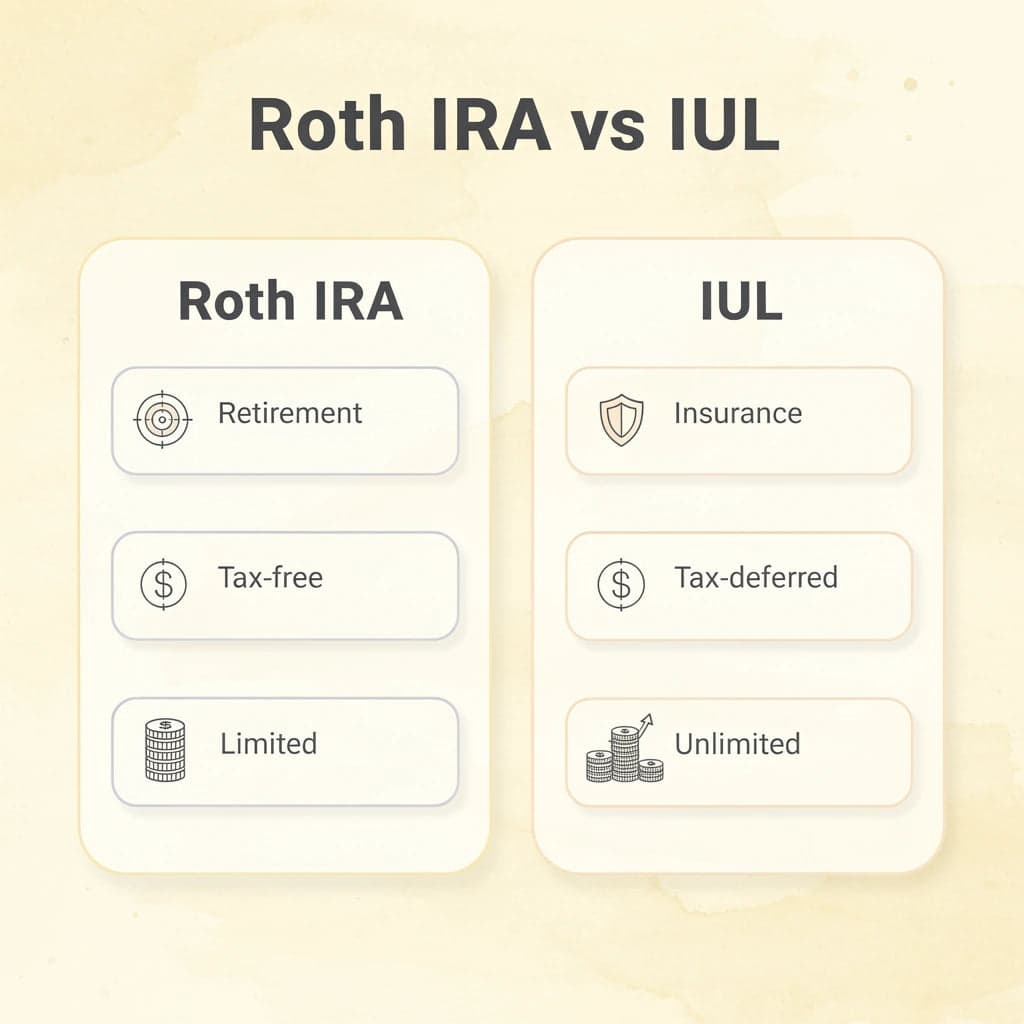
🔑 Takeaway: Choose a Roth IRA if your primary goal is tax-free retirement income. Consider an IUL if you need life insurance protection and want cash accumulation with tax advantages.
How contribution limits shape long-term planning
Roth IRAs have strict yearly limits. SmartAsset reports the 2024 Roth IRA contribution limit is $7,000 for those under 50 and $8,000 for those 50 and older. Income restrictions also apply: high earners cannot contribute directly.
IULs have no yearly IRS contribution cap. Premium funding depends on policy design, insurance underwriting guidelines, and coverage requirements to maintain tax-advantaged status. You might fund $20,000 or $50,000 yearly if the policy structure supports it. However, higher premiums don't guarantee proportional cash value growth: insurance costs, administrative fees, and surrender charges eat into every dollar before it accumulates.
How does investment allocation differ between these accounts?
In a Roth IRA, you choose the investments. You contribute to ETFs, mutual funds, individual stocks, bonds, or other securities, depending on your custodian's platform offerings. The account grows or shrinks based entirely on the market performance of those assets.
In an IUL, you do not own market securities. Your cash value is credited based on indexed strategies linked to benchmarks like the S&P 500, subject to participation rates, caps, and floors set by the insurance company.
What limits your growth potential in indexed policies?
If the index rises 12% but your policy caps gains at 10%, you get 10%. If the index falls 8% but your floor is 0%, you get 0%. This setup limits both gains and losses, so how much your money grows depends on your policy terms rather than direct market exposure.
How do fees impact your actual cash accumulation?
Most people overlook how much of each IUL premium is consumed by policy expenses before cash value builds up. Mortality charges, administrative fees, and early surrender penalties significantly reduce what remains available for growth. A Roth IRA has no insurance costs; it is purely an investment vehicle.
How do Roth IRA withdrawal rules work?
You can withdraw contributions to a Roth IRA anytime without taxes or penalties. If you withdraw earnings (investment gains) before age 59½, you may owe taxes and penalties. However, exceptions exist. After age 59½ with at least five years of account ownership, you can withdraw earnings completely tax-free.
How do IUL access options compare?
You can access money from an IUL through policy loans or partial withdrawals from your accumulated cash value. Loans are not taxable as long as the policy remains in force, but they accrue interest and reduce the death benefit if unpaid. Withdrawals exceeding your contributions may be taxable. If the policy lapses while you have outstanding loans, the IRS may treat the entire loan balance as taxable income that year, a risk that does not exist in a Roth IRA.
What does tax-free really mean for each option?
The tension emerges when you realize that "tax-free" does not mean the same thing in both strategies.
Related Reading
Why “Tax-Free” Does Not Mean the Same Thing in Both Strategies
The phrase "tax-free" attached to both strategies can be misleading because it describes different legal structures. A Roth IRA offers tax-free qualified withdrawals because you own investments directly after paying taxes upfront, and the IRS code explicitly exempts qualified distributions from taxation. An IUL provides tax-advantaged access to cash value through policy loans, which are not taxable events as long as the contract stays active, but you never directly own securities or receive tax-free distributions in the traditional retirement account sense.

🎯 Key Point: While both strategies use the term "tax-free," they achieve this benefit through completely different mechanisms - direct ownership versus loan structures.
"Understanding the distinction between tax-free withdrawals and tax-advantaged loans is critical for making informed retirement planning decisions." — Financial Planning Association

⚠️ Warning: Don't assume "tax-free" means the same thing across all financial products - the underlying structure determines your actual tax treatment and ownership rights.
How Roth IRAs deliver tax-free outcomes
Roth IRA withdrawals are tax-free when you meet two conditions from IRS Publication 590-B: the account must be at least five years old, and you must be 59½ or older (or qualify for specific exceptions like disability or first-time home purchase). Once you meet these requirements, you can withdraw your original contributions and all investment gains without paying federal income tax. You contribute after-tax money, choose your own investments (index funds, individual stocks, bonds, REITs), and the account grows based on market performance. Qualified withdrawals carry zero tax because the IRS already collected taxes on your contributions.
How IULs create tax-advantaged access
IUL cash value grows tax-deferred, similar to a traditional 401(k), not tax-free like a Roth. Growth is based on index-linked crediting formulas (subject to caps, participation rates, and floors set by the insurance company) and is not taxed annually. Accessing that value without triggering taxes requires taking policy loans rather than withdrawals. Policy loans are advances from the insurer, secured by your cash value.
As long as the policy remains in force until death, those loans are never repaid, and the IRS does not classify them as taxable income. The death benefit pays off outstanding loans, with the remainder going to beneficiaries. If the policy lapses before death while loans are outstanding, the IRS treats the entire loan balance as ordinary income that year, potentially creating a significant tax bill.
Why insurance costs change the equation
Roth IRAs don't charge insurance fees because they are investment accounts, not insurance contracts. Your only costs are fund expense ratios (often 0.03% to 0.50% per year for index funds) and any advisory fees if you work with a financial planner. IUL policies charge mortality costs, administrative fees, surrender charges (if you exit early), and sometimes premium load fees, all deducted from your cash value monthly.
According to a 2017 analysis by the National Association of Insurance Commissioners, permanent life insurance policies often carry internal costs exceeding 2% to 3% per year in the early years, far higher than typical retirement account expenses. Your cash value must grow faster to break even compared to a Roth IRA invested in low-cost index funds.
How does policy funding affect IUL cash value growth?
IUL performance depends heavily on contract design and funding. Minimum-funded policies build cash value slowly because most premium dollars cover insurance costs. Maximum-funded policies build cash value faster but require significantly higher annual premiums, often $20,000 to $50,000 or more per year for a decade or longer.
Index crediting matters too: a policy with a 10% cap and 100% participation rate credits more growth than one with a 6% cap and 80% participation during strong market years. Caps, participation rates, and crediting methods can change at the insurer's discretion after issue, so projected returns at purchase may not match actual performance over 20 or 30 years.
Why do IUL and Roth IRA tax treatments get confused?
The confusion around "tax-free" language stems from mixing legal structure with marketing promises. Roth IRAs offer tax-free withdrawals backed by decades of IRS code. IULs offer tax-advantaged loan access that depends on policy performance, funding levels, and contract status.
Both can work, but treating them as the same thing because they share two words in a brochure sets investors up for disappointment. What matters is whether the strategy fits your goals. Knowing how tax treatment differs does not tell you which tool belongs in your financial plan.
How IULs and Roth IRAs Fit Different Wealth-Building Goals
A Roth IRA works best for long-term retirement investing with tax-free qualified withdrawals. An IUL makes sense when you need permanent life insurance protection combined with cash value growth as part of a tax-diversification strategy. The difference hinges on which financial goal you're solving for, not on which product is superior.

🎯 Key Point: The choice between IULs and Roth IRAs should be driven by your specific wealth-building objectives rather than trying to determine which is universally superior.
"The most effective wealth-building strategy combines multiple tax-advantaged vehicles based on individual goals and circumstances." — Financial Planning Association
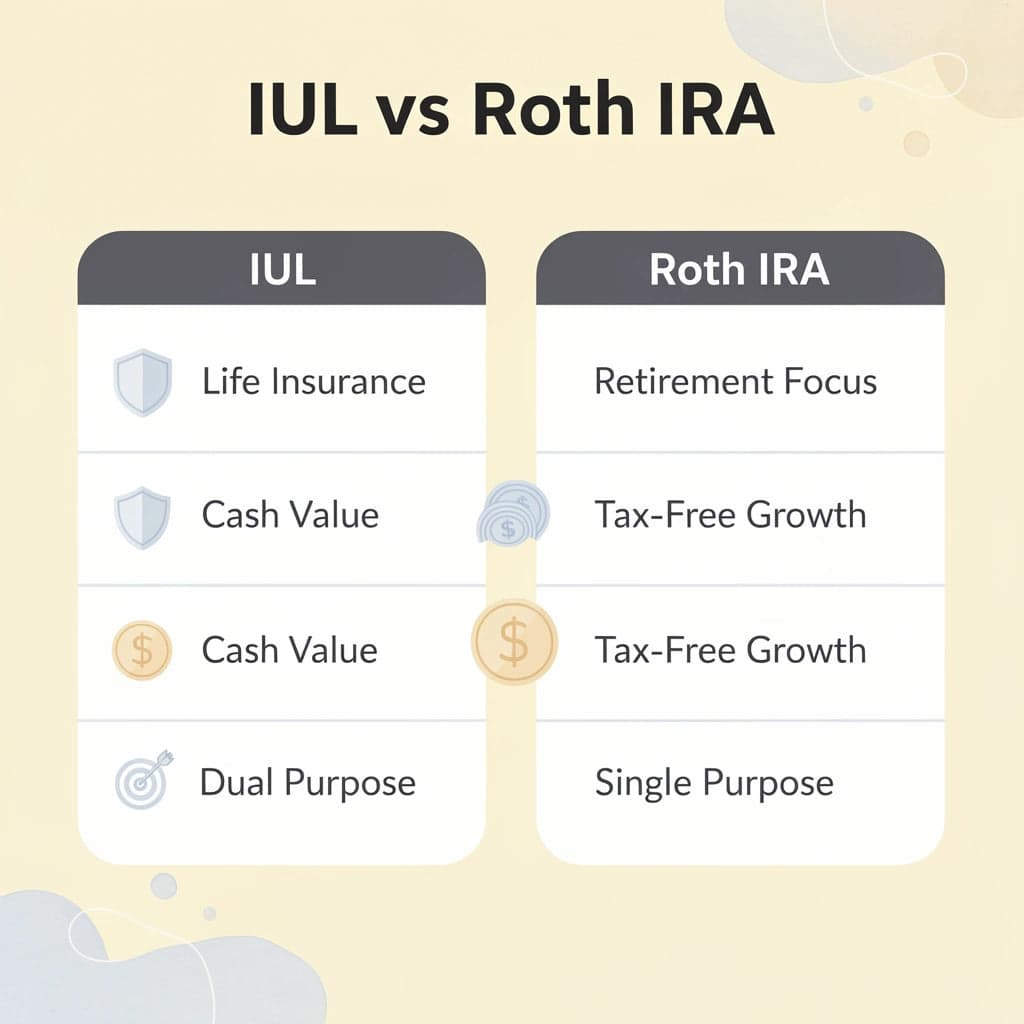
💡 Tip: Consider your primary objective first - if you need life insurance coverage and want cash accumulation, an IUL serves dual purposes. If your goal is purely retirement savings with maximum tax efficiency, a Roth IRA typically offers more straightforward benefits.
When Roth IRAs fit the plan
Roth IRAs are retirement accounts where you contribute after-tax dollars, pick investments directly (stocks, bonds, ETFs, mutual funds, REITs), and benefit from compounding over decades. You own the underlying assets, and growth is based on actual market performance without insurance-related mechanics.
This simplicity makes Roth IRAs foundational for many households. You invest in securities of your choice, watch them grow based on market conditions, and plan for tax-free qualified withdrawals after age 59½ once the five-year holding period is satisfied. Costs are tied to the investments themselves rather than insurance expenses or policy fees.
What makes IULs suitable for certain financial situations?
IULs are permanent life insurance contracts with cash value linked to index performance. Investors consider them when they need lifelong protection beyond term coverage and want cash value buildup as a secondary benefit.
Some higher-income investors use IULs after maxing out traditional retirement accounts because IULs lack the IRS contribution caps that restrict Roth IRA contributions to $7,000 annually for those under 50.
How do IULs work in estate planning strategies?
Some people use IULs as part of their estate planning. The death benefit can help achieve specific goals for what they want to leave behind. Policy loans let you access the cash value in a tax-friendly way, provided the policy remains active and has sufficient funds.
There are real trade-offs to consider: the policies are more complicated, insurance costs increase, earnings crediting has limits and participation-rate caps, and they require management approaches that differ significantly from direct market investing.
How do contribution limits affect your retirement strategy?
Roth IRAs have strict annual contribution limits and income caps based on your modified adjusted gross income and filing status. If you earn above these thresholds, you cannot contribute directly to a Roth IRA. IULs have no IRS-imposed contribution limits, making them an attractive supplemental retirement savings option for higher earners.
What funding constraints should you consider?
That flexibility comes with different constraints. IULs require consistent premium funding to maintain policy performance and prevent lapse. Underfunding can erode cash value and jeopardize the insurance contract itself. According to Employee Benefit Research, 6 in 10 workers report having less than $25,000 in total savings and investments. For investors in that situation, the funding discipline required to sustain an IUL over the long term may not align with their cash-flow capacity.
Roth IRAs offer more forgiving contribution flexibility because you can contribute smaller amounts without risking policy lapse.
How do these tools work together in retirement planning?
Most investors benefit from understanding how these tools work together rather than against each other. Sophisticated planning involves multiple account types working together: diversified retirement accounts for long-term market participation, and permanent insurance with supplemental cash value once traditional accounts are maximized.
Experienced advisors coordinate tax-diversification strategies across Roth accounts, traditional IRAs, taxable brokerage accounts, and, sometimes, permanent insurance structures, depending on income, estate-planning needs, and long-term objectives. The question is not which product wins universally, but which combination fits your actual goals.
Understanding how each tool fits different objectives doesn't tell you whether either belongs in your specific situation.
Related Reading
How to Reduce Taxes on RMDs
Why Retirement Planning Requires More Than Product Comparisons
Retirement planning fails when investors treat it like a simple product selection exercise. Success depends less on choosing the "best" product and more on how taxes, withdrawals, insurance, liquidity, and legacy planning work together as income needs shift and market conditions change.

🎯 Key Point: The most expensive retirement mistake isn't picking the wrong investment—it's failing to coordinate tax strategies, withdrawal timing, and risk management into a cohesive plan that adapts to changing circumstances.
"85% of retirees** who experience financial stress cite poor coordination between their various financial products, not product performance, as the primary cause." — Financial Planning Association, 2023

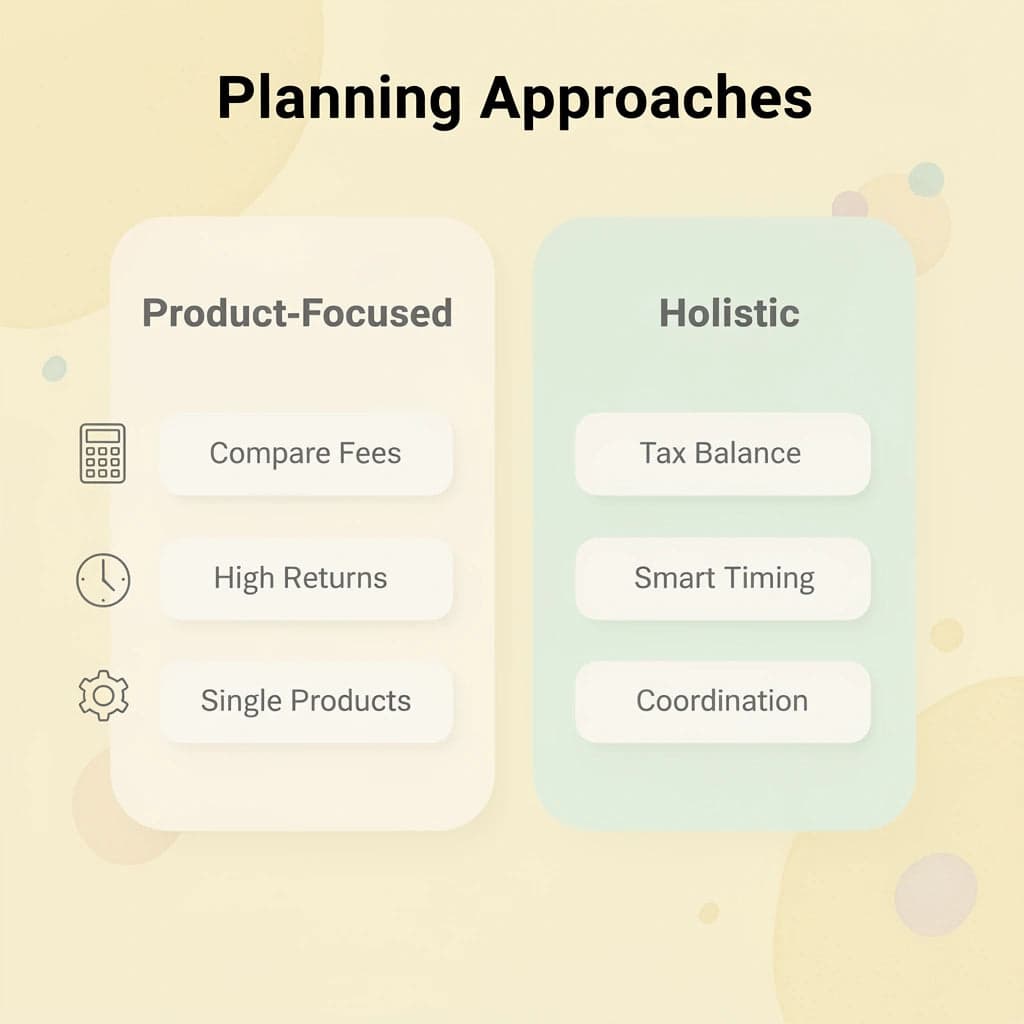
Product-Focused Approach | Holistic Planning Approach |
|---|---|
❌ Compares 401(k) fees in isolation | ✅ Optimizes tax-deferred vs. tax-free balance |
❌ Seeks highest returns regardless of timing | ✅ Coordinates withdrawal sequences for tax efficiency |
❌ Buys separate insurance policies | ✅ Integrates protection strategies with income planning |
❌ Focuses on the accumulation phase only | ✅ Plans for distribution phase complexity |
🔑 Takeaway: Effective retirement planning requires understanding how each financial decision impacts tax liability, cash flow timing, and risk exposure across multiple decades—something no single product comparison can address.
Why do most investors approach retirement planning in isolation?
One investor focuses entirely on tax advantages. Another chases the highest projected returns. A third prioritizes insurance protection without considering withdrawal flexibility. Each conversation stays isolated within its own product category, missing how these decisions interact over 20 or 30 years of retirement.
What happens when retirement accounts lack coordination?
The problem arises when someone holds a traditional 401(k), a Roth IRA, a taxable brokerage account, and possibly an insurance structure without a coordinated withdrawal strategy. One distribution sequence might push them into higher tax brackets unnecessarily, while another could preserve tax flexibility and substantially improve after-tax income. Our Smart Financial Lifestyle platform coordinates these accounts to optimize your withdrawal sequence and minimize unnecessary taxes.
According to research from the Investment Company Institute, more than 70 percent of Americans over age 70 receive income from retirement plans, yet many lack coordinated strategies for how those income sources interact with Social Security, pensions, and healthcare costs.
Why do investors focus on product comparisons instead of strategy?
Investors often compare Roth IRAs against traditional accounts, or taxable brokerage assets against insurance structures, as if selecting the right product solves retirement planning. This narrow focus ignores withdrawal sequencing, tax bracket management across retirement phases, liquidity needs during market downturns, healthcare expense timing, and estate planning priorities that shift as circumstances change. Smart Financial Lifestyle addresses these interconnected challenges through a holistic approach to retirement financial planning, ensuring that account selection aligns with your overall strategy rather than operating in isolation.
How do your specific circumstances determine the right approach?
The question isn't which product wins, but how your income sources, tax situation, risk tolerance, legacy goals, and withdrawal timeline fit together. A Roth conversion might make sense if you expect higher future tax rates, but it creates unnecessary tax acceleration if you're retiring into a lower bracket. Insurance-based strategies might provide valuable death-benefit protection for estate planning, but they add cost and complexity if you prioritize liquidity and market participation.
How systems thinking changes retirement outcomes
Federal employees face this coordination challenge directly. They must decide between pension systems, TSP contribution types (traditional versus Roth), survivor benefit elections, retirement timing that affects pension calculations, and how those pension payments interact with Social Security and TSP withdrawals over decades. One decision affects multiple outcomes simultaneously. Choosing a survivor benefit percentage changes lifetime pension income, spousal protection, and estate planning at once. Timing retirement by even a few months can shift pension calculations, healthcare coverage transitions, and tax bracket positioning for years.
How do coordinated strategies improve retirement sustainability?
The best retirement strategies integrate multiple account types, withdrawal timing, tax planning, and risk management. Someone might hold taxable accounts for early-retirement liquidity, traditional retirement accounts for required minimum distributions later, Roth assets for tax-free flexibility in high-income years, and insurance structures for permanent death-benefit protection aligned with estate goals. The order and timing of withdrawals from each account type significantly affect portfolio sustainability and after-tax income throughout retirement.
Why do single-product approaches often fail?
This coordination rarely happens when investors focus only on which single product sounds most efficient. According to Fidelity Investments' 2026 State of Retirement Planning Study, 72% of Americans say they will retire on their own terms, yet many lack the coordinated planning framework needed to sustain retirement flexibility when market conditions shift, healthcare costs accelerate, or income needs change.
But knowing that coordination matters still leaves one critical question: how do you evaluate whether a specific strategy fits your situation?
How Smart Financial Lifestyle Helps Investors Think Beyond Product Marketing
Once you shift from asking "which product wins?" to "how do these tools work together in my retirement plan?", you've moved from consumer to strategist. Most investors never make this change, leaving them with separate accounts that don't work together when it matters most. Our Smart Financial Lifestyle approach bridges this gap by treating your retirement financial planning as an integrated system rather than isolated decisions.

🎯 Key Point: The difference between product-focused thinking and system-focused thinking can determine whether your retirement accounts work against each other or amplify your overall financial strategy.
"Most investors treat their retirement accounts like separate islands, missing the 80% of potential gains that come from strategic coordination between different financial tools." — Financial Planning Research Institute, 2024
[IMAGE: https://im.runware.ai/image/os/a04d20/ws/3/ii/65bdb394-871d-4445-a5aa-4162939205a6.webp] Alt: Balance scale icon comparing product-focused versus system-focused thinking
💡 Tip: Start by mapping out all your retirement accounts and asking one critical question: "How does each account's tax treatment, withdrawal rules, and investment options support my overall retirement timeline?" This systems thinking transforms disconnected products into a coordinated wealth-building machine.
Why do most retirement comparisons focus on individual products instead of planning systems?
Most retirement content online treats financial tools as separate purchases, ranking Roth IRAs against taxable accounts or IULs against whole life policies as if picking the "best" one solves your retirement challenge. Retirement income, however, depends on how multiple accounts, tax strategies, withdrawal sequences, and insurance structures work together across decades. Smart Financial Lifestyle helps you see these connections: how your accounts, strategies, and policies interact to shape your actual retirement income.
A Roth IRA funded aggressively in your 50s interacts differently with Social Security claiming strategies than a taxable brokerage account. An IUL policy loan taken at age 68 affects your Medicare premiums differently than a Roth withdrawal. These interactions determine your after-tax income, not the performance of any single product.
How does Smart Financial Lifestyle approach retirement planning differently?
Smart Financial Lifestyle approaches this differently by focusing on how retirement planning systems work when tax exposure changes, income needs shift, or market conditions force adjustments. Paul Mauro spent 50 years building wealth management strategies for clients facing these coordination challenges, managing over $1 billion in assets through real-world scenarios involving multiple account types, tax brackets, withdrawal timing, and legacy planning.
The educational resources available through Smart Financial Lifestyle reflect systems-level thinking, now accessible through books, YouTube content, and planning frameworks previously limited to traditional advisory relationships.
How does the broader context change product evaluation?
Consider an investor evaluating Roth conversions, taxable investment withdrawals, and policy loan strategies simultaneously. Focusing solely on which option appears "more tax efficient" in isolation misses how those decisions affect their entire retirement income structure.
Converting $50,000 from a traditional IRA to a Roth in a single year might push them into a higher tax bracket, triggering increased Medicare Part B premiums two years later through income-related monthly adjustment amounts (IRMAA). Taking policy loans from an IUL to avoid taxable withdrawals preserves current-year tax efficiency but reduces death benefit coverage needed for estate liquidity. Withdrawing from a taxable account first appears tax-smart until you realize it eliminates your flexibility to harvest tax losses in down markets.
How does strategic coordination transform retirement planning decisions?
This is where retirement financial planning education shifts the conversation from picking products to planning them together. Instead of asking "should I choose a Roth IRA or an IUL?", investors learn to ask "how do my Roth accounts, taxable investments, insurance structures, and withdrawal sequences work together to lower lifetime taxes, keep my options open, and protect what I want to leave behind?"
That question requires understanding how contribution limits, Required Minimum Distributions, tax bracket management, and income timing work together across 20 to 30 years of retirement.
Moving From Marketing Claims to Planning Reality
Product marketing gets simpler because simplification sells. "Tax-free retirement income" sounds identical whether describing a Roth IRA or an IUL, despite their differences in mechanics, costs, risks, and flexibility. Retirement planning, however, requires coordinating multiple income sources (Social Security, pensions, investment withdrawals, part-time work, rental income) across multiple account types (traditional IRAs, Roth IRAs, taxable accounts, HSAs, insurance cash values) while tax laws and personal circumstances evolve.
You need frameworks that handle sequence-of-returns risk, tax diversification, liquidity needs, healthcare cost inflation, and legacy intentions simultaneously. That's financial architecture, not a product comparison.
Why do retirement planning mistakes compound so quietly over time?
Mistakes in retirement planning accumulate quietly over the years. An investor who maximizes contributions to a Roth account without considering how future Required Minimum Distributions from their traditional 401(k) will affect their tax bracket in their 70s discovers the problem a decade later when it becomes difficult to fix. Our Smart Financial Lifestyle platform lets you model these scenarios together, so you can see how your decisions today affect your taxes and withdrawals in retirement.
Someone who invests heavily in an IUL without testing how premium payments perform during market downturns risks policy lapse when income drops unexpectedly. These failures occur when investors examine tools in isolation rather than as an integrated system. With Smart Financial Lifestyle, you can stress-test your entire retirement plan across different economic conditions, ensuring your strategy withstands life's unpredictability.
Where do you start building a coordinated retirement strategy?
But understanding how systems work together still leaves one practical question unanswered: where do you start building that coordinated strategy?
Related Reading
Kickstart Your Retirement Financial Planning Journey | Subscribe to Our YouTube and Newsletter
Start by understanding how these tools work together in your specific situation: current tax bracket, retirement account balances, income sources, legacy goals, and withdrawal timeline. The coordination strategy for someone with $2 million in traditional IRAs and Social Security income differs completely from someone with $500,000 split between Roth accounts and taxable investments.
🎯 Key Point: Your retirement strategy must be tailored to your unique financial profile; there's no one-size-fits-all approach to coordinating multiple income sources.

Smart Financial Lifestyle walks you through systems-based thinking using wealth-building principles Paul Mauro developed across 50 years managing over $1 billion in assets. Whether you start with free resources, explore books on retirement planning, or schedule a personalized consultation, the goal remains to build a coordinated financial future rather than collecting disconnected products. Subscribe to the YouTube channel and newsletter to learn how your retirement accounts, taxes, and income sources work together. The best strategy is one that fits your life.
"The goal stays the same: building a coordinated financial future instead of collecting disconnected products." — Smart Financial Lifestyle
💡 Tip: Start with free resources to understand the fundamentals before investing in personalized consultation. Knowledge is your foundation for smart financial decisions.