Maxing Out Roth IRA: When It Helps and When It Doesn’t

Maxing out a Roth IRA seems like obvious financial wisdom, but the reality depends entirely on individual circumstances. Tax-efficient retirement strategies require careful consideration of current tax brackets, future income expectations, and long-term wealth-building goals. Contributing the maximum annual limit makes sense in many scenarios, yet it can sometimes work against financial objectives.
The key lies in developing a personalized approach that weighs current tax situations against future projections. Smart decisions require analyzing income thresholds, estate planning needs, and overall investment strategies rather than following generic contribution advice. Building an effective strategy starts with comprehensive retirement financial planning.
Summary
The psychological appeal of maxing out a Roth IRA transformed genuinely useful financial advice into an oversimplified internet consensus. Financial guidance that feels clean and definitive spreads more easily than messy, personalized planning frameworks that require context and analysis. According to Bankrate, the $7,000 contribution limit for 2025 became a psychological milestone rather than one component within a coordinated long-term wealth-building framework. Many investors stretch themselves aggressively, trying to hit that target while neglecting emergency savings or carrying high-interest debt that compounds faster than their likely investment returns.
Starting Roth IRA contributions at 25 versus 35 creates an exponential wealth gap of approximately $1.1 million by age 65, assuming consistent 8% returns. The ten-year delay costs only $70,000 in actual contributions but eliminates decades of compounding that those early dollars would have generated tax-free. According to Acorns, Investor A, who starts at 25, accumulates roughly $2.1 million by retirement, while Investor B, who waits until 35, reaches approximately $930,000. Duration matters more than contribution size because compounding eventually generates growth on top of prior growth without taxation, reducing what accumulates.
An employer 401(k) match delivers an immediate 100% return that no other investment strategy can reliably duplicate. Walking away from that match to prioritize Roth contributions means leaving guaranteed compensation unclaimed. NerdWallet reports that retirement contributions typically represent 3% to 6% of salary, but when high-interest debt is at 18% or 22%, redirecting those dollars toward eliminating that debt first may yield better long-term outcomes than tax-free compounding alone.
Required minimum distributions from traditional IRAs force taxable income at age 73, potentially pushing retirees into higher tax brackets and triggering Medicare premium surcharges. According to Falcon Wealth Planning, advisors managing over a billion dollars in assets consistently see retirees pushed into tax brackets they never anticipated simply because their retirement structure lacked tax diversification across multiple account types. The order in which money is withdrawn from taxable accounts, Traditional IRAs, and Roth accounts directly affects Medicare premiums, Social Security taxation, and the length of time portfolio assets last.
Account selection is only one component of a broader retirement structure that must coordinate multiple income sources, manage lifetime tax exposure, and maintain withdrawal flexibility over 30 or 40 years. Most investors accumulate retirement savings systematically but give almost no thought to withdrawal sequencing until they actually retire. Without coordination between Roth conversions, Traditional withdrawals, and taxable account distributions, retirees end up paying far more in taxes than necessary because they withdrew from accounts in the wrong order rather than as part of an integrated tax strategy.
Retirement financial planning addresses this by coordinating Roth contributions with tax diversification, withdrawal sequencing, Social Security timing, and estate planning considerations rather than treating individual accounts as isolated checklist items.
Why “Max Out Your Roth IRA” Became Default Financial Advice
The Rise of Universal Roth IRA Advice
The recommendation to max out your Roth IRA has become the default financial advice because it offers powerful benefits: tax-free qualified withdrawals, decades of compounding growth without future taxation, and flexible access to contributions. This simplicity helped the advice spread across YouTube channels, Reddit forums, podcasting networks, and investing blogs.
What happens when good advice becomes oversimplified?
The problem isn't that Roth IRAs lack value—they often represent an excellent retirement planning tool. The issue is that a good financial strategy became oversimplified once it turned into an internet consensus. "Max your Roth IRA first" stopped being presented as one useful approach within a comprehensive plan and became treated as a universal rule applicable to nearly everyone, regardless of their specific financial situation.
Why Simple Advice Spreads Faster Than Nuanced Strategy
Financial advice that sounds clean and definite spreads more easily than messy, personalized planning. It's simpler to say "always max your Roth IRA" than to explain tax diversification strategies, retirement income sequencing, future marginal tax uncertainty, withdrawal coordination across multiple account types, or employer match optimization. Your best strategy depends on factors such as your current tax bracket, expected retirement income, debt obligations, employer benefits, and liquidity needs.
How do contribution limits become psychological milestones?
According to Bankrate, the $7,000 contribution limit for 2025 has become a psychological goal rather than part of a larger wealth-building strategy. Many investors pursue that target while neglecting emergency savings, paying off high-interest debt that grows faster than investment returns, or forgoing employer 401(k) matches, which represent free money. The contribution signals financial responsibility rather than reflecting a deliberate choice weighed against other uses of that capital.
The Gap Between Popular Advice and Personal Optimization
Someone in a high tax bracket benefits from reducing taxable income through pre-tax retirement contributions. An investor carrying credit card debt at 18% interest should address that obligation before funding tax-advantaged accounts with expected long-term returns of 7-10%.
Why does online investing culture promote universal Roth IRA maxing?
Yet online investing culture promotes Roth IRA maxing as the default priority because the advice feels psychologically safer than confronting the uncomfortable reality that your specific circumstances might require a different approach.
How can retirement financial planning frameworks help with personalized decisions?
That's where retirement financial planning frameworks become essential. Rather than following rigid rules designed for mass consumption, you need a personalized structure that evaluates whether maxing your Roth IRA represents the most efficient use of your next investing dollar, considering your complete financial picture: current taxation, future income expectations, debt structure, employer benefits, estate planning goals, and multi-generational wealth transfer strategies.
Before evaluating whether maxing out makes sense for your situation, you need to understand what that commitment requires and what trade-offs it creates in your broader financial life.
Related Reading
What Maxing Out a Roth IRA Actually Means
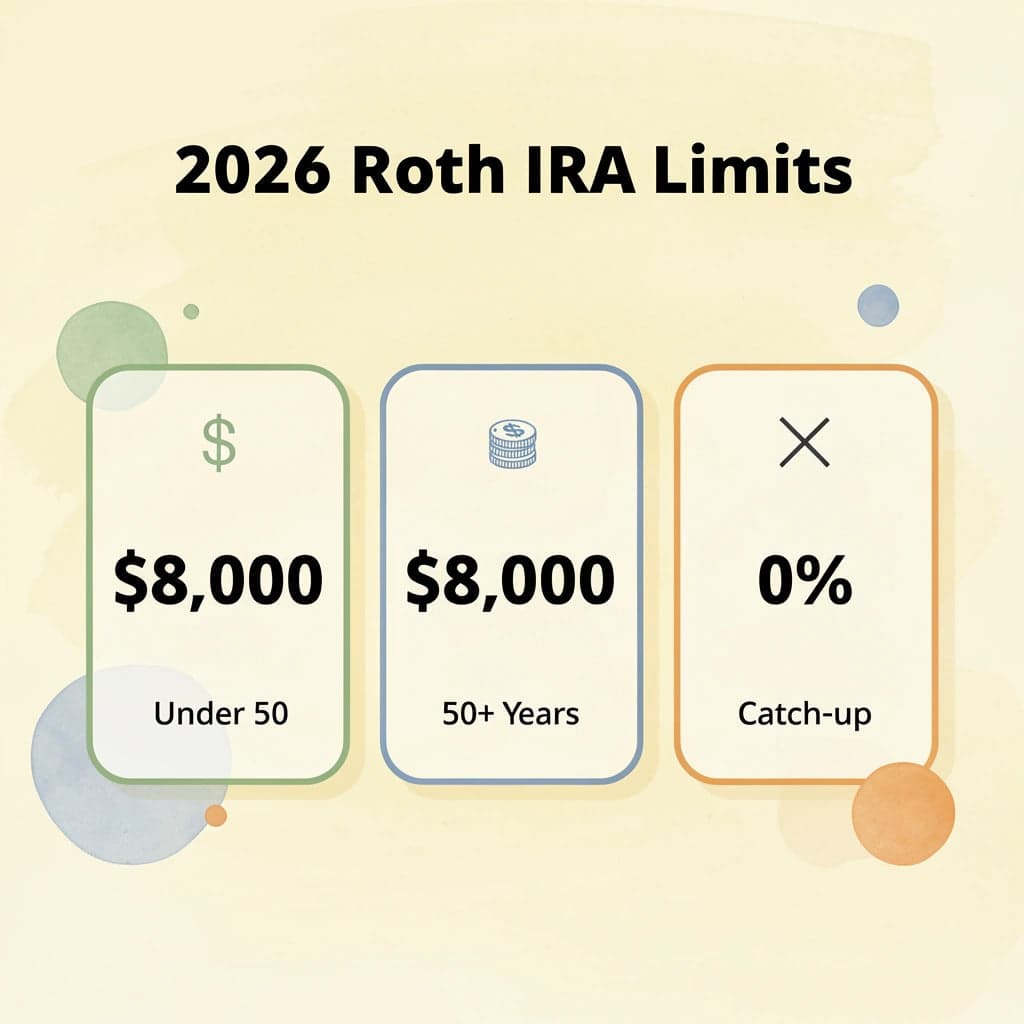
Maxing out a Roth IRA means contributing the full amount that the IRS allows for that tax year. For 2026, the contribution limit is $8,000 for people under age 50 and $10,000 for those age 50 or older, according to Charles Schwab and Bankrate.

🎯 Key Point: The $8,000 annual limit applies to all Roth IRA contributions combined, regardless of how many accounts you have or which financial institutions you use.
"For 2026, the Roth IRA contribution limit remains $8,000 for all eligible taxpayers, with no additional catch-up contribution for those age 50 or older." — IRS Guidelines, 2026
🔑 Takeaway: Understanding these contribution limits is essential because exceeding them results in tax penalties - making it crucial to track your annual contributions carefully across all retirement accounts.
How do contribution limits work across multiple IRA accounts?
These limits apply to all your IRA accounts combined, not to each individual account. This can create confusion for investors managing both Traditional and Roth IRAs simultaneously.
What income limits affect Roth IRA eligibility?
Roth IRA eligibility phases out based on modified adjusted gross income. Single filers lose direct contribution eligibility starting at $153,000 in 2026, with a complete phaseout at $168,000. Married couples filing jointly face phaseouts from $242,000 to $252,000.
Investors near these thresholds often wait until they file taxes the following year before contributing, creating tension between wanting to maximize contributions early and needing certainty about eligibility first.
The Contribution Room You Lose Forever
Unused Roth IRA contribution room disappears once the tax year deadline passes. If you qualify to contribute $8,000 but only manage $3,000, that remaining $5,000 vanishes forever. You cannot carry it forward or make it up later. This creates pressure because every year you delay represents decades of potential tax-free compounding you cannot recover.
How do different retirement account types compare?
The difference between account types affects your tax liability, withdrawal timing, and estate planning. A Roth IRA is opened by one person using after-tax money and allows tax-free withdrawals in retirement. A Traditional IRA may provide an upfront tax deduction, depending on your income and whether you have a work retirement plan, though you'll pay taxes on withdrawals later. A Roth 401(k) is employer-sponsored, permits higher annual contributions, but offers fewer investment options.
Websites like retirement financial planning help investors understand these differences through one-on-one meetings that examine their current taxes, future earnings potential, and legacy goals. This clarifies the advantages and disadvantages of different contribution types, strategies for navigating income limits, such as backdoor Roth conversions, and how each choice compounds your wealth over time.
What makes consistent Roth IRA funding so powerful?
A Roth IRA becomes powerful when you fund it consistently year after year, keep the money invested in growth-oriented assets, and let compounding work over multiple decades without future tax drag. Timing your market entry matters far less than building the discipline to contribute regularly and giving those investments maximum time to compound tax-free.
Understanding what maxing out means answers the mechanical question of how much and when, but not whether you should prioritize this over other competing financial decisions.
Why Maxing Out a Roth IRA Early Matters More Than Most Investors Realize
Starting a Roth IRA at 25 versus 35 creates a significant difference: $2.1 million versus $930,000 in tax-free wealth by age 65, assuming 8% returns. That missing decade costs you not only the money you contribute, but years of tax-free growth on those early investments.
"Starting a Roth IRA at 25 versus 35 creates a difference of over $1.1 million in tax-free wealth by retirement." — Investment Analysis, 2024
🔑 Key Takeaway: The 10-year head start provides decades of compound growth on those early investments, making the timing of your first contribution more critical than the amount.
💡 Pro Tip: Even $100 per month in your twenties will outperform larger contributions made in your thirties due to the power of compounding.

The Math Nobody Warns You About
Think about two investors who earn the same long-term returns. Investor A puts the maximum amount into their Roth IRA starting at 25, contributing according to Acorns, $7,000 every year until age 65. Investor B waits until 35 to start making the same contributions. The ten-year delay seems recoverable.
Investor A builds up roughly $2.1 million tax-free by retirement. Investor B reaches about $930,000. The difference in contributions is only $70,000, yet the wealth gap exceeds $1.1 million. That's compounding—when you have more time and are free from future taxes.
Why Waiting to "Catch Up Later" Rarely Works
Many investors believe future earnings will compensate for delayed savings. However, recovering lost time requires substantially higher monthly contributions, which proves difficult to sustain. A 35-year-old aiming to match someone who started at 25 would need to save more than the annual Roth IRA limit allows, forcing them to use taxable accounts where they pay taxes on investment gains.
How does time become your most valuable investing asset?
Investors often wait to make Roth contributions while expecting promotions, paying off debt, or anticipating market changes. Each year of waiting reduces the single most valuable asset in long-term investing: time. Small but steady contributions grow into surprisingly large balances because growth compounds on earlier growth, and inside a Roth IRA, that process continues without taxes, reducing qualified withdrawals.
Duration Matters More Than Size
A 25-year-old who consistently invests smaller amounts often builds more long-term wealth than someone who invests aggressively at 40. The earlier investor gives compounding more time to work: a decade of lost growth cannot be fully restored by future income, no matter how large.
The earlier Roth contributions begin, the more years tax-free compounding can work, turning modest yearly contributions into substantial retirement assets that face no taxation upon withdrawal.
Should maxing out your Roth IRA be your first priority?
But knowing when to start putting the most money into a Roth IRA assumes it should be your first priority, which complicates the advice more than most people expect. Our retirement financial planning approach helps you prioritize which accounts deserve your contributions first based on your unique situation.
When Maxing Out a Roth IRA May Not Be the Best First Move
When the match comes first
The clearest situation where maxing out a Roth IRA should not be your first priority is when an employer offers a 401(k) match. A dollar-for-dollar employer match delivers an immediate 100% return that no other investment strategy can reliably duplicate. If your employer matches contributions up to 6% of salary, contributing less than that threshold before funding a Roth IRA means accepting a smaller total retirement balance than you could have built with the same amount of money.
When debt costs more than compounding earns
High-interest debt creates a fundamental conflict. Carrying credit card balances at 18% or 22% interest while maxing out a Roth IRA is mathematically counterproductive: you compound losses faster than diversified portfolios grow. Paying down expensive debt produces more immediate net worth improvement than tax-free compounding. According to NerdWallet, retirement contributions typically range from 3% to 6% of salary, but redirecting those dollars toward eliminating debt first may yield better long-term outcomes.
When liquidity matters more than tax-free growth
Many investors max out their Roth accounts while keeping minimal cash on hand. When an unexpected $5,000 expense occurs, they're forced to take on new debt or withdraw money early, which hurts the $7,000 contribution they just made. Retirement accounts are designed for withdrawals decades away, not for short-term money problems. Emergency savings prevent the financial disruptions that can derail long-term plans.
When does prioritizing current tax savings make more sense than future tax-free withdrawals?
Roth contributions use after-tax money, so you forgo an immediate tax break but withdraw funds tax-free later. This trade-off suits younger investors in lower tax brackets who expect higher earnings in retirement. High earners in the 32% or 35% federal tax bracket may benefit more from pre-tax 401(k) contributions that reduce current taxes, particularly if they expect to retire into a lower bracket.
Tax planning involves organizing your current taxes with your future withdrawal plan across different account types, creating flexibility and control over lifetime tax liability. Smart Financial Lifestyle helps you map out a comprehensive tax strategy that aligns your savings decisions with your retirement goals.
How do you determine the right retirement strategy for your situation?
The right retirement strategy depends on current income, expected retirement income, tax exposure, debt structure, employer benefits, liquidity needs, and long-term withdrawal planning. Younger workers may benefit from decades of tax-free Roth growth, while high-income professionals nearing retirement may prioritize tax deferral instead. Our Smart Financial Lifestyle platform helps you evaluate these tradeoffs based on your specific situation.
Others may need a hybrid approach using both pre-tax and Roth accounts for future tax flexibility. Effective financial plans coordinate taxes, cash flow, investment growth, and retirement income rather than following simplified rules about account priority.
But getting the account priority right does not solve the deeper problem most people face.
Related Reading
How to Reduce Taxes on RMDs
The Bigger Retirement Planning Mistake Is Focusing on Accounts Instead of Strategy
Picking an account type is not a retirement strategy—it's a part of one. Too many investors spend decades debating Roth IRAs versus Traditional 401(k)s without coordinating how these accounts work together across taxes, withdrawals, Social Security timing, and long-term income needs. The planning challenge is to build a retirement structure that coordinates multiple income sources, manages lifetime tax exposure, and maintains withdrawal flexibility over 30 or 40 years.

🎯 Key Point: The account type debate distracts from the bigger picture—you need a comprehensive strategy that coordinates all your retirement income sources, not just individual account optimization.
"The real planning challenge is building a retirement structure that coordinates multiple income sources, manages lifetime tax exposure, and maintains withdrawal flexibility across 30 or 40 years."
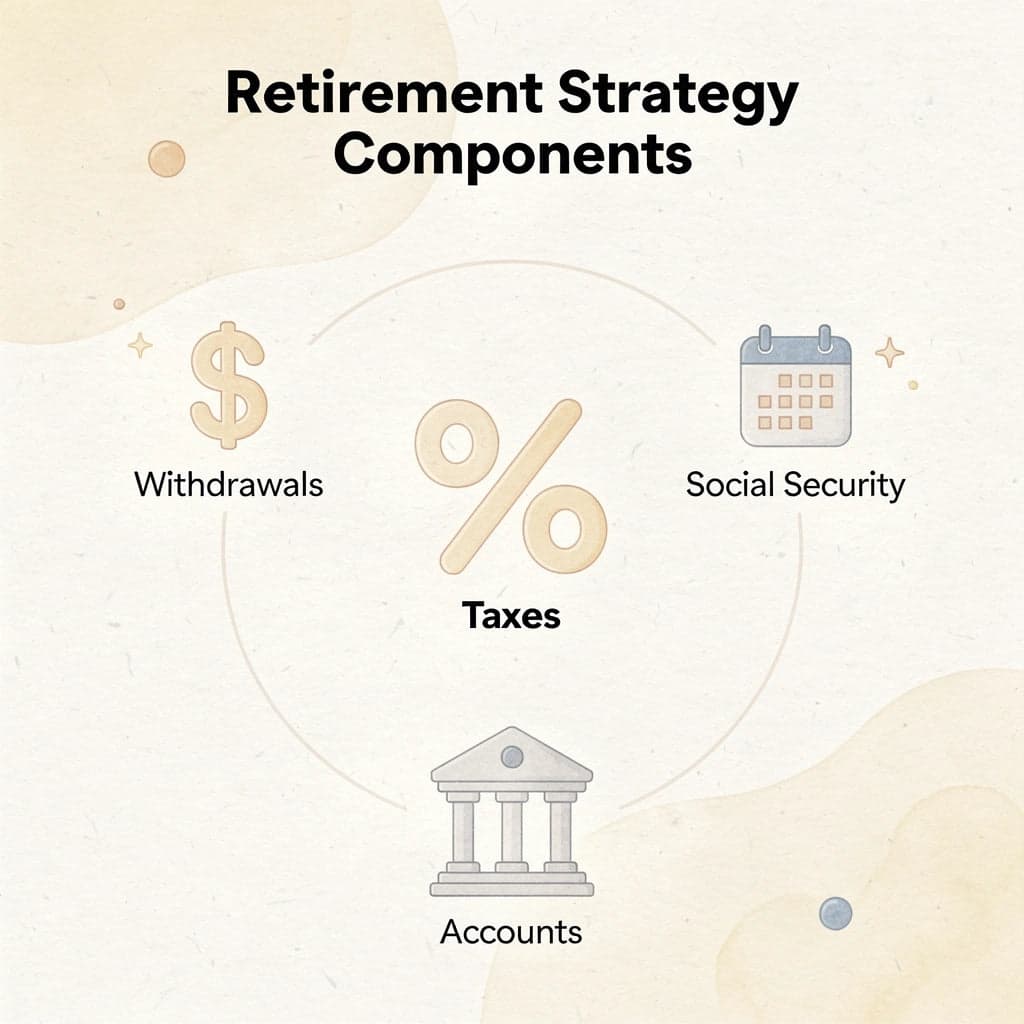
⚠️ Warning: Spending decades focused on account selection while ignoring tax coordination, withdrawal sequencing, and Social Security optimization can cost you significantly more than choosing the "wrong" account type ever would.
Why does account-first thinking create retirement problems?
Most investors build retirement savings step by step, but rarely consider withdrawal sequencing until retirement arrives. The order in which money comes from taxable accounts, Traditional IRAs, and Roth accounts directly affects Medicare premiums, Social Security taxation, required minimum distribution burdens, and portfolio longevity. Our Smart Financial Lifestyle platform coordinates these withdrawals as part of a comprehensive retirement financial planning strategy.
A poorly coordinated withdrawal plan can push retirees into higher tax brackets despite decades of careful saving, because the accounts were never integrated into a broader income strategy. Smart Financial Lifestyle addresses this by aligning your withdrawal sequencing with your overall retirement financial planning goals.
How do required minimum distributions amplify tax problems?
Required minimum distributions exacerbate this problem. Traditional retirement accounts require withdrawals starting at certain ages under IRS rules, and investors who contribute too much to tax-deferred accounts often find that mandatory distributions create unexpectedly high taxable income.
According to Falcon Wealth Planning, advisors managing over a billion dollars in assets consistently see retirees pushed into unanticipated tax brackets due to a lack of tax diversification. This reflects a planning problem, not a savings problem.
Why does tax diversification matter more than maximizing individual accounts?
Roth accounts become powerful when they add flexibility to a retirement income plan that includes taxable brokerage accounts, Traditional IRAs, pre-tax 401(k)s, and Social Security benefits. Without coordination, investors optimize individual accounts while missing how those pieces interact over time. Our Smart Financial Lifestyle platform helps you see these connections across all your accounts, enabling you to build a truly integrated retirement strategy.
A Roth IRA invested too conservatively for 30 years underperforms its tax-free compounding potential, while excessive risk late in the accumulation phase creates avoidable volatility when retirement timing matters most. Strategic asset allocation, not the account type itself, solves these problems.
How can withdrawal flexibility improve retirement tax strategy?
Many investors focus on contribution limits and employer match percentages but spend little time considering how their retirement assets will generate returns. Withdrawal flexibility requires tax diversification across multiple account types so retirees can control which income sources they use each year.
Platforms like retirement financial planning from Smart Financial Lifestyle help investors coordinate Roth conversions, Traditional withdrawals, and taxable account distributions into a cohesive tax strategy rather than treating each account as an isolated decision.
How does strategic planning differ from product selection?
Product-level thinking asks whether a Roth IRA is better than a Traditional 401(k). Strategic planning asks how all retirement income sources work together over three decades to minimize lifetime taxes, preserve purchasing power, and pass wealth to the next generation. The most effective retirement plans integrate Roth accounts into a coordinated structure alongside pensions, Social Security timing, estate planning, and family tax implications rather than treating them as standalone checklist items.
What specific question determines if maxing out a Roth IRA makes sense?
Even investors who understand this coordination challenge often struggle with one specific question that determines whether maxing out a Roth IRA makes sense for their situation.
How Smart Financial Lifestyle Helps Investors Think Beyond Basic Roth IRA Advice
Retirement planning breaks down when investors treat it like a product catalog instead of a living system. The decision to max out a Roth IRA depends on how that account works with taxable savings, pre-tax retirement balances, Social Security claiming strategies, estate planning goals, and the tax situation you'll face in 20 or 30 years. Advice that stops at the account level leaves many people who followed every rule discovering tax inefficiencies they didn't anticipate.

🎯 Key Point: Roth IRA contributions should be evaluated as part of your complete financial ecosystem, not as an isolated decision that ignores your overall tax strategy.
"The biggest retirement planning mistakes happen when investors optimize individual accounts without considering how they work together as a comprehensive tax management system." — Financial Planning Research, 2024

💡 Tip: Before maxing out any retirement account, map out your projected tax brackets in retirement and consider how Roth conversions, Social Security timing, and withdrawal sequencing will impact your overall tax burden.
Why does viral retirement advice often fail in practice?
Viral retirement advice fails because it treats retirement as an independent decision rather than an interconnected system. A 55-year-old with $800,000 in a traditional 401(k), a paid-off mortgage, and pension eligibility faces different tax dynamics than a 30-year-old starting out. The first person might benefit more from strategic Roth conversions than maxing contributions; the second might need liquidity over tax diversification. What works depends entirely on the surrounding financial structure.
How does structural planning reveal coordination opportunities?
Smart Financial Lifestyle was built around this structural perspective, drawing from Paul Mauro's 50 years of managing wealth across multiple market cycles and tax environments. Managing over $1 billion in assets revealed a consistent pattern: investors who optimized individual accounts often missed the coordination questions that determined retirement sustainability. The hard part wasn't choosing the right products—it was understanding how those products worked together over decades of changing tax laws, income levels, and withdrawal needs.
Where most retirement planning actually breaks down
Required minimum distributions from traditional IRAs force taxable income at age 73, potentially pushing retirees into higher tax brackets and triggering Medicare premium surcharges. Social Security benefits become taxable when combined income crosses certain thresholds. Pension income cannot be controlled or delayed. Without a withdrawal sequence that accounts for these interactions, retirees pay far more in taxes than necessary—not because they saved in the wrong accounts, but because they withdrew from them in the wrong order.
What separates strategic planning from product advice?
Product advice tells you which accounts to open. Strategic planning tells you how to coordinate withdrawals, manage taxable income, time Social Security claims, and structure estate transfers to preserve wealth across generations. Smart Financial Lifestyle focuses on these operational realities through personalized Roth IRA conversion consultations and retirement income coordination frameworks. The goal is to help you determine whether that decision fits your specific tax situation, income trajectory, and long-term wealth-transfer goals.
Why do most investors eventually need personalized guidance?
Most investors eventually realize the internet gave them answers to questions they didn't know they should ask. Real value comes from understanding which questions matter most for your situation: moving past simple rules into the personalized territory where retirement planning happens.
Related Reading
Kickstart Your Retirement Financial Planning Journey | Subscribe to Our YouTube and Newsletter
Applying what you've learned means starting with your actual numbers, not generic benchmarks. Understand where your retirement income will come from, what tax bracket you'll occupy during retirement, and how different account types work together before deciding whether maxing out a Roth IRA serves your wealth-building goals.

🎯 Key Point: Smart Financial Lifestyle offers books, free YouTube content, and a 5-step financial checklist based on frameworks Paul Mauro used over 50 years managing over $1 billion in client assets. These resources show how Roth contributions, tax diversification, retirement income sequencing, and Social Security timing fit together as a coordinated system rather than disconnected tactics.
"These resources show how Roth contributions, tax diversification, retirement income sequencing, and Social Security timing fit together as a coordinated system rather than disconnected tactics." — Smart Financial Lifestyle Framework
Subscribe to the YouTube channel for practical walkthroughs on Roth conversion strategies, tax-efficient withdrawal sequencing, and multi-generational wealth transfer planning. Sign up for the newsletter to receive actionable checklists and planning tools that move you past simplified advice into personalized retirement planning. Start with free resources, then explore personalized Roth IRA conversion consultations if your situation involves complex tax considerations or legacy planning beyond what generic calculators can provide.
💡 Tip: Start with the free resources to build your foundation before investing in personalized consultations for complex situations.