403(b) vs Roth IRA: Which Builds More Retirement Wealth?

Choosing between a 403(b) and a Roth IRA can determine how much money remains after taxes in retirement. A 403(b) offers immediate tax deductions and potential employer matching, while a Roth IRA provides tax-free withdrawals decades later. Each account follows different contribution limits, withdrawal rules, and tax treatments that directly impact long-term wealth accumulation. The right choice depends on current income, tax bracket, and retirement timeline.
Rather than navigating complex IRS regulations alone, workers benefit from understanding how these accounts complement each other in a tax-efficient retirement strategy. The key lies in matching account types to individual financial situations and goals. Smart Financial Lifestyle's retirement financial planning approach simplifies these decisions by focusing on practical strategies that maximize after-tax retirement income.
Table of Contents
Why So Many Savers Get Stuck Choosing Between a 403(b) and Roth IRA
The Biggest Mistake People Make When Comparing These Accounts
How Smart Financial Lifestyle Helps You Make Better Retirement Decisions
Kickstart Your Retirement Financial Planning Journey | Subscribe to Our YouTube and Newsletter
Summary
Employer matching contributions represent an immediate 100% return that no investment strategy can replicate. A worker whose employer matches 50% of contributions up to 6% of salary effectively earns that match before any market gains occur. According to the PSCA 2025 403(b) Survey, the average employer contribution among 403(b) plans was 5.4%. Over a 30-year career, consistently capturing that match can add six figures to a retirement portfolio, making it the highest-priority decision before considering any other account type.
Automatic payroll deductions through 403(b) plans create contribution consistency that manual transfers rarely achieve. Vanguard's 2025 How America Saves report found that participants in employer-sponsored retirement plans had an average savings rate of 7.7% of pay, largely due to automatic contributions that bypass decision fatigue. Money moves from paycheck to investment account before reaching your checking account, eliminating the temptation to spend it elsewhere. This behavioral advantage often matters more than tax treatment when building retirement wealth over decades.
Contribution limits create dramatically different savings capacity between account types. For 2026, employees can contribute up to $24,500 to a 403(b), with catch-up contributions pushing the total to $35,750 for eligible participants. Roth IRAs cap contributions at $7,000 for 2025, with a $1,000 catch-up for those 50 and older. Over 20 years at 7% returns, maximizing a 403(b) generates roughly $1.5 million compared to $328,000 from maximizing only a Roth IRA. The higher limit creates wealth that wouldn't otherwise exist in a tax-advantaged account.
Tax diversification in retirement provides flexibility that single-account strategies cannot match. Having both pre-tax and after-tax retirement savings allows you to control taxable income in retirement by choosing which accounts to draw from each year. This flexibility helps manage Medicare premiums, Social Security taxation thresholds, and bracket creep. Northwestern Mutual's 2025 Planning & Progress Study found that 51% of Americans believe they are somewhat or very likely to outlive their savings, a concern that comprehensive tax planning addresses more effectively than account selection alone.
Time amplifies the value of tax-free growth in Roth IRAs for younger workers. A $7,000 contribution at age 30 that grows at 7% annually becomes roughly $53,000 by age 60, with the entire balance available tax-free. Early-career professionals typically earn less than they will in their peak earning years, so current tax rates are lower than future retirement rates. Paying taxes at a 12% rate today to avoid a 22% rate later creates measurable value when decades of compounding separate contributions from gains.
Retirement financial planning addresses this by evaluating your specific tax situation, employer benefits, contribution capacity, and timeline rather than applying generic rules that ignore individual circumstances.
Why So Many Savers Get Stuck Choosing Between a 403(b) and Roth IRA
The confusion stems from treating these accounts as competitors when they serve different purposes. A 403(b) offers immediate tax benefits and possible employer contributions, while a Roth IRA provides tax-free withdrawals and investment flexibility. The question is which fits your current tax situation, income level, and retirement timeline.

🎯 Key Point: 403(b) and Roth IRA accounts aren't mutually exclusive - they're complementary tools that can work together in your retirement strategy.
"The biggest mistake savers make is viewing retirement accounts as an either-or decision when strategic diversification across account types provides the most tax flexibility in retirement."

⚠️ Warning: Choosing based on immediate benefits alone can cost you thousands in the long run - your current tax bracket and expected retirement income should drive the decision.
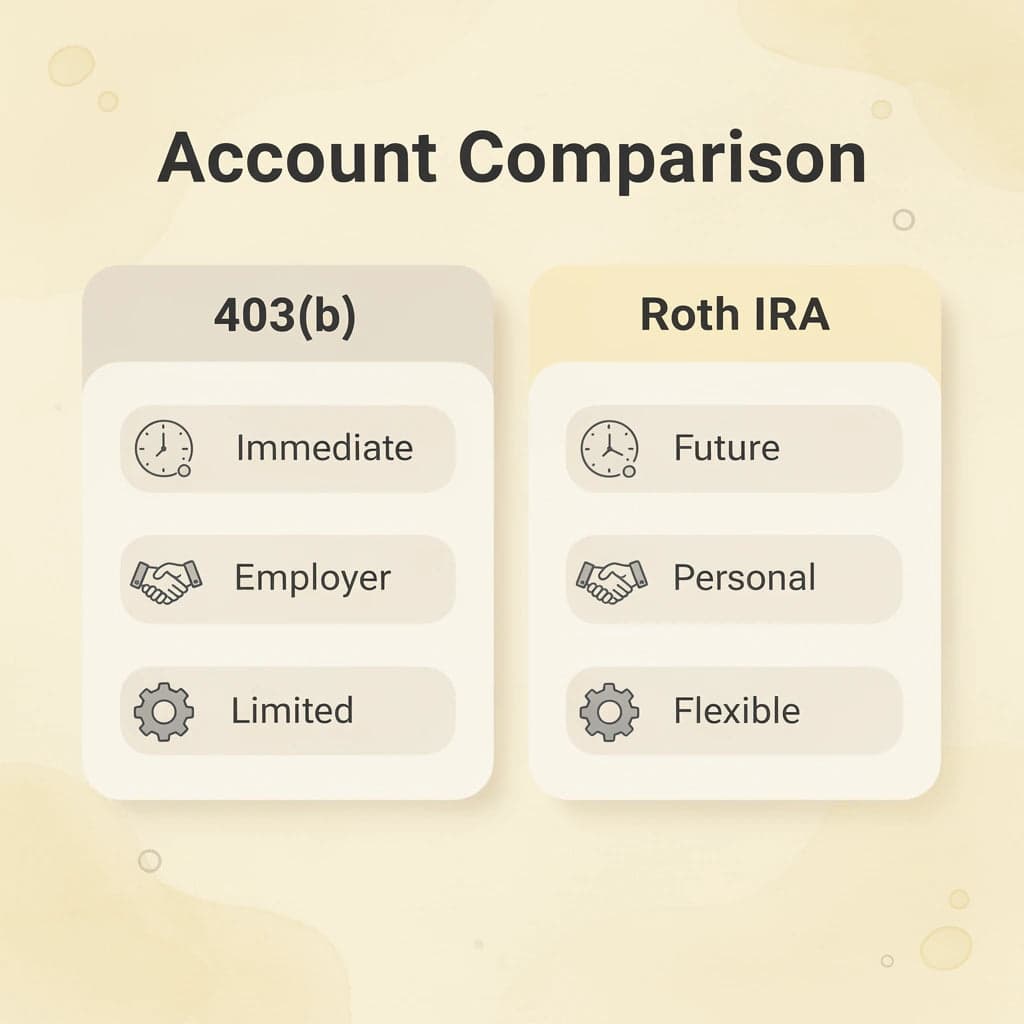
Factor | 403(b) Advantage | Roth IRA Advantage |
|---|---|---|
Tax Treatment | Immediate deduction | Tax-free withdrawals |
Employer Match | Often available | Not applicable |
Investment Options | Limited to plan choices | Unlimited flexibility |
Income Limits | None for contributions | Strict eligibility rules |
Why does conflicting financial advice create confusion?
Walk into any financial planning conversation, and you'll hear conflicting advice: one advisor touts the tax deduction from a 403(b) for high earners, another champions tax-free growth in a Roth IRA over 30 years, a third prioritizes securing employer match first. Each sounds confident and presents convincing math.
How does decision paralysis impact retirement savings?
This creates paralysis. You want to make the smart choice, but conflicting guidance obscures what "smart" means in your situation. According to Bankrate's 2025 Retirement Savings Report, 58% of American workers say their retirement savings are behind where they should be. When already behind, the fear of making the wrong choice intensifies.
Why isn't there a simple rule for retirement account choices?
Most people hope for a simple rule: "always max out your 403(b) first" or "Roth IRAs are always better for younger workers." A universal rule removes uncertainty and accelerates decision-making. Retirement planning doesn't work that way.
How do personal circumstances affect retirement account decisions?
What makes sense for a 28-year-old nonprofit worker earning $45,000 differs significantly from what works for a 52-year-old hospital administrator earning $120,000. The first person may benefit more from Roth contributions because they're in a lower tax bracket now than they'll likely face in retirement. The second may need the immediate tax deduction to reduce their current tax burden.
The "best" account depends on variables that change throughout your career: income, tax brackets, employer benefits, and retirement goals. A strategy that worked at 30 may need adjustment at 50.
What Gets Ignored While Debating Accounts
Someone spends three months researching whether pre-tax or after-tax contributions optimize their retirement outcome, yet they're leaving a 5% employer match uncaptured because they haven't increased their 403(b) contribution enough to claim it.
That employer match represents an immediate 100% return on your contribution. No investment strategy, tax optimization, or account selection can beat that.
How does analysis paralysis hurt your retirement savings?
The same pattern emerges with contribution timing. Savers delay investing while deciding which account to fund first. Months pass. The market moves up 15%, and they've earned nothing because perfect planning prevented them from acting.
Why does behavior matter more than optimization?
Research consistently shows that behavior matters more than optimization in retirement outcomes. Contributing regularly, increasing your savings rate over time, and staying invested through market cycles have a greater impact than picking the theoretically best account.
The difference between contributing 10% to a "not ideal" account and contributing nothing to the "perfect" account is substantial.
Why do retirement account rules create confusion?
Retirement account rules change annually. The IRS sets a 403(b) contribution limit of $23,000 for 2024, with the limit adjusted annually. Catch-up contributions are available for workers over 50. Income limits affect Roth IRA eligibility. Employer matching formulas vary by company.
Tax law adds another layer of complexity. Your effective tax rate differs from your marginal rate, and your retirement tax situation depends on Social Security benefits, pension income, required minimum distributions, and potential tax policy changes decades ahead. These factors are difficult to predict with accuracy.
How does complexity lead to decision paralysis?
This complexity creates decision fatigue. Every factor seems important, each calculation requires unknowable assumptions, and deeper research makes confidence in any choice harder to achieve.
Workplace plans complicate matters further. Some 403(b) plans offer low-cost index funds; others charge excessive fees and limit options. Some employers match 6% of salary; others offer nothing. What works at one organization might be poor advice at another.
Why asking which account is better misses the point
Most savers ask, "Which account is better?" as if a single right answer exists. This framing almost guarantees frustration because these accounts work together rather than compete.
The more useful question is "Which account helps me reach my retirement goals given where I am right now?" This shift moves you from searching for universal truth to examining your specific situation: income level, current tax bracket, expected retirement tax bracket, employer benefits, existing retirement savings, time until retirement, and legacy goals.
How do different situations change the answer?
A 35-year-old teacher earning $55,000 with 30 years until retirement faces different tradeoffs than a 58-year-old healthcare administrator earning $140,000 with seven years left. The first might prioritize Roth contributions to lock in their current low tax rate, while the second might need traditional 403(b) contributions to reduce taxable income and avoid higher Medicare premiums.
Neither choice is wrong; they're answers to different situations.
Beyond the Single Decision
Retirement success depends on a comprehensive plan that integrates multiple elements: minimizing taxes, contributing regularly, selecting sound investments, maintaining discipline during market downturns, maximizing employer benefits, and coordinating different income sources in retirement.
Why do so many Americans fear outliving their savings?
According to Northwestern Mutual's 2025 Planning & Progress Study, 51% of Americans believe they are somewhat or very likely to outlive their savings. Address that fear by building a complete plan that maximizes contributions, reduces taxes, leverages employer benefits, and establishes sustainable withdrawal strategies.
The 403(b) versus Roth IRA decision is one piece of a larger financial puzzle. Understanding how these accounts work together clarifies the choice.
How does personalized planning cut through retirement confusion?
The textbook answer rarely matches real-world situations. Your tax situation, employer benefits, income trajectory, and retirement goals create a unique combination that demands a personalized approach.
Retirement financial planning with Smart Financial Lifestyle starts with your specific circumstances. Instead of debating which account wins in theory, our approach helps you evaluate which strategy works for your current tax bracket, employer match, contribution capacity, and retirement timeline.
Moving Past Paralysis
Choosing between a 403(b) and Roth IRA feels overwhelming because you're navigating an unknowable future while managing present circumstances. You can't predict tax rates in 2055 or know exactly what your retirement income will look like.
What information do you actually need to decide?
Start with what you know: your current income, tax bracket, employer's matching policy, existing retirement savings, and time horizon. These facts give you enough information to make a solid choice today—not a perfect one, but one that moves you forward.
What's the real cost of waiting for perfect clarity?
The real cost of this confusion isn't choosing a suboptimal account. It's the months or years of delayed contributions while searching for nonexistent certainty, the employer match you miss while debating account types, and the compound growth you forfeit while perfect planning prevents action.
Understanding how these accounts work transforms the decision from an overwhelming puzzle into a manageable choice.
How a 403(b) and Roth IRA Actually Work
A 403(b) is a retirement plan your employer offers, with money deducted from your paycheck and your employer often adding matching contributions. A Roth IRA is a personal account you fund with after-tax dollars, allowing tax-free withdrawals in retirement. Beyond tax differences, these accounts differ in control, contribution limits, and how they fit into your overall retirement strategy.
🎯 Key Point: The main difference is who controls the account: your employer manages the 403(b) while you have full control over your Roth IRA.
"Understanding the fundamental differences between employer-sponsored 403(b) plans and individual Roth IRAs is essential for building a comprehensive retirement strategy." — Financial Planning Association
💡 Tip: Consider using both accounts together: maximize your employer match in the 403(b) first, then contribute to a Roth IRA for additional tax-free growth.

How does the 403(b) provide convenience through automation?
Your employer handles most of the heavy lifting with a 403(b). Contributions come out automatically before you see the paycheck, removing monthly decisions about whether to save. For workers in public schools, nonprofits, churches, and certain healthcare institutions, this automation creates consistency that manual saving rarely achieves.
According to Vanguard's 2025 How America Saves report, participants in employer-sponsored retirement plans saved an average of 7.7% of pay. Automatic payroll deductions bypass willpower entirely, making the system effective.
What are the tax implications of traditional vs Roth 403(b) contributions?
Traditional 403(b) contributions lower your taxable income today. If you earn $80,000 and contribute $10,000, you pay taxes on only $70,000. However, you'll pay taxes on withdrawals as regular income in retirement.
Many employers now offer a Roth 403(b) option alongside the traditional version. You contribute after-tax dollars, but withdrawals in retirement are tax-free. You're choosing between a tax break now or tax-free income later, depending on whether you expect your tax rate to be higher or lower in retirement.
How do contribution limits and employer matching maximize 403(b) benefits?
The contribution limits make 403(b) accounts particularly powerful for aggressive savers. The IRS increased the maximum employee elective deferral limit for 403(b) and similar workplace retirement plans to $24,500 for tax year 2026. Workers age 50 and older can add catch-up contributions, enabling faster retirement savings accumulation.
Employer matching changes the entire calculation. When your employer contributes additional money based on your contributions, you earn an immediate return before any investment growth occurs. A 50% match on 6% of salary compounds over decades.
How does a Roth IRA provide tax-free growth and portability?
A Roth IRA works the opposite way: you pay taxes on contributions today, then never pay taxes on that money again. After you turn 59½ and have held the account for five years, all earnings come out tax-free. For workers who expect higher retirement income or believe tax rates will rise, this setup creates significant value.
A Roth IRA is yours no matter where you work. Change jobs, move to a new place, or retire early: the account stays with you, and your investment choices remain the same, unlike a 403(b), which belongs to your employer's plan and limits you to their negotiated investment options.
What investment flexibility does a Roth IRA offer?
Investment flexibility expands dramatically with a Roth IRA. While 403(b) participants might choose from 15 to 30 mutual funds, Roth IRA owners can access thousands of stocks, bonds, ETFs, and funds depending on their brokerage, enabling more precise portfolio construction aligned with their risk tolerance and time horizon.
What are the contribution limits and income restrictions?
The contribution limits are lower. For 2026, you can contribute up to $7,500 to a Roth IRA, with an additional $1,100 catch-up contribution for individuals age 50 and older: less than one-third of the 403(b) limit, which constrains how much tax-free growth you can generate through this account alone.
Income restrictions add another layer of complexity. As your income rises, your ability to contribute directly to a Roth IRA phases out, and higher earners often find themselves locked out entirely, though backdoor Roth strategies can sometimes circumvent these limits.
Where the Pro-Rata Rule Creates Real Complications
People saving money who approach the Roth IRA contribution limits face a hidden problem: the pro rata rule. This rule surprises many workers when they discover that an existing rollover IRA blocks their backdoor Roth conversion strategy.
How does the pro-rata rule affect your conversion taxes?
The pro-rata rule requires you to treat all your traditional IRA balances as a single group when converting to a Roth IRA. If you have $95,000 in a rollover IRA and add $7,500 to a traditional IRA that you plan to convert, you cannot convert only the $7,500. The IRS calculates the taxable portion based on your total IRA balance, so most of that conversion will trigger taxes.
When should you convert to avoid pro-rata complications?
One practical approach: convert rollover IRA balances to Roth when amounts are relatively small, and your income hasn't reached peak earning years. The tax hit hurts less on a $15,000 balance than on a $150,000 balance, and completing the conversion early eliminates pro rata complications for future backdoor Roth contributions.
When Employer Match Overrides Every Other Consideration
If your employer matches 403(b) contributions, that match represents the highest guaranteed return you'll find anywhere. A 100% match on the first 3% of salary doubles your money immediately, before any market returns. No Roth IRA can compete with that gain.
What's the optimal contribution strategy with employer matching?
Put enough money into your employer's plan to get the full employer match first, even if a Roth IRA sounds better. After securing that match, put extra savings into a Roth IRA if tax-free withdrawals align with your long-term tax plan.
Why do many savers make the wrong choice?
Many savers do this in reverse order. They contribute the maximum to a Roth IRA first because tax-free growth feels more appealing, then put whatever remains into their 403(b). This approach means they miss out on employer matching dollars—essentially turning down a raise.
Why do most comparisons focus on unpredictable tax scenarios?
Most comparison articles focus on whether pre-tax or after-tax contributions are better, attempting to guess your tax bracket 30 years from now and building complex spreadsheets to compare scenarios. But that level of detail is mostly theater: nobody knows what tax rates will look like in 2055, what your retirement income will be, what deductions will exist, or how your spending needs will change.
What factors can you actually control today?
What we know: contribution limits differ, employer matches create immediate value, investment options vary by account type, and portability matters across employers. These factors influence your retirement outcome regardless of future tax rates.
Savers focus heavily on the tax debate while overlooking practical factors such as contribution limits, employer match, and investment flexibility. These accounts serve different purposes within a complete retirement strategy rather than competing for the same role.
Why Both Accounts Often Make More Sense Than Choosing One
Tax diversification provides flexibility that single-account strategies cannot match. Having both pre-tax and after-tax retirement savings lets you control your tax liability in retirement by choosing which accounts to draw from each year. If tax rates rise, Roth IRA distributions will help you avoid those higher rates entirely. If rates remain stable or decline, the larger balance you built through your 403(b) contributions may provide greater total retirement income.
How should you layer 403(b) and Roth IRA contributions?
The best retirement strategies use these accounts together rather than choosing a single one. First, get the employer match through your 403(b). Then, contribute extra money to a Roth IRA up to the contribution limit. If you can still save more, contribute additional funds to your 403(b) beyond the match amount.
What benefits does this approach offer families over 50?
For families over 50 seeking to accelerate retirement savings while managing current tax obligations, this layered approach addresses multiple goals simultaneously: building tax-free income, maximizing employer contributions, and creating flexibility to manage Required Minimum Distributions later. Our Smart Financial Lifestyle platform helps coordinate these strategies to optimize across all three areas.
Related Reading
The Biggest Mistake People Make When Comparing These Accounts
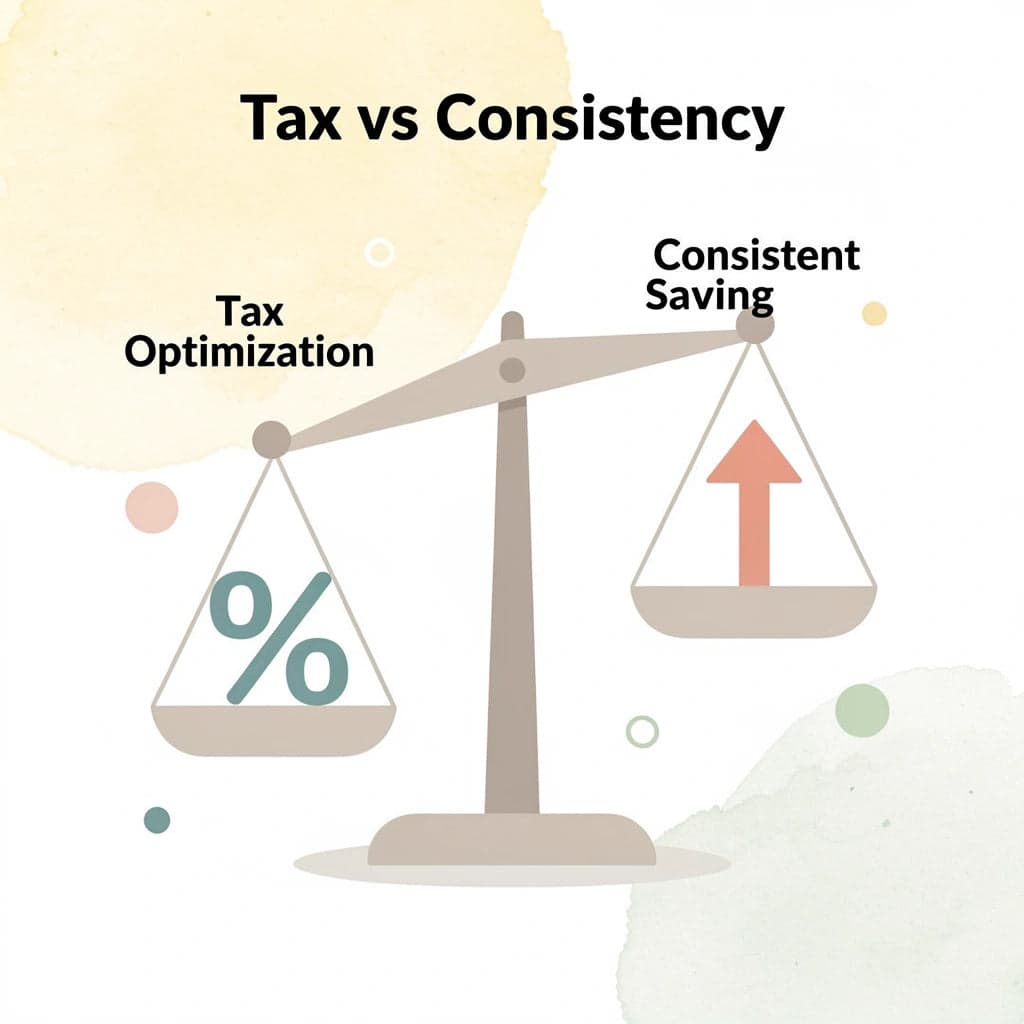
A common mistake is assuming the decision between a 403(b) and Roth IRA comes down to taxes. While tax treatment is easy to compare, retirement wealth is seldom determined by it alone.

🎯 Key Point: The tax structure of your retirement account matters less than your consistency and investment strategy over time.
Consider two workers: one spends years debating pre-tax versus Roth contributions, while the other consistently saves and invests regardless of account type. Thirty years later, the disciplined saver is in a far stronger position. Several factors have a bigger impact on long-term outcomes than the tax difference between accounts.

"Retirement wealth is rarely determined by tax treatment alone - consistency and investment strategy typically have a bigger impact on long-term outcomes."
⚠️ Warning: Don't let tax optimization paralysis prevent you from starting your retirement savings journey - time in the market beats timing the market.
Factor | Impact on Retirement Wealth |
|---|---|
Consistency of contributions | High - compound growth over time |
Investment strategy | High - asset allocation and fees |
Tax treatment | Medium - important but not decisive |
Time horizon | Critical - earlier start = exponential gains |
The employer match changes everything
If your employer offers a match through a 403(b), that match significantly improves your retirement results. A worker who contributes enough to receive the full match immediately increases annual investments. Ignoring that benefit while chasing a perceived tax advantage elsewhere can be costly: employer contributions represent free money that compounds over decades.
Contribution capacity matters more than you think
Many people saving for retirement eventually want to invest more money than their IRAs allow. Workplace retirement plans offer much higher contribution limits, making them valuable for building savings faster. Yet contribution limits matter little without consistent contributions.
Why do investing habits matter more than account selection?
Research shows that long-term investing success depends less on finding the perfect account and more on developing habits that keep money invested year after year. Automatic payroll deductions, recurring contributions, and steady participation during market fluctuations often have greater influence on outcomes than optimizing a tax strategy.
According to Yahoo News, Americans lost an average of nearly $1,000 to financial errors in 2025, many of which stemmed from poor planning or inconsistent saving habits. An investor contributing $500 monthly for decades will accumulate far more wealth than someone who contributes sporadically while perfecting their retirement account selection.
How should you evaluate retirement account options?
Retirement accounts should not be evaluated in isolation. A 403(b) offers more than a tax deduction, and a Roth IRA offers more than tax-free growth. Each provides a different mix of benefits, limitations, and opportunities. The right choice depends on your income, employer benefits, savings rate, retirement timeline, and future goals. Our Smart Financial Lifestyle platform helps you evaluate these factors together so you can see how each account type fits into your complete financial picture.
A better question than "Which account has the better tax treatment?" is: "Which account helps me save and invest more effectively over the long run?" The investor who contributes consistently, takes advantage of available employer benefits, and stays invested for decades will outperform the investor who spends years searching for the perfect account.
But knowing that doesn't reveal which account deserves your next dollar.
When a 403(b) May Be the Better Choice
Make your 403(b) a priority when your employer offers matching contributions, you need to reduce your taxes this year, or automatic payroll deductions are the only way you'll save money consistently.

🎯 Key Point: Employer matching is essentially free money - failing to contribute enough to get the full match is like turning down an immediate 100% return on your investment.
"Employees who participate in automatic enrollment save 3-4 times more than those who must actively choose to contribute." — Employee Benefit Research Institute, 2023

⚠️ Warning: Don't let tax procrastination drive your retirement strategy - while 403(b) contributions can reduce your current tax burden, they should fit into your long-term financial plan, not just solve this year's tax problem.
The Employer Match Changes Everything
If your employer matches contributions, that money represents an immediate return unavailable elsewhere. A worker earning $60,000 whose employer matches 50% of contributions up to 6% of salary could contribute $3,600 and receive an additional $1,800.
How much can employer matching add to your retirement?
According to the PSCA 2025 403(b) Survey, the average employer contribution among 403(b) plans was 5.4%. Over a 30-year career, consistent matching can add six figures to a retirement portfolio, depending on investment returns. No Roth IRA provides this benefit.
When do you actually own the employer match?
The match vests according to your employer's schedule. Nearly half of 403(b) plans have immediate vesting for matching and non-matching contributions, meaning the money belongs to you right away. Other plans use graded vesting schedules, where you earn ownership over several years. Staying long enough to capture vested contributions adds wealth you'd otherwise lose.
When Current Tax Relief Matters More Than Future Tax Freedom
People in the 24% or 32% federal tax bracket receive substantial benefits from traditional 403(b) contributions. For every dollar contributed, you save 24 to 32 cents in taxes immediately, allowing more of your money to remain invested rather than going to the IRS. Roth IRA contributions offer no tax deduction because the money goes in after taxes have already been paid.
How much can high earners save with traditional 403(b) contributions?
If someone makes $150,000 a year and contributes $15,000 to a traditional 403(b), their taxable income drops to $135,000, yielding $3,600 in immediate tax savings at the 24% tax bracket.
When does paying taxes now versus later make sense?
This strategy becomes especially valuable if you expect your retirement tax rate to be lower than your current rate. Many retirees find themselves in lower brackets once they stop earning a salary, particularly if they plan withdrawals strategically across taxable, tax-deferred, and tax-free accounts. Paying 24% now to avoid 12% later makes little sense.
How do automatic payroll deductions change saving behavior?
Automatic payroll deductions take the thinking out of your routine. Money goes to your investment account before reaching your checking account, so you won't be tempted to spend it. This system requires no discipline or willpower.
Roth IRAs need you to manually transfer money from your bank account after you've already decided to use that money for something else. That extra step makes it easy to skip contributions when unexpected expenses come up.
What is the long-term impact of consistent contributions?
The difference compounds over time. A person who saves $500 monthly through automatic payroll deduction for 30 years at 7% returns builds roughly $607,000. Someone relying on manual transfers might average $350 per month instead, ending up with around $425,000. The $182,000 gap stems from execution, not tax treatment.
Contribution Limits That Actually Matter
For 2026, employees can contribute up to $24,500 to a 403(b), plus an $8,000 catch-up contribution for ages 50+, or $11,250 for ages 60–63 under SECURE 2.0 rules, for a total of up to $35,750 annually for eligible participants.
Roth IRAs cap at $7,000 for 2025 ($8,000 with a catch-up for those 50+), representing $27,750 per year in additional tax-advantaged space.
For high earners, this gap compounds significantly. Maxing both accounts yields $43,750 annually versus $8,000 in a Roth IRA alone. Over 20 years at 7% returns, that's roughly $1.5 million versus $328,000.
What makes 403(b) investment options good enough today?
In the past, critics correctly pointed out that annuities in 403(b) plans were expensive. Today, many plans offer low-cost index funds from Vanguard, Fidelity, or similar providers that charge less than 0.10% in fees.
How many investment choices do you actually need?
A total stock market index fund, a total bond market fund, and an international stock fund provide everything needed for a diversified portfolio. More choices rarely improve results and often lead to paralysis or performance chasing.
If your plan's core options are solid and fees are reasonable, a Roth IRA's unlimited investment choices offer little practical advantage. Most investors benefit more from simple, low-cost funds they'll stick with than from access to thousands of unused options.
What makes managing a single 403(b) account easier?
A 403(b) consolidates your contributions, employer match, and investment growth in one place. You receive one statement, make one set of investment decisions, and track one balance.
How does adding a Roth IRA complicate your financial management?
Opening a Roth IRA requires creating a separate account at a different bank, manually transferring funds, selecting investments, and managing two accounts with different tax rules. For people who find managing money stressful, this complexity often leads to neglect: accounts sit uninvested, contributions get skipped, and rebalancing never happens.
When retirement planning feels overwhelming, retirement financial planning frameworks help families over 50 clarify which accounts to prioritize based on their specific tax situation, income level, and retirement timeline. Our Smart Financial Lifestyle approach provides a clear decision process that eliminates second-guessing and enables consistent execution.
What income restrictions apply to Roth IRAs versus 403(b) plans?
Roth IRAs phase out for higher earners. For 2025, you cannot make direct contributions if you earn more than $165,000 of modified adjusted gross income as a single filer or more than $246,000 if married filing jointly.
How do 403(b) plans benefit high-income earners?
Traditional and Roth 403(b) contributions have no income limits. A surgeon earning $400,000 can contribute the full $24,500, plus catch-up contributions if eligible. This makes the 403(b) one of the few remaining tax-advantaged savings vehicles available to high earners without requiring workarounds like backdoor Roth conversions.
For professionals whose income exceeds the Roth IRA eligibility limits, the 403(b) remains a straightforward option that requires no special tax planning or multi-step conversions.
What early withdrawal options does a 403(b) provide?
If you plan to retire before age 59½, a 403(b) offers access to funds through substantially equal periodic payments under IRS Rule 72(t) or through separation from service at age 55 or later. These provisions allow penalty-free withdrawals earlier than the standard 59½ threshold that applies to IRAs.
How do Roth IRA early withdrawal rules compare?
Roth IRAs let you withdraw contributions anytime without penalty, but withdrawing earnings before age 59½ typically incurs a 10% penalty unless you qualify for certain exceptions. For someone retiring at 52 who needs money before Social Security starts, a 403(b) offers more options.
Why does this matter for financial independence planning?
This advantage matters most for people who save aggressively early and want to achieve financial independence before normal retirement age. The 403(b) simplifies early retirement planning by allowing penalty-free access to your money, eliminating the need for complex Roth conversion ladders.
Related Reading
When a Roth IRA May Be the Better Choice
A Roth IRA often makes more sense than a traditional 403(b) if you expect your tax rate to rise in retirement or are early in your career with decades of growth ahead. You pay taxes now at your current rate in exchange for tax-free withdrawals later, a bet that pays off when your future tax rate exceeds today's or when tax-free growth substantially outweighs the initial tax cost.

🎯 Key Point: The Roth IRA advantage becomes most powerful when you have 20+ years until retirement, allowing compound growth to work in your favor without any future tax burden.
"Tax-free growth over decades can result in hundreds of thousands more in retirement income compared to tax-deferred accounts, especially for younger investors." — Financial Planning Research, 2023

⚠️ Warning: Don't choose a Roth IRA if you're in your peak earning years and expect to be in a lower tax bracket in retirement—the immediate tax savings of a traditional account may be more valuable than future tax-free withdrawals.
Why do younger workers benefit most from Roth IRAs?
Younger workers typically earn less than they will at their peak earning years. A 28-year-old teacher making $48,000 pays a marginal federal rate of 12%. That same person at age 55, after promotions and salary increases, might earn $85,000 and face a 22% rate. Paying 12% today to avoid 22% later is straightforward math. The 2025 IRA contribution limit of $7,000 (or $8,000 if age 50+) becomes more valuable over 30 years, as those contributions compound without future tax drag.
How does compound growth amplify Roth IRA benefits?
A $7,000 contribution at age 30 that grows at 7% annually would amount to roughly $53,000 by age 60. In a Roth IRA, the entire balance is withdrawn tax-free. In a traditional account, you owe taxes on the full amount at your retirement rate. The longer the runway, the larger the portion of your balance represents gains rather than contributions, making tax-free treatment increasingly valuable.
How does tax diversification help you manage retirement income strategically?
Many people approaching Roth IRA contribution limits feel pressured to lock in tax-free space before losing access. Having both pre-tax and after-tax retirement accounts lets you manage taxable income strategically: drawing from traditional accounts in lower-income years and using Roth funds to avoid triggering higher Medicare premiums, provisional income thresholds for Social Security taxation, or bracket creep.
Why does tax-free income matter for estate planning?
Tax-free income matters for estate planning. Roth IRAs pass to heirs without the required minimum distribution pressure that traditional accounts impose on original owners. Beneficiaries still face distribution rules, but withdrawals remain tax-free, a difference that carries weight for families focused on generational wealth.
What investment options do 403(b) plans and Roth IRAs offer?
Workplace 403(b) plans limit you to your employer's investment menu—some offer 15 solid options, others 40 mediocre ones. A Roth IRA typically gives you access to thousands of mutual funds, ETFs, and individual securities across multiple custodians. If you want specific index funds with low expense ratios, sector exposure your 403(b) doesn't offer, or more control over asset location and tax-loss harvesting, the Roth IRA wins on flexibility. That control becomes especially valuable for investors who understand their portfolio strategy and don't want to be limited by a committee's fund selection from three years ago.
Why do investors prioritize Roth IRAs over 403(b) plans?
Most people who choose a Roth IRA do so because they expect higher tax rates later, have time on their side, or prefer tax-free retirement withdrawals. These aren't guesses but decisions grounded in career path, income expectations, and how you want to organize your financial life decades ahead. The question isn't which account is theoretically better, but which fits the tax reality you'll face when you need the money.
How Smart Financial Lifestyle Helps You Make Better Retirement Decisions
The other half is learning to ask better questions: not "which account wins?" but "how does this decision fit into the bigger picture of my financial life?" Retirement planning rarely fails because of a single wrong choice—it fails when decisions are made in isolation, without understanding how each piece connects to the next.

🎯 Key Point: The most successful retirement savers don't just pick the "best" investment—they understand how each financial decision creates a ripple effect throughout their entire wealth-building strategy.
"Retirement planning rarely fails because of a single wrong choice—it fails when decisions are made in isolation, without understanding the interconnected nature of financial wellness."

💡 Tip: Before making any major financial decision, ask yourself: "How does this choice support my long-term retirement vision?" and "What other areas of my financial life will this impact?" This holistic thinking is what separates successful retirement planners from those who struggle with fragmented strategies.
What makes Smart Financial Lifestyle's approach different?
Smart Financial Lifestyle helps you build that connective tissue through financial-planning books, educational resources, and a five-step wealth-building framework for families over 50. Our platform addresses retirement accounts, tax strategy, and legacy planning based on Paul Mauro's 50-year wealth management career, during which he helped clients manage over $1 billion in assets. That experience shapes how you think about money in ways theory and headlines cannot.
What makes this approach different from traditional advice?
The 403(b) versus Roth IRA decision isn't about finding a universally correct option. It's about understanding your current tax bracket, expected future income, employer's contribution structure, timeline, and how those variables interact over decades. Americans with a financial plan are 2x more likely to feel confident about their retirement decisions, according to the Northwestern Mutual Planning & Progress Study 2025. Confidence comes from knowing why you chose an account and how it serves your long-term goals.
How does Smart Financial Lifestyle help with retirement planning?
Smart Financial Lifestyle builds clarity through free YouTube content and practical frameworks. Rather than chasing optimization, you prioritize consistency. Rather than worrying about perfect timing, you focus on habits that compound. The platform teaches you how to think about financial decisions so each one reinforces the others rather than creating confusion.
Retirement planning as a system, not a product
Successful investors understand that building wealth is a system in which the savings rate, employer benefits, tax diversification, and investment discipline work together. A 403(b) offers immediate tax relief and employer matching. A Roth IRA provides tax-free withdrawals and investment flexibility. But neither account matters if you're not saving enough, ignoring free employer contributions, or making decisions based on short-term headlines rather than long-term goals. Our Smart Financial Lifestyle platform helps you see the whole picture.
Knowing these principles is useful only if you can apply them to your specific situation.
Related Reading
Kickstart Your Retirement Financial Planning Journey | Subscribe to Our YouTube and Newsletter
Not sure whether your next retirement dollar should go in a 403(b) or a Roth IRA? Paul Mauro's books and free YouTube content through Smart Financial Lifestyle provide a comprehensive framework examining your tax bracket, timeline, employer's match policy, and wealth-building goals. His principles have guided more than $1 billion in assets under management. You'll learn how account selection, contribution strategy, and long-term investing work together to build retirement wealth.
💡 Tip: Start by evaluating your current tax bracket versus your expected retirement tax bracket to determine whether traditional or Roth contributions make more sense for your situation.

Subscribe to the Smart Financial Lifestyle YouTube channel and newsletter for actionable guidance based on 50 years of real-world experience. Get proven strategies that help families over 50 make confident decisions about retirement accounts, tax planning, and legacy building.
🎯 Key Point: Access to expert guidance with decades of experience can be the difference between a comfortable retirement and financial stress in your golden years.
"His principles guided more than $1 billion in assets under management, proving the effectiveness of systematic retirement planning approaches." — Smart Financial Lifestyle Track Record
Resource Type | What You Get | Best For |
|---|---|---|
YouTube Channel | Free video tutorials and strategies | Visual learners wanting step-by-step guidance |
Newsletter | Regular actionable tips and updates | Staying current with retirement planning strategies |
Books | Comprehensive frameworks and principles | Deep-dive learning and reference material |