How to Reduce Taxes on RMDs Without Costly Mistakes
Required minimum distributions begin at age 73, often pushing retirees into higher tax brackets and triggering unexpected Medicare surcharges. Most people discover these costly consequences only after the damage is done, missing opportunities to implement strategies that could have preserved thousands of dollars annually. Fortunately, several proven techniques can significantly reduce the tax burden on RMDs, from Roth conversions and qualified charitable distributions to strategic withdrawal sequencing that optimizes your overall tax situation.
The key lies in planning before you're locked into unfavorable positions, examining factors like IRA balances, Social Security timing, and tax bracket thresholds to create a personalized approach. Whether your goal is leaving more to heirs, avoiding unnecessary Medicare costs, or simply keeping more of your hard-earned savings, the right strategies make a measurable difference in your retirement income. Smart Financial Solution specializes in helping retirees implement these tax reduction techniques through comprehensive retirement financial planning.
Summary
Most retirees get blindsided by RMD taxes because they spent decades saving in tax-deferred accounts without planning for how those withdrawals would interact with other retirement income. When mandatory distributions finally begin at age 73, taxable income spikes higher than expected, often triggering consequences that ripple across Medicare premiums, Social Security taxation, and overall financial flexibility. The focus during working years stays locked on contribution limits and account growth, while the future tax bill quietly compounds in the background.
RMDs don't exist in isolation. They layer on top of pensions, Social Security, part-time income, and investment returns, creating a cumulative tax burden that reaches far beyond the withdrawal itself. Medicare Part B premiums can increase by $300 or more per month for high-income beneficiaries when RMDs push modified adjusted gross income over specific thresholds. Up to 85% of Social Security benefits may become taxable due to RMD income pushing retirees over key thresholds, creating a double taxation effect where you're taxed on the RMD itself and that same RMD income makes previously untaxed Social Security benefits taxable.
Missing an RMD entirely triggers a 50% penalty on the amount not withdrawn, one of the harshest tax penalties in the code. Vanguard reports that 6.7% of investors with a Vanguard-administered IRA did not take any required minimum distribution in 2024, underscoring how confusing these rules remain even for engaged savers. That confusion leads to penalties, missed opportunities for tax efficiency, and a nagging sense that retirement income feels less flexible than it should.
The years between retirement and RMD age are often the lowest-income period many retirees experience, yet few use that window strategically. Instead, they live on savings or taxable accounts, leaving pre-tax balances untouched until the IRS forces their hand. Once RMDs begin, the withdrawal amounts increase annually based on account balances and life expectancy tables, creating a tax obligation that compounds over time.
Surviving spouses face a tax trap that catches most people completely off guard. When one spouse dies, the survivor shifts from married filing jointly to single filing status, and tax brackets compress dramatically. The same retirement income that felt manageable under joint filing suddenly pushes the survivor into higher marginal brackets, sometimes jumping from 12% to 22% or higher on identical income.
Retirement financial planning helps coordinate withdrawal timing, Roth conversions, Medicare thresholds, and survivor planning across multiple years rather than optimizing for just one tax season.
Why So Many Retirees Get Surprised by RMD Taxes
Most retirees are surprised by RMD taxes because they spent decades saving in tax-deferred accounts without planning how those withdrawals would interact with other retirement income. Our Smart Financial Solution platform lets you model these scenarios in advance, so you can understand your tax liability before taking distributions.

🎯 Key Point: The biggest mistake retirees make is treating RMDs as "free money" without considering how these mandatory withdrawals will push them into higher tax brackets and affect their overall retirement tax strategy.
"73% of retirees report being surprised by the tax impact of their first RMD, with many facing 25-30% higher annual tax bills than anticipated." — Financial Planning Association, 2023
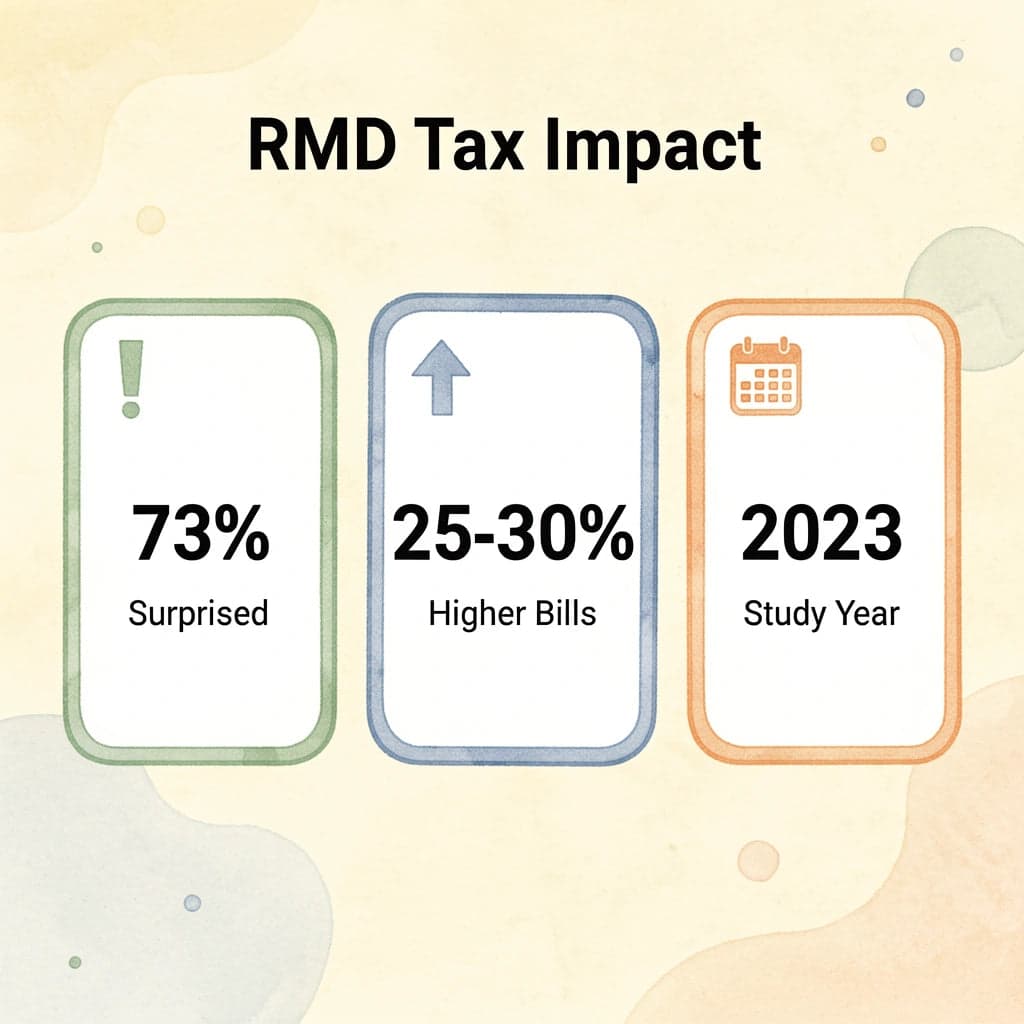
⚠️ Warning: RMDs don't just create immediate tax obligations - they can also trigger Medicare premium increases, reduce Social Security benefits, and push you into higher tax brackets for years to come.
How do RMDs push retirees into higher tax brackets?
When mandatory distributions begin, taxable income spikes higher than expected, often triggering consequences across Medicare premiums, Social Security taxation, and overall financial flexibility. Our retirement financial planning approach helps clients anticipate the impact of these distributions before they occur.
The surprise extends beyond owing taxes. A retiree might already receive Social Security and pension payments plus investment income. RMDs add to this total, pushing taxable income into higher brackets and triggering thresholds most people never considered during their accumulation years.
What happens if you miss an RMD deadline?
According to Kiplinger, missing an RMD triggers a 50% penalty on the amount not withdrawn. This serious consequence affects retirees who misunderstood distribution timing or failed to coordinate withdrawals across multiple accounts.
How do multiple income streams create unexpected tax problems?
One income stream alone rarely creates tax problems. But when Social Security, pension payments, investment gains, and mandatory RMD withdrawals converge in the same year, taxable income climbs faster than most retirees expect.
That increase can push the modified adjusted gross income high enough to trigger Medicare IRMAA surcharges, which raise Part B and Part D premiums based on income from two years prior. Healthcare costs increase not because of medical needs, but because of how retirement income accumulates.
Why does Social Security taxation surprise so many retirees?
Social Security taxation adds another layer of frustration. Many retirees assume their benefits will remain mostly untaxed, only to discover that higher combined income can make up to 85% of those benefits taxable.
They maximized contributions, diversified investments, and let accounts compound, yet distribution rules reshape their tax picture once withdrawals become mandatory.
What happens when retirees start tax planning too late?
Tax planning during retirement requires a different approach than accumulation strategies, and most people begin considering this coordination only after RMDs have started. By then, options narrow.
Vanguard reports that 6.7% of investors with a Vanguard-administered IRA did not take a required minimum distribution in 2024, demonstrating how confusing these rules remain for careful savers.
That confusion leads to penalties, missed opportunities to save money on taxes, and a nagging sense that retirement income lacks the flexibility it should have.
What RMD Taxes Actually Affect Beyond Basic Income Tax
Required Minimum Distributions don't exist in isolation; they layer on top of pensions, Social Security, part-time income, and investment returns, creating a cumulative tax burden that extends far beyond the withdrawal itself. This stacking triggers consequences across Medicare premiums, Social Security taxation, and investment income treatment simultaneously.

🎯 Key Point: Your RMD amount doesn't just create one tax bill—it pushes your total income higher, potentially triggering Medicare surcharges and making more of your Social Security benefits taxable.
"RMDs can push retirees into higher tax brackets, causing a cascading effect where Medicare premiums increase and Social Security benefits become subject to taxation." — Tax Foundation Analysis

⚠️ Warning: Many retirees underestimate the compound impact of RMDs because they focus only on the withdrawal tax while ignoring how it affects their overall tax situation across multiple income sources.
How do RMDs affect your Medicare premium costs?
Medicare uses your modified adjusted gross income from two years prior to calculate Income-Related Monthly Adjustment Amounts. When RMDs push you over certain income thresholds, Farther reports that Medicare Part B premiums can increase by $300 or more monthly for higher-income individuals. This recurring cost persists as long as your income remains elevated, transforming a required withdrawal into an ongoing reduction in retirement spending power.
Why don't retirees see Medicare surcharges coming?
The frustration stems from a timing problem: you take an RMD this year, but the Medicare surcharge doesn't appear until two years later. By the time you see the premium increase, the income event that caused it feels distant. Many retirees don't connect those dots until they've already locked in multiple years of higher premiums.
How does the provisional income formula affect Social Security taxation?
Social Security benefits aren't automatically tax-free. The IRS uses a provisional income formula that includes half your Social Security benefits plus other income sources, including RMDs. As combined income rises, more of your Social Security becomes taxable. Farther notes that up to 85% of Social Security benefits may become taxable when RMD income pushes retirees over key thresholds.
What is the double taxation effect of RMDs on Social Security?
This creates a double taxation effect: you pay taxes on the required minimum distribution itself, and that same distribution income makes previously untaxed Social Security benefits taxable. A $10,000 required minimum distribution might trigger $8,500 in additional taxable Social Security income, meaning you're effectively taxed on $18,500 of income rather than the $10,000 withdrawal.
How does the Net Investment Income Tax affect retirees?
Higher adjusted gross income from RMDs can push retirees into the Net Investment Income Tax, a 3.8% surtax on investment income for those exceeding certain income thresholds. John G. Ullman & Associates identifies this as an often-overlooked layer of taxation. Capital gains, dividends, and interest income are subject to an additional 3.8% tax once RMDs raise total income above the NIIT threshold.
What creates the compounding tax cascade effect?
The compounding effect is particularly painful. You're paying ordinary income tax on the RMD while also facing higher Medicare premiums, increased Social Security taxation, and potential investment income surtaxes. Each consequence triggers the next, creating a tax cascade that most retirees never anticipated when contributing to their 401(k) decades earlier.
Related Reading
Do Retirees Need To File Taxes
The Biggest RMD Tax Mistakes Retirees Make
The biggest RMD tax mistakes happen years before the first withdrawal. Retirees wait until age 73 to start planning when their large pre-tax balances have already locked them into a distribution path that increases taxable income, eliminating strategic options that could have reduced future tax exposure. Our Smart Financial Solution retirement planning approach identifies these opportunities earlier, when you have meaningful choices to optimize your tax strategy.

🎯 Key Point: The most costly RMD mistakes are not calculation errors or missed deadlines—they're the strategic oversights that happen in your 50s and 60s when you could have been implementing tax diversification strategies to reduce future required distribution amounts.
"73% of retirees wish they had started RMD tax planning at least 5-10 years earlier to avoid being locked into higher tax brackets during retirement." — Financial Planning Association, 2023
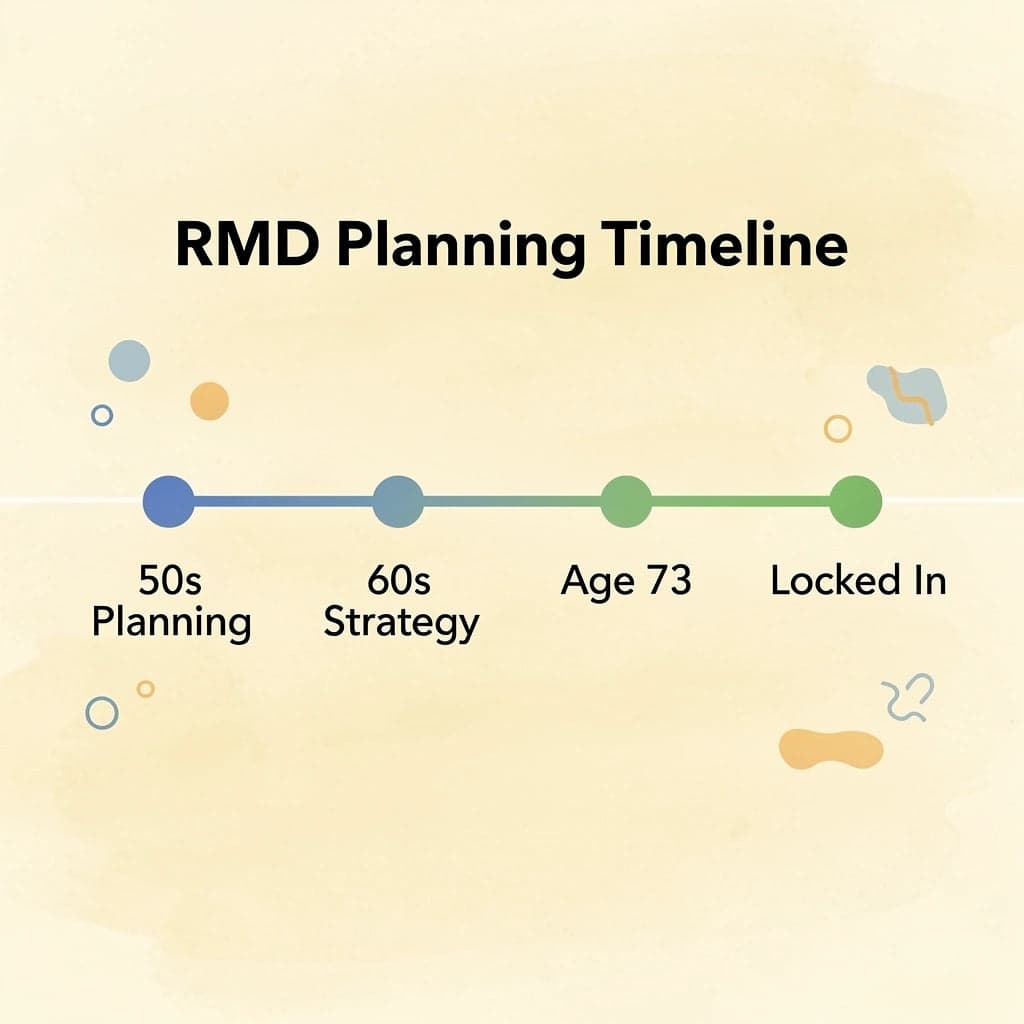
⚠️ Warning: Once you reach age 73, your RMD amounts are largely predetermined by your account balances and the IRS distribution tables. The time for proactive tax optimization through Roth conversions, strategic withdrawals, or asset repositioning is before you're required to take mandatory distributions.
Why do most people wait until the RMD age to plan withdrawals?
Most people contribute to 401(k)s and traditional IRAs for decades without planning how those accounts will create mandatory taxable income. The years between retirement and RMD age often represent the lowest-income period many retirees experience, yet few use that window strategically. Our retirement financial planning approach helps you leverage this critical window to minimize taxes before RMDs kick in. Rather than living on savings or taxable accounts while leaving pre-tax balances untouched until the IRS forces action, Smart Financial Solution can help you develop a proactive strategy.
How do RMD amounts increase over time?
Once RMDs begin, withdrawal amounts increase annually based on account balances and life expectancy tables. A retiree with $800,000 in a traditional IRA at age 73 might face a $30,000 RMD in year one, but that same account could require $45,000 or more ten years later if the balance grows. Each year, the mandatory withdrawal represents a larger percentage of the remaining balance, increasing the tax obligation over time.
Taking large withdrawals during high-income years
Some retirees cause unnecessary tax increases by stacking multiple income events into the same year: selling a rental property, completing a Roth conversion, and taking a large IRA distribution without calculating how those combine with Social Security, pension income, and investment returns. The result is taxable income that jumps into higher brackets, which they could have avoided with better timing. Our retirement financial planning approach coordinates these events to minimize tax impact.
According to CNBC, missing an RMD entirely incurs a 50% penalty on the amount not withdrawn. Retirees who take their RMDs on time often fail to coordinate those withdrawals with other taxable events, creating avoidable bracket creep.
What are Medicare IRMAA thresholds, and why do they matter?
Tax brackets get most of the attention, but Medicare IRMAA thresholds often create steeper marginal costs. A retiree might carefully manage income to stay within the 22% federal bracket while unknowingly crossing an IRMAA threshold that adds $2,000 annually to healthcare premiums. Our retirement financial planning approach coordinates tax strategy with Medicare planning to avoid these costly surprises.
The premium increase lasts for an entire year based on income from two years earlier, meaning a single large withdrawal creates a delayed cost that many people never connect to the original decision.
Why don't retirees notice the connection between withdrawals and Medicare surcharges?
The most common pattern is a retiree who completes a Roth conversion or takes a large distribution without realizing that income will appear on their Modified Adjusted Gross Income calculation two years later. When the Medicare premium notice arrives, the connection between the withdrawal and the surcharge feels invisible due to the time lag. Our Smart Financial Solution retirement planning tools bridge this visibility gap by modeling these multi-year tax implications upfront, enabling informed distribution decisions today.
What happens when you fail to coordinate withdrawals across account types?
Retirees often withdraw more from tax-deferred accounts while leaving Roth accounts and taxable brokerage balances untouched. This approach backfires once required minimum distributions (RMDs) begin, forcing larger mandatory withdrawals that could have been spread more efficiently across multiple account types in earlier years. Our retirement financial planning approach optimizes withdrawal strategies across account types to minimize tax impact and preserve wealth throughout retirement.
How does poor withdrawal sequencing affect surviving spouses?
Strategic withdrawal sequencing considers future RMD pressure, estate planning goals, and the surviving spouse's eventual tax situation. A retiree who delays all pre-tax withdrawals until RMD age might leave a surviving spouse with a massive inherited IRA that generates high taxable income precisely when that spouse has moved from married filing jointly to single filing status, where tax brackets compress significantly.
Why is timing crucial for Roth conversions?
Roth conversions can lower future withdrawal amounts, but converting too much during high-income years creates immediate tax bills that often exceed later savings. The years between retirement and required minimum distributions offer better conversion opportunities, since you no longer earn work income but haven't yet faced mandatory withdrawals.
Converting $50,000 during a year when your total income is $60,000 costs you less in taxes than converting the same $50,000 when your income is already $120,000 or more.
How do Roth conversions affect Social Security taxation?
According to Wealth Management, up to 85% of Social Security benefits may be taxed based on provisional income, which includes half of Social Security benefits plus other income sources such as RMDs and Roth conversion amounts.
Many retirees complete conversions without considering how that income affects the taxable portion of their Social Security, creating an unexpected double tax impact.
What planning approach minimizes long-term tax exposure?
Retirement tax planning means looking at multiple years simultaneously, not just lowering this year's taxes. Our retirement financial planning helps retirees see how different withdrawal plans and conversion strategies affect taxes over the long term. These tools account for required minimum distributions (RMDs), Medicare thresholds, and changes in filing status.
Strategies That Can Help Reduce Taxes on RMDs
While you cannot avoid RMDs, you can reduce the taxes you owe through planning decisions made years before your first withdrawal. You have flexibility in when you take withdrawals, which accounts you withdraw from, and how you coordinate your income across multiple retirement years.

🎯 Key Point: The timing of your RMD strategy is critical - decisions made 5-10 years before your first required withdrawal can save you thousands of dollars in taxes over your retirement.
"Strategic RMD planning can reduce lifetime tax burden by 15-25% for retirees who implement tax-efficient withdrawal strategies across multiple account types." — Financial Planning Association, 2023
RMD Tax Strategy | Best Timing | Potential Tax Savings |
|---|---|---|
Roth Conversions | 5-10 years before RMDs | 10-20% reduction |
Tax-Loss Harvesting | Ongoing coordination | 5-15% reduction |
Charitable Giving (QCD) | Age 70½ and beyond | Up to 100% of RMD |
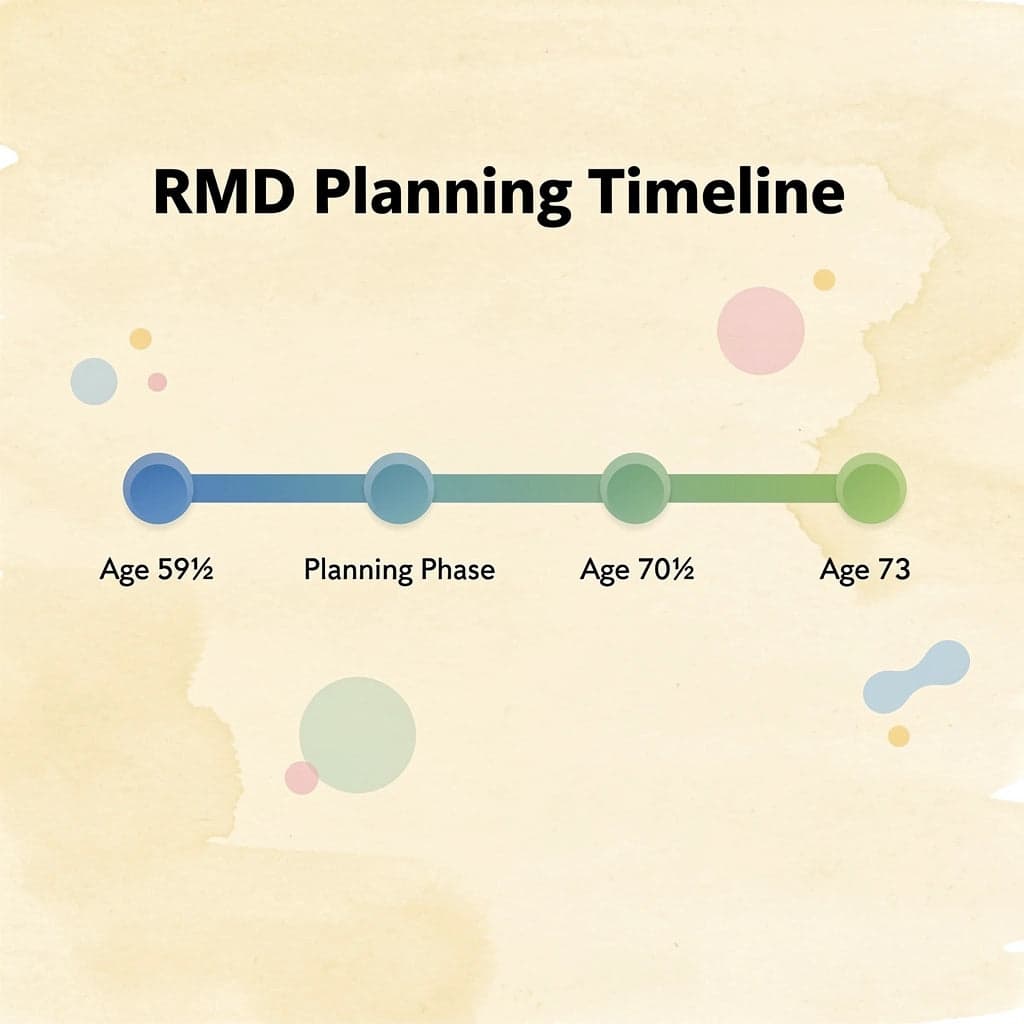
💡 Tip: Start your RMD tax planning immediately after age 59½ when you can access retirement funds without penalties - this gives you a 10-year window to implement tax-reduction strategies before mandatory withdrawals begin at age 73.
Roth Conversions Before RMD Age
Moving money from traditional IRAs into Roth IRAs before RMDs begin creates space that future withdrawals won't fill. According to Charles Schwab, missing an RMD triggers a 50% penalty on the amount not withdrawn. Roth accounts don't require lifetime RMDs for original owners, so every dollar converted earlier becomes one less dollar, forcing taxable income later. The years between retirement and age 73 often present lower-taxable-income windows where partial conversions can occur without pushing into tax brackets that Social Security and pension income will later occupy.
Tax Bracket Filling Strategy
Some retirees intentionally create income during lower-earning years to fill available bracket space before RMDs force large withdrawals into higher brackets. A retiree in the 12% bracket with room before hitting 22% might convert enough traditional IRA funds to use that space, since future RMDs will otherwise push income into higher tax brackets when combined with other retirement sources.
How do qualified charitable distributions reduce taxable income?
For retirees planning charitable contributions, Bulman Wealth Group notes that up to $105,000 per year can be donated directly from an IRA to qualified charities through Qualified Charitable Distributions. These transfers satisfy RMD requirements while potentially excluding the amount from adjusted gross income calculations.
Lower AGI reduces Medicare IRMAA exposure, decreases Social Security benefit taxation, and keeps income below thresholds that trigger compounding tax effects. The distribution goes directly from the IRA custodian to the charity, bypassing the account owner's hands and tax return.
Why does strategic withdrawal sequencing matter for long-term planning?
Taking money strategically from regular investment accounts, Roth accounts, and tax-deferred retirement accounts creates smoother income over many years instead of large spikes. Many retirees focus on this year's tax bill, not on the real cost that accumulates over twenty years of retirement income decisions.
Personalized planning frameworks, such as those offered through retirement financial planning consultations, coordinate decisions across account types, filing status changes, and shifting income thresholds that standard tax software cannot address. This approach reduces taxes on required minimum distributions while showing how each retirement decision affects downstream outcomes.
Related Reading
Why Retirement Tax Planning Requires More Than Individual Tactics
Retirement tax planning fails when it treats each decision as independent. A Roth conversion that makes sense on paper can trigger Medicare surcharges that erase the tax benefit. A withdrawal strategy that minimizes this year's tax bill can force larger mandatory distributions later. Each decision affects everything else in the system.

🎯 Key Point: Every retirement tax decision creates a ripple effect that impacts your Medicare premiums, future tax brackets, and required minimum distributions.
"A single Roth conversion can trigger Medicare surcharges that completely eliminate the intended tax savings, turning a smart strategy into a costly mistake."

Our Smart Financial Solution approach integrates these moving parts, showing how each choice impacts your complete retirement picture. We focus on coordinated strategies that work together to minimize your total tax burden across all retirement years, rather than optimizing individual tactics in isolation.
⚠️ Warning: The biggest retirement tax planning mistakes happen when advisors focus on single-year tax savings instead of lifetime tax optimization.
How does retirement income stacking affect your tax burden?
Retirement income doesn't come in separate buckets. Social Security benefits, pension payments, investment income, and RMDs stack on top of each other, pushing total taxable income higher than most retirees expect. According to the Centers for Medicare & Medicaid Services guidance, Medicare premiums can increase by up to 240% based on income.
A strategic Roth conversion during a year when capital gains or pension income run high can add $300 or more to monthly Medicare costs two years later, when IRMAA surcharges kick in based on prior income.
Why does Social Security taxation compound the problem?
The same stacking effect determines how much of your Social Security becomes taxable. When provisional income (which includes half your Social Security plus other income like RMDs) crosses certain thresholds, up to 85% of Social Security benefits become taxable. A $40,000 IRA withdrawal can turn previously untaxed Social Security into taxable income, creating an effective tax rate far higher than your regular tax bracket.
How does losing a spouse change your tax situation?
Surviving spouses face a tax trap that catches most people off guard. When one spouse dies, the survivor shifts from married filing jointly to single filing status. Tax brackets compress dramatically: the same retirement income that felt manageable under joint filing suddenly pushes the survivor into higher marginal brackets, sometimes jumping from 12% to 22% or higher on identical income.
Why do most retirement plans fail to provide for surviving spouses?
Planning that looks solid for a couple becomes punishing for the survivor, especially when RMDs continue growing while income thresholds shrink. Most retirement tax strategies assume filing status remains constant. That assumption breaks when one spouse dies, yet few couples build survivor tax exposure into their withdrawal sequencing or Roth conversion timing. By then, the window to reposition accounts has closed.
Why multi-year coordination beats annual optimization
Retirees who focus only on lowering this year's tax bill often create bigger problems later on. Delaying withdrawals to stay in a lower tax bracket today means larger account balances in the future, which, in turn, force larger RMDs once distributions are required at age 73 (according to the SECURE 2.0 Act). Growing RMDs increase taxable income, push more Social Security benefits into taxation, trigger Medicare surcharges, and reduce flexibility when unexpected expenses or health costs arise.
How do effective strategies coordinate multiple retirement factors?
The most effective strategies coordinate withdrawal timing, Roth conversions, Medicare thresholds, and survivor planning across multiple years. Retirement financial planning consultations map how income flows across decades, identifying years when extra withdrawals or conversions fit into lower brackets before RMDs, Social Security, and other income sources accumulate. Our Smart Financial Solution platform coordinates these multi-year strategies, ensuring your retirement income is optimized across tax brackets and life stages.
What aspect of retirement tax planning gets overlooked?
But even with careful planning, most people overlook one critical aspect of retirement tax planning until it's too late.
How Smart Financial Lifestyle Helps Investors Think Beyond RMD Tax Tactics
Retirement tax planning often fails when people treat each decision as an isolated event. A Roth conversion gets evaluated on this year's tax bill. A withdrawal gets timed to avoid a Medicare surcharge. An RMD gets calculated to meet the minimum requirement.

🎯 Key Point: The biggest mistake in retirement planning is treating each financial decision as a standalone event rather than part of an integrated strategy.
"The most successful retirees view their financial decisions as interconnected pieces of a larger puzzle, not isolated tax-saving tactics." — Financial Planning Research, 2024

💡 Tip: Before making any major retirement account decision, ask yourself how it impacts your overall financial picture for the next 5-10 years, not just the current tax year.
Why do isolated decisions create unintended consequences?
Each choice makes sense on its own, but together they create unintended consequences because no one mapped how the decisions connect across decades.
How does Smart Financial Lifestyle approach comprehensive tax planning?
Smart Financial Solution treats tax planning as part of a broader wealth strategy, examining how withdrawal timing, Medicare costs, account sequencing, and survivor tax exposure interact over time. This perspective stems from Paul Mauro's 50 years of managing over $1 billion in assets, where the costliest mistakes occurred when clients optimized one variable without considering ripple effects elsewhere.
What happens when retirees focus only on short-term tax savings?
A common pattern emerges when retirees focus solely on lowering taxes annually. They delay withdrawals to stay in lower brackets today, which inflates future Required Minimum Distributions (RMDs) and pushes them into higher brackets when RMDs begin at age 73. They perform large Roth conversions to reduce taxable accounts, but the temporary income spike triggers Medicare IRMAA surcharges lasting two years. They lower taxes each year without considering how a surviving spouse will face compressed single-filer brackets decades later.
Why do retirees struggle to find comprehensive tax guidance?
Many retirees struggle to find professionals who provide strategic guidance beyond annual tax preparation. CPAs handle current-year compliance well, but strategic coordination across withdrawal sequencing, Roth conversions, and Medicare-aware income planning requires a different approach. Our Smart Financial Solution platform bridges this gap by offering educational resources focused on long-term wealth preservation and demonstrating how retirement income decisions interconnect.
What does holistic retirement planning actually address?
Smart Financial Solution provides books, free YouTube content, and educational retirement planning insights that connect withdrawal coordination with tax-efficient portfolio structure and Medicare-aware income planning. The goal isn't to eliminate taxes completely—it's helping retirees understand that a Roth conversion may reduce future RMDs while temporarily increasing Medicare costs, or that delaying withdrawals may lower taxes now while creating larger survivor tax exposure later.
How does coordinated planning improve retirement outcomes?
Retirement planning works best when you consider the whole picture rather than making separate tax decisions each year. Personalized Roth IRA conversion planning consultations map out how your income flows over many years, helping you identify years when you can make extra withdrawals or conversions that fit into lower tax brackets before multiple income sources accumulate. Our Smart Financial Solution approach to retirement tax planning becomes more effective when you coordinate your decisions.
What makes implementation challenging?
But understanding the strategy is only the first step. The harder part is putting it into practice consistently across the years that matter most.
Kickstart Your Retirement Financial Planning Journey | Subscribe to Our YouTube and Newsletter
Turning strategy into action means setting up systems that keep you on track over the years when small adjustments matter most. Exploring Smart Financial Lifestyle provides access to educational resources, planning frameworks, and personalized consultations that coordinate withdrawal sequencing, Roth conversion timing, and long-term retirement tax planning.

Subscribe to our YouTube channel and newsletter for ongoing guidance based on 50 years of practitioner experience managing over $1 billion in assets. Receive step-by-step frameworks that show how coordinated tax decisions reduce lifetime tax burdens and protect family wealth across generations.
Your financial situation is unique, and the decisions you make today shape the tax landscape you'll face in your 70s and 80s. The sooner you coordinate these moving parts, the more control you maintain over the income you've spent decades building.
Related Reading