Can a 401(k) Be Rolled Into a Roth IRA? What to Know First
Rolling a 401(k) into a Roth IRA represents one of the most significant decisions retirees face when positioning their savings for tax-efficient retirement. The conversion process involves paying taxes upfront on the transferred amount, but it can provide decades of tax-free growth and withdrawals later. Understanding the mechanics, timing, and tax implications helps determine whether this strategy aligns with specific financial goals and circumstances.
Several factors influence whether a 401(k)- to-Roth IRA rollover makes financial sense, including current tax brackets, expected retirement income, and anticipated future tax rates. The decision becomes more complex when considering required minimum distributions, inheritance planning, and the ability to pay conversion taxes without touching retirement funds. Professional guidance can help evaluate these variables and develop a comprehensive retirement financial planning strategy.
Summary
Rolling a traditional 401k into a Roth IRA is legally permitted, but it triggers a taxable conversion because money moves from a pre-tax account to an after-tax structure. The converted amount gets added to your taxable income for that year, which can push portions into higher federal brackets. A $100,000 conversion could generate a $24,000 to $32,000 tax bill, depending on your existing income and filing status, not counting state taxes or potential Medicare premium surcharges that appear two years later.
The strongest conversion opportunities appear during temporary income drops, not during high-earning years. Early retirees who stop working at 60 but delay Social Security until 70 often have a five to ten-year window where taxable income falls dramatically. Converting $40,000 to $60,000 annually during those gap years can keep you in the 12% or 22% federal brackets instead of paying 24% or higher once pensions, Social Security, and required minimum distributions activate simultaneously.
The time horizon determines whether paying conversion taxes today yields enough tax-free growth to justify the upfront cost. A 45-year-old converting $100,000 has 25 to 30 years for that balance to compound without future tax interference. A 68-year-old converting the same amount may only have 10 years before withdrawals begin, which limits the tax-free accumulation period and reduces the mathematical advantage of paying taxes early.
Using retirement account funds to pay conversion taxes significantly reduces the strategy's effectiveness. When you withdraw $24,000 from the converted amount to cover the IRS bill, only $76,000 remains invested in the Roth structure. The missing $24,000 never compounds tax-free, and if you're under 59½, that withdrawal may trigger an additional 10% early distribution penalty on top of ordinary income taxes.
Medicare premium surcharges based on modified adjusted gross income create a delayed cost that most pre-retirees overlook. A large conversion executed at age 63 can trigger Income-Related Monthly Adjustment Amounts (IRMAA) at age 65, increasing monthly Part B and Part D premiums by hundreds of dollars. These surcharges last for the full year and are based on tax returns from two years prior, meaning conversion income affects healthcare costs long after the tax return is filed.
Retirement financial planning addresses this by modeling how conversion amounts interact with future Medicare costs, Social Security taxation, and required minimum distributions over multiple years, showing whether spreading conversions or executing a single large rollover yields better after-tax outcomes for your specific income timeline.
Why Many Investors Assume a Roth Conversion Is Always a Good Idea
The appeal of tax-free retirement income is strong. Roth IRA withdrawals won't trigger federal income taxes when you retire, which is why investors often view a 401(k) to Roth IRA rollover as an automatic upgrade that eliminates future tax worries.

🎯 Key Point: The tax-free withdrawal benefit of Roth IRAs creates a powerful psychological appeal that can overshadow the immediate tax costs of conversion.
"The allure of tax-free retirement income often blinds investors to the upfront tax burden and opportunity costs of Roth conversions." — Financial Planning Research, 2024

⚠️ Warning: This automatic upgrade mentality can lead to costly conversion mistakes when investors fail to analyze their current tax bracket versus their expected retirement tax situation.
The Promise of Tax-Free Growth
Roth IRAs offer tax-free withdrawals in retirement, a benefit most retirement accounts don't provide. With traditional 401(k)s, every dollar you withdraw gets taxed as ordinary income. A Roth conversion lets you pay taxes today and avoid that future tax bill completely.
This benefit becomes more appealing when considering the unpredictability of tax policy. Federal debt levels remain high, spending pressures persist, and tax rates vary with political priorities. Some investors believe locking in today's rates protects them from potentially higher rates decades ahead, preferring the known cost now over uncertainty about what Congress might do in 2040.
Freedom From Required Minimum Distributions
Traditional retirement accounts require distributions at specific ages. According to the IRS, traditional IRAs and 401(k)s require withdrawals starting at age 73 (for those born 1951–1959) or age 75 (for those born 1960+). These required minimum distributions force withdrawals regardless of need, potentially pushing you into higher tax brackets and creating unplanned taxable income.
Roth IRAs eliminate this constraint for the original owner. Your money stays invested and grows tax-free for life. You control when and how much to withdraw, not the IRS, which is valuable for those with other retirement income sources or who want to preserve wealth for heirs.
The Consolidation Advantage
If you've changed jobs several times, you might have 401(k) accounts scattered across multiple employers, each with its own login, investment options, and administrative fees. Rolling everything into a single Roth IRA simplifies your finances while offering tax advantages: one account, one statement, one set of decisions.
Managing multiple retirement accounts complicates asset allocation and rebalancing. A Roth conversion consolidates these accounts and switches them to what many investors consider a superior account type.
When Popular Advice Skips the Fine Print
Financial media regularly highlights Roth conversions as smart, proactive moves that separate savvy investors from those who haven't done their homework. Articles, videos, and retirement planning podcasts emphasize the long-term benefits of tax-free growth and distribution flexibility. The message is clear: if you're not converting, you're missing out.
What immediate costs do conversion advocates overlook?
The problem is that these conversations frequently focus on future benefits while overlooking immediate costs. A traditional 401(k) is funded with pre-tax contributions, so you haven't paid income taxes on that money yet.
When you convert assets into a Roth IRA, the IRS treats the converted amount as taxable ordinary income in the year of conversion. Converting $100,000 adds $100,000 to your taxable income for that year. Depending on your existing income, this could push portions of the conversion into the 24%, 32%, or higher federal tax brackets, plus state income taxes.
When does a Roth conversion actually make financial sense?
That creates an immediate tax bill. A Roth conversion makes sense only if your future tax rate will exceed your current rate or if you have specific estate planning goals that justify the cost. Without that context, it becomes an expensive mistake disguised as smart planning.
Whether a 401(k) rollover to a Roth IRA makes sense depends on factors most investors never figure out.
Can a 401(k) Be Rolled Into a Roth IRA?
Yes, a 401(k) can be rolled into a Roth IRA, but the taxes you pay depend on the specific type of 401(k) you have. Different types of rollovers have dramatically different tax results.

🎯 Key Point: Understanding how each type works is absolutely critical before you decide whether a rollover makes sense for your particular financial situation.
"The tax implications of a 401(k) to Roth IRA rollover can significantly impact your retirement strategy and should be carefully evaluated." — Financial Planning Association
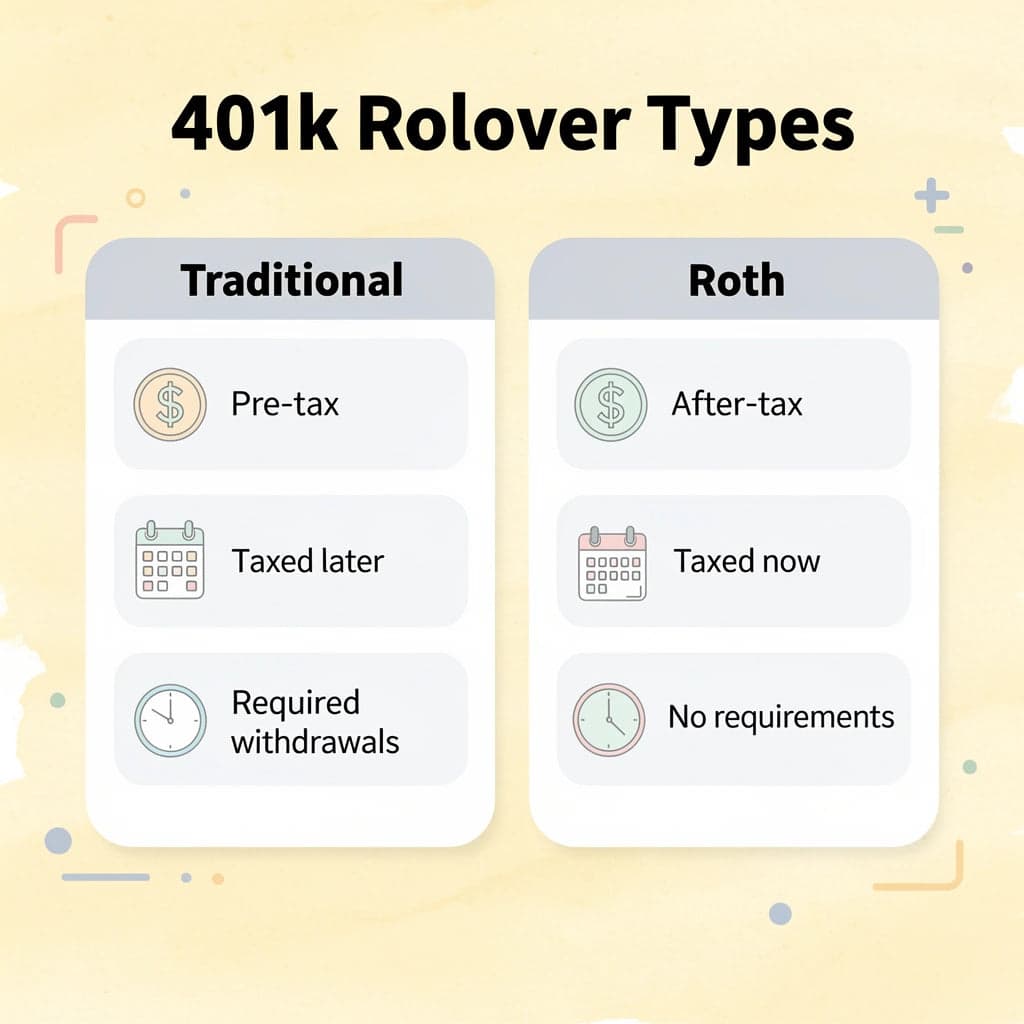
⚠️ Warning: Not all 401(k) rollovers are created equal - the tax consequences can vary substantially depending on whether you have a traditional or Roth 401(k).
Traditional 401(k) to Roth IRA
You can move money from a traditional 401(k) into a Roth IRA, but this counts as a Roth conversion rather than a tax-free rollover. The money moves from a pre-tax account into an after-tax account, triggering tax liability on the converted amount.
What are the tax implications of this conversion?
The key tradeoff is taxes. Because traditional 401(k) contributions are made with pre-tax dollars, the converted amount becomes taxable ordinary income in the year of conversion. If you convert an $80,000 balance, that full amount is taxable at your marginal tax bracket, though the money then grows tax-free inside the Roth account.
What timing requirements must you follow?
According to Titan Wealth International, the IRS enforces a 60-day deadline for indirect rollovers. Missing this deadline treats the withdrawn money as taxable income, and you may face early withdrawal penalties if you're under 59½.
Traditional 401(k) to Traditional IRA
A traditional 401(k) can usually be rolled into a traditional IRA without triggering immediate income taxes, provided the rollover is executed correctly. Since both accounts hold pre-tax retirement money, the funds retain their tax-deferred status and continue to grow without immediate tax consequences. Taxes are owed upon withdrawal.
This rollover is commonly used when you change jobs or combine retirement accounts, as the tax character of the money doesn't change.
Roth 401(k) to Roth IRA
A Roth 401(k) can usually be rolled into a Roth IRA without creating a taxable conversion, since both accounts use after-tax dollars. Assets move from one Roth account to another without triggering additional income tax, and qualified withdrawals remain tax-free.
However, the five-year holding requirements for Roth IRAs still apply. The clock for tax-free earnings withdrawals starts when you first contribute to any Roth IRA, not when you roll over a Roth 401(k).
Why Understanding the Difference Matters
Many investors assume that rolling a 401(k) into a Roth IRA works the same way regardless of account type. It does not.
A traditional 401(k) rolled into a Roth IRA is usually taxable, whereas rolling it into a traditional IRA typically is not. A Roth 401(k) rolled into a Roth IRA is also typically not taxable. This distinction significantly affects outcomes: a traditional-to-Roth rollover may create a substantial tax bill in the current year, while a traditional-to-traditional rollover generally does not.
The Contribution Limit Confusion
Some investors mistakenly believe that rolling over a 401(k) into a Roth IRA counts against annual contribution limits. It does not. Rollovers are treated separately from new contributions.
According to Empower, you can contribute up to $23,000 in 2024 to a 401(k) and up to $7,000 to an IRA, depending on your age and income. Rollovers don't reduce those limits, so you can execute a six-figure Roth conversion in the same year you max out your IRA contributions.
When the Rollover Becomes a Strategic Decision
The real question is not whether a rollover is allowed, but whether the tax consequences, timing, and long-term retirement benefits make it worthwhile for your situation. Our Smart Financial Lifestyle platform helps you model these scenarios and understand the true impact of your rollover decision.
A traditional 401(k) rollover to a Roth IRA works well in some contexts and poorly in others.
What factors should you consider before converting?
The decision depends on your current tax bracket, expected tax bracket in retirement, timeline to retirement, available cash to pay conversion taxes, legacy goals, and whether you want to leave tax-free assets to heirs.
Most people do not take these factors into account before converting. They hear "tax-free retirement income" and assume the conversion is automatically beneficial, an assumption that can prove expensive.
Why do some conversions backfire financially?
After decades of working with families, I have seen too many people convert large traditional 401(k) balances during high-income years, only to pay taxes at a higher rate than they would have in retirement.
Our retirement financial planning at Smart Financial Lifestyle helps retirees and those approaching retirement evaluate whether a Roth conversion aligns with their tax situation, family structure, and legacy goals. We run the numbers honestly so you can make an informed decision.
The Timing Question Most Investors Overlook
When you move money from a traditional 401(k) to a Roth IRA, the entire converted amount gets added to your taxable income for that year. This can push you into a higher tax bracket, trigger Medicare premium surcharges, or affect your eligibility for certain tax credits.
Poorly timed conversion can cost more than it saves. Converting $100,000 while still working at a high salary might trigger a 32% or 35% federal tax rate, versus 12% or 22% in retirement. On a $100,000 conversion, that's a $10,000 difference ($32,000 versus $22,000) for the same transaction, determined solely by timing.
What is the five-year rule for Roth IRA withdrawals?
After moving money from a Roth 401(k) into a Roth IRA, you cannot withdraw earnings without paying taxes. The Roth IRA five-year rule applies to earnings withdrawals. The clock starts when you first contribute to any Roth IRA, not when you roll over the Roth 401(k).
How does the five-year rule affect new Roth IRA owners?
If you're rolling over a Roth 401(k) but have never had a Roth IRA before, you must wait five years from your first Roth IRA contribution before withdrawing earnings tax-free (assuming you're also over 59½). You can withdraw contributions at any time without tax or penalty, but earnings are subject to the five-year rule.
What common mistake do people make with the five-year rule?
A common mistake: assuming years in a Roth 401(k) satisfy the five-year rule. The Roth IRA has its own separate five-year clock.
The Indirect Rollover Risk
A direct rollover transfers money straight from your 401(k) custodian to your Roth IRA custodian. An indirect rollover sends you a check that you must deposit into the Roth IRA within 60 days.
What happens if you miss the 60-day deadline?
The indirect rollover is riskier: missing the 60-day deadline triggers taxes on the full distribution, plus a 10% early withdrawal penalty if you're under 59½.
Why do 401k plans withhold 20% for taxes on indirect rollovers?
Additionally, 401(k) plans typically withhold 20% for taxes on indirect rollovers. You must replace that 20% out of pocket to complete the full rollover; otherwise, the withheld amount is treated as taxable income.
For example, a $100,000 rollover generates an $80,000 check with $20,000 withheld. To complete the rollover, you must deposit the full $100,000 within 60 days, which will require $20,000 from your own savings. Depositing only the $80,000 leaves the $20,000 withheld amount taxable.
The State Tax Complication
Federal taxes are only part of the conversion cost. If you live in a state with income tax, the converted amount is typically subject to state income tax as well. Rates vary significantly: some states have no income tax, while others, such as California and New York, impose rates above 10%.
Combined federal and state taxes can exceed 40% of the converted amount in high-tax states. Some retirees strategically move to a no-income-tax state before executing a large conversion, while others spread conversions across multiple years to stay in lower tax brackets. These decisions require planning.
Why consider estate planning when rolling a 401(k) to a Roth IRA?
One reason some investors roll over a traditional 401(k) to a Roth IRA, despite paying taxes upfront, is estate planning. Roth IRAs don't require withdrawals during your lifetime, allowing your money to grow tax-free indefinitely.
When you die, your heirs inherit the Roth IRA and can withdraw money tax-free, provided the account has been open for at least five years. This enables families to pass tax-free assets to the next generation.
When does the estate planning strategy make financial sense?
However, this only makes sense if you have enough money that you won't need the retirement account for living expenses. If you convert a traditional 401(k) to a Roth IRA, pay a large tax bill, and then need to withdraw the money in retirement, the conversion may not have been worthwhile.
The math only works if you can afford to leave the Roth IRA untouched, and your heirs will benefit from the tax-free inheritance. Without that context, the conversion is an expensive bet on future tax rates.
Related Reading
The Hidden Tax Cost Many Investors Don't See Coming
Many investors underestimate the immediate tax consequences of a Roth conversion by focusing only on future tax-free withdrawals. A Roth conversion is not simply moving money between accounts: the converted amount is generally added to your taxable income for that year.

🎯 Key Point: The tax impact hits immediately in the conversion year, not when you retire.
"A Roth conversion adds the converted amount directly to your taxable income for that year, potentially pushing you into higher tax brackets." — IRS Publication 590-B

When assets move from a traditional 401(k) into a Roth IRA, the tax impact can be substantial. An investor earning $90,000 who converts $150,000 may see their taxable income jump to $240,000 for that year. This can push income into higher tax brackets, depending on filing status, deductions, and other factors.
Before Conversion | After Conversion |
|---|---|
$90,000 taxable income | $240,000 taxable income |
Lower tax bracket | Higher tax bracket |
Standard tax liability | Significantly increased tax bill |
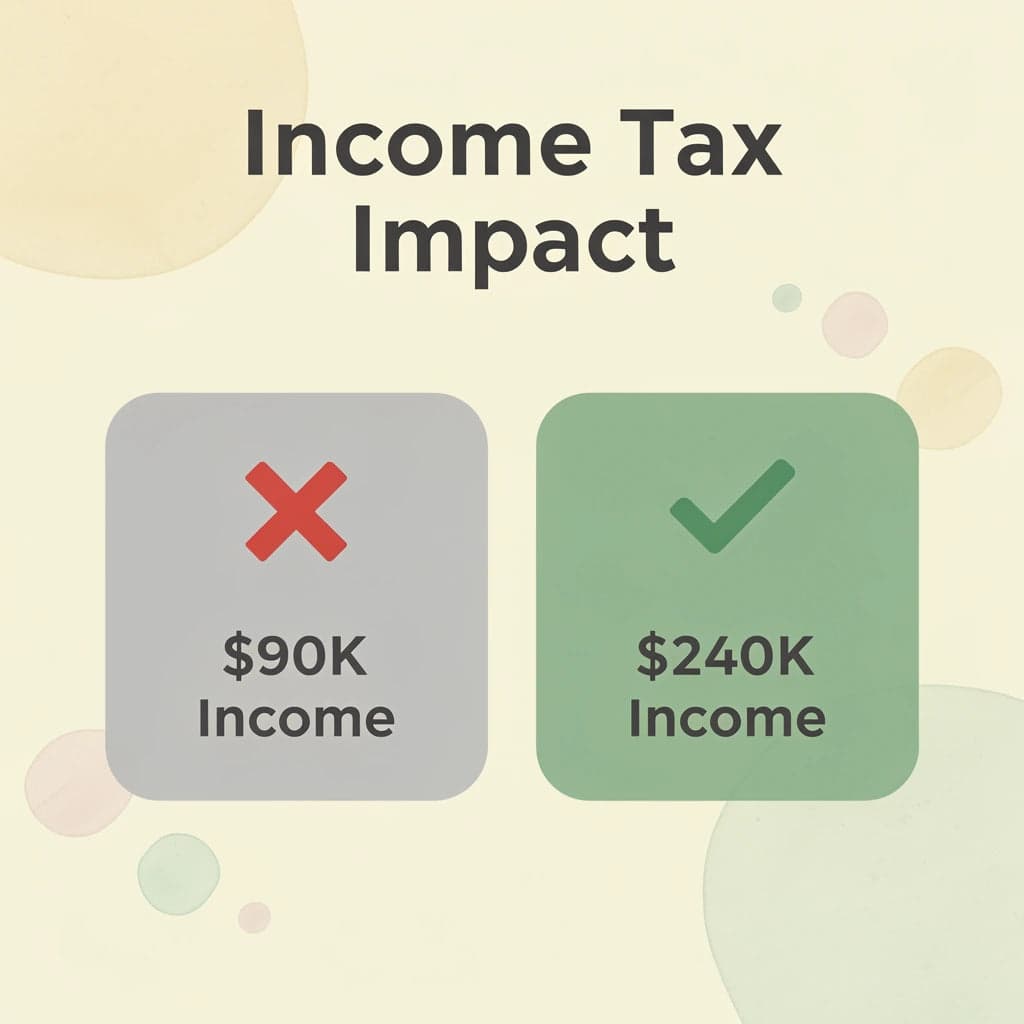
⚠️ Warning: Many investors are shocked by the immediate tax bill from conversions, especially when it pushes them into the next tax bracket or triggers additional Medicare taxes.
How Conversions Push Income Into Higher Tax Brackets
Because the U.S. tax system is progressive, large conversions can push income into higher federal tax brackets. For example, in 2025, a married couple filing jointly moves from the 22% federal tax bracket to the 24% bracket once taxable income exceeds $206,700, according to the IRS's tax inflation adjustments for tax year 2025. A large conversion may cause part of the converted balance to be taxed at higher rates than the investor originally expected. Many financial professionals evaluate conversions over multiple years rather than converting large balances at once.
Medicare Premiums Can Increase Two Years Later
Many retirees overlook another important consequence: Medicare costs. Medicare Part B and Part D premiums are subject to the Income-Related Monthly Adjustment Amount (IRMAA), which increases premiums for higher-income retirees. According to the Social Security Administration's Medicare premium structure, adjustments are based on modified adjusted gross income from prior tax years. A large Roth conversion can increase income enough to trigger higher Medicare premiums.
When the Tax Bill Becomes Unaffordable
Think about two investors. Investor A converts $20,000 from a traditional 401(k) during a year when they earn a relatively low income. Investor B converts $300,000 during a year when they earn a high salary. Both gain the same long-term Roth benefits. However, their immediate tax outcomes differ significantly. Investor A may handle the conversion with minimal tax impact. Investor B may face a larger tax bill, trigger higher Medicare costs in future years, and lose access to certain income-based tax benefits. When you convert matters.
How do tax brackets affect conversion amounts?
Most retirees assume they'll pay one flat tax on the conversion amount. They don't realize that every dollar converted is added to existing income, pushing portions into progressively higher tax brackets. A $100,000 conversion is split across multiple brackets, with the top dollars taxed at rates exceeding 30% when state taxes are factored in. That's when the math stops working.
Retirement financial planning consultations with Smart Financial Lifestyle show that spreading conversions across multiple years can save tens of thousands in taxes while achieving the same long-term Roth benefits.
When does paying higher taxes today make sense?
But there's one scenario where paying those taxes today makes sense, and it has nothing to do with guessing what future tax rates will be.
When Rolling a 401(k) Into a Roth IRA Can Make Sense
Paying conversion taxes today makes sense when your current tax situation offers a temporary advantage: your taxable income drops below your normal earnings, you have many years for tax-free growth, or you're building a tax-efficient legacy for your heirs.
🎯 Key Point: The optimal timing for a Roth conversion often coincides with temporary income dips, such as early retirement, job transitions, or sabbaticals, when you're in a lower tax bracket than usual.
"The power of tax-free growth in a Roth IRA becomes most pronounced over long time horizons, making conversions particularly valuable for younger investors or those planning multi-generational wealth transfers." — Financial Planning Research, 2024
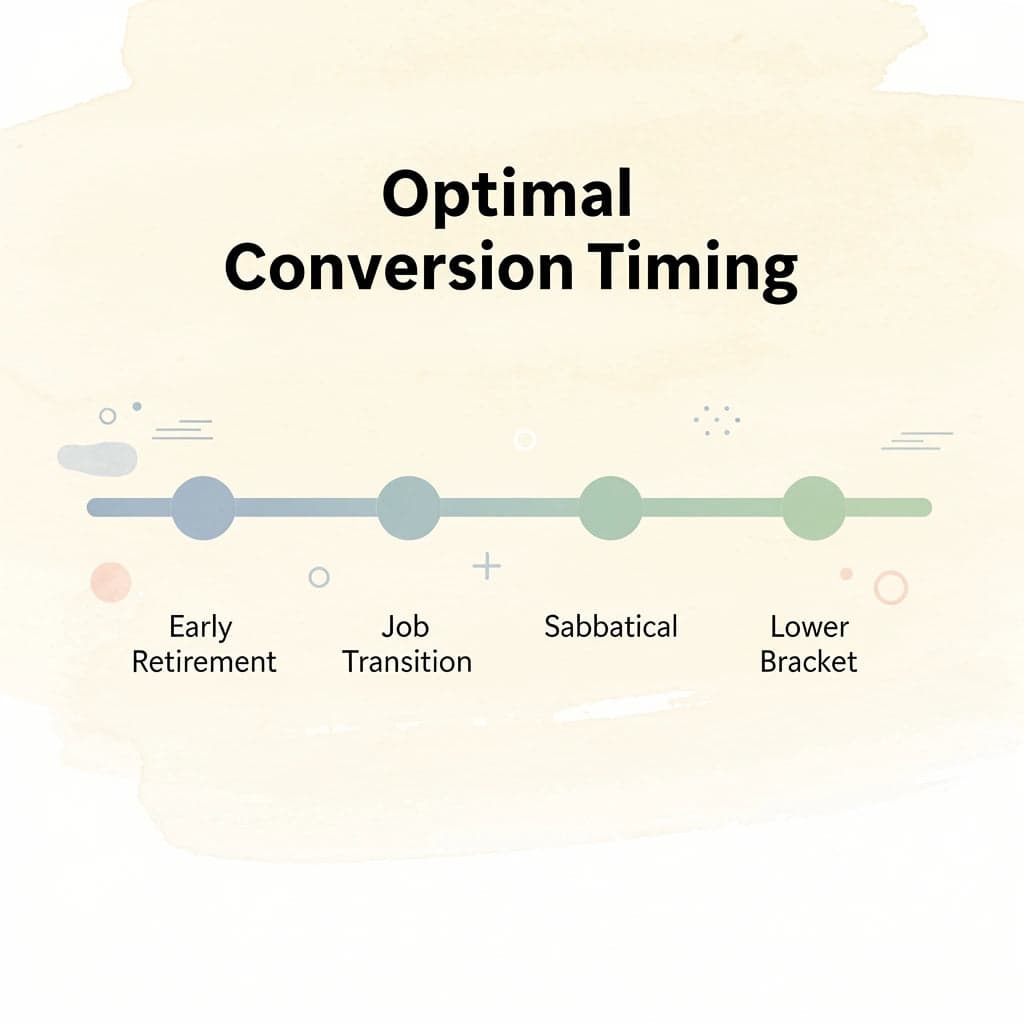
💡 Tip: Consider strategic conversion timing during years when you have significant tax deductions (like medical expenses or business losses) that can help offset the conversion tax burden and maximize your overall tax efficiency.
Lower Current Tax Bracket
The strongest case for conversion happens when you're paying taxes at a rate meaningfully lower than what you'll face later, creating a personal tax window worth exploiting.
When does the income gap strategy work best?
Think about someone earning $200,000 annually who expects retirement income from a pension, Social Security, rental properties, and traditional IRA withdrawals totaling $180,000. Their tax rate during working years might be 24% or higher. If they retire at 62 and wait until 70 to start Social Security, they could have several years where their income drops to $80,000. Converting $50,000 during those lower-income years keeps them in the 12% or 22% tax bracket, rather than paying 24% or more later when all income sources begin.
How do you calculate if the tax rate difference justifies conversion?
The maths works when the difference between current and future tax rates justifies paying taxes today. A conversion that moves you from the 12% bracket to the 22% bracket to avoid the 24% or 32% bracket later makes sense. A conversion that moves you from the 22% bracket to the 32% bracket to avoid the 24% bracket later does not.
Temporary Income Reduction
The best chances of converting occur during years when your income drops below normal, such as early retirement before Social Security starts, changing jobs, taking a work break, business slowdowns, or time between jobs.
How can gap years maximize tax-free conversions?
Someone who retires at 60 but delays Social Security and required distributions until later may have five to ten years where taxable income consists only of investment withdrawals or part-time work. These "gap years" create space to convert retirement assets while remaining in lower tax brackets. Our Smart Financial Lifestyle platform helps you model these conversion scenarios across multiple years to see how different strategies affect your tax liability.
Spreading conversions across multiple low-income years—converting $40,000 to $60,000 annually—keeps you within the 12% or 22% federal tax brackets while systematically moving assets into tax-free status. Converting $300,000 in a single year would push you into higher tax brackets. With Smart Financial Lifestyle, you can test conversion amounts and visualize the tax impact before executing your retirement financial planning strategy.
Long Investment Time Horizon
Time makes a Roth conversion more valuable. The longer your money stays invested in a Roth IRA, the more it can grow tax-free.
How do different time horizons affect conversion outcomes?
Let's compare two investors: one converts $100,000 at age 45 and leaves it invested for 25 years; the other converts the same amount at age 70 and begins withdrawals within 5 years. If the younger investor's $100,000 grows to $400,000 over 25 years, the entire $300,000 gain remains protected from future taxes.
The older investor's shorter timeframe limits total tax-free growth. Conversions work best with at least 10 to 15 years before needing the funds; shorter timeframes mean you pay taxes upfront but gain less tax-free compounding.
Estate Planning Goals
Beneficiaries inherit Roth IRA assets without paying income taxes if distribution requirements are met. Although most non-spouse beneficiaries must withdraw inherited Roth IRA assets within 10 years under the SECURE Act, qualified withdrawals remain tax-free.
How does converting during your lifetime protect heirs from higher tax rates?
Converting to a Roth during your lifetime lets you pay taxes at the rate you know now, eliminating future tax obligations for heirs who might face higher rates and preventing their income from being pushed into higher brackets by inherited traditional IRA distributions.
What's the best way to pay conversion taxes?
This strategy works best when you have money outside retirement accounts to pay the conversion taxes. Using IRA funds to pay the tax bill reduces the conversion amount and limits future tax-free growth. Paying from taxable accounts keeps the full conversion amount inside the Roth structure.
Tax Diversification
People talk extensively about spreading investments across different types, but diversifying tax treatment receives far less attention despite offering similar benefits. Placing money in accounts taxed differently provides greater flexibility in retirement. Using only one account type limits these options.
How does tax diversification work in practice?
Tax diversification means holding assets in taxable, traditional tax-deferred, and Roth accounts. This structure lets you choose where to withdraw money based on market conditions, tax laws, and income needs. Need $60,000 this year but want to avoid a higher tax bracket? Pull $40,000 from traditional accounts and $20,000 tax-free from Roth. Market down and you don't want to sell taxable investments at a loss? Use Roth funds instead.
Why does Roth conversion flexibility matter for retirement?
A Roth conversion provides flexibility by allowing you to withdraw money without increasing your tax bill on qualified distributions. This choice becomes more valuable as tax laws change, your income fluctuates, or unexpected expenses arise.
Context Matters More Than Blanket Rules
The same conversion produces different results for different investors. A conversion that creates substantial value for someone in a temporary low-income year may be less attractive for someone already in a high tax bracket. A conversion that makes sense for a 45-year-old may differ significantly for a 75-year-old.
Why isn't there a universal answer for Roth conversions?
Financial media often portrays Roth conversions as either always smart or always wasteful. Neither is correct. The real question isn't whether a 401(k) can be rolled into a Roth IRA, but whether the conversion improves your after-tax financial situation based on your specific circumstances, goals, and timeline.
How can professional guidance improve conversion decisions?
Most people handle this analysis alone, using online calculators or broad assumptions about future tax rates. As income sources multiply and estate goals become more complex, the analysis becomes harder to navigate without specialized input. Our Retirement financial planning consultations model multiple scenarios, showing how different conversion amounts affect current taxes, future income, Medicare premiums, and legacy outcomes—providing clarity that generic calculators cannot match.
Successful retirement planning requires understanding your current tax situation relative to your expected future situation, how long assets will remain invested, whether you're building wealth for spending or a legacy, and whether you have resources outside retirement accounts to cover conversion taxes without reducing the amount converted.
Related Reading
When a Roth Conversion May Be a Mistake
A Roth conversion can be powerful, but it's not right for everyone. The upfront tax cost can outweigh future benefits when the timing is poor, cash flow is tight, or the strategy doesn't align with your retirement spending plans. Poor conversions create unnecessary tax burdens as often as they unlock value.

⚠️ Warning: Converting during high-income years or when you lack cash reserves to pay the taxes can backfire spectacularly, leaving you worse off than if you'd done nothing at all.
"The biggest Roth conversion mistake is paying taxes today that you could have avoided entirely in retirement." — Tax Planning Institute, 2024

🔑 Takeaway: A poorly timed conversion can cost you thousands in unnecessary taxes while providing zero benefit to your long-term financial picture.
Why is converting to a high tax bracket problematic?
Paying taxes at today's rate makes sense only if you expect to pay more later. When your current income already puts you in a higher bracket, adding a conversion can be expensive. A $100,000 conversion might push you from the 24% federal bracket into 32%, meaning a significant portion of the converted amount gets taxed at rates you were trying to avoid.
What do retirement income patterns reveal about conversion timing?
According to Retirement Theory, many investors convert while in the 22% tax bracket or higher, assuming future tax rates will worsen. However, retirement often brings lower taxable income: Social Security may be partially tax-free, pensions are modest, and required minimum distributions are manageable. If your retirement income keeps you in the 12% or 15% tax bracket, paying 24% or 32% today to convert makes little mathematical sense.
What's the best way to pay conversion taxes?
The conversion itself doesn't cost you money out of pocket, but the taxes do. Ideally, pay conversion taxes from a taxable brokerage account, emergency fund, or other non-retirement assets. This keeps the fully converted amount in the Roth IRA, where it can grow tax-free for years or decades.
What happens when you use retirement funds for taxes?
When you withdraw part of the converted amount to cover taxes, you reduce the money that stays invested. A $100,000 conversion might require $24,000 in taxes. If that $24,000 comes from the retirement account itself, only $76,000 remains in the Roth. You may also trigger early withdrawal penalties if you're under 59½. The strategy loses power when money that could grow gets withdrawn to pay the IRS.
Converting Too Close to Retirement
Time amplifies tax-free growth. A 50-year-old converting $80,000 has 30–40 years for that money to grow without taxes. A 68-year-old converting the same amount may have only 10–15 years before needing to withdraw funds. The upfront tax paid may never be recovered through future tax savings.
Should older investors avoid conversions entirely?
Older investors shouldn't automatically avoid conversions, but the math must work harder to justify the cost. If you're leaving the Roth IRA to heirs who will benefit from decades of tax-free growth, conversion may still make sense. If you expect to spend the money soon, you're paying a large tax bill today for a benefit you may not realize.
How can you determine if conversion makes financial sense?
Platforms like retirement financial planning help model these scenarios with precision, comparing the after-tax value of converting versus staying in a traditional IRA based on withdrawal timelines, tax assumptions, and legacy intentions. Our Smart Financial Lifestyle platform lets you run these numbers with your specific situation, helping you distinguish between a smart conversion and an expensive mistake.
When Fear Drives the Decision
Investors convert for many reasons: some based on analysis, others on emotion. Worry about future tax increases, Roth IRA rule changes, or political uncertainty can prompt conversions that don't improve their financial situation. Retirement planning works best when based on your numbers, timeline, and goals, not news stories or worst-case scenarios.
Recognizing when a conversion might backfire is only part of the answer. The harder part is determining whether it genuinely improves your outcome.
How Smart Investors Evaluate Roth Conversion Decisions
Smart investors rarely evaluate a Roth conversion by asking whether they can do it. The more useful question is whether they should—examining how the conversion affects their overall financial picture, including future tax liability, cash flow needs, estate planning goals, and the opportunity cost of paying taxes today versus later.

🎯 Key Point: The decision framework should prioritize strategic fit over simple eligibility. Tax-savvy investors analyze multiple variables simultaneously to determine optimal conversion timing and amounts.
"The most successful Roth conversions aren't about maximizing the conversion amount—they're about optimizing the after-tax wealth over the investor's entire planning horizon." — Financial Planning Research, 2024
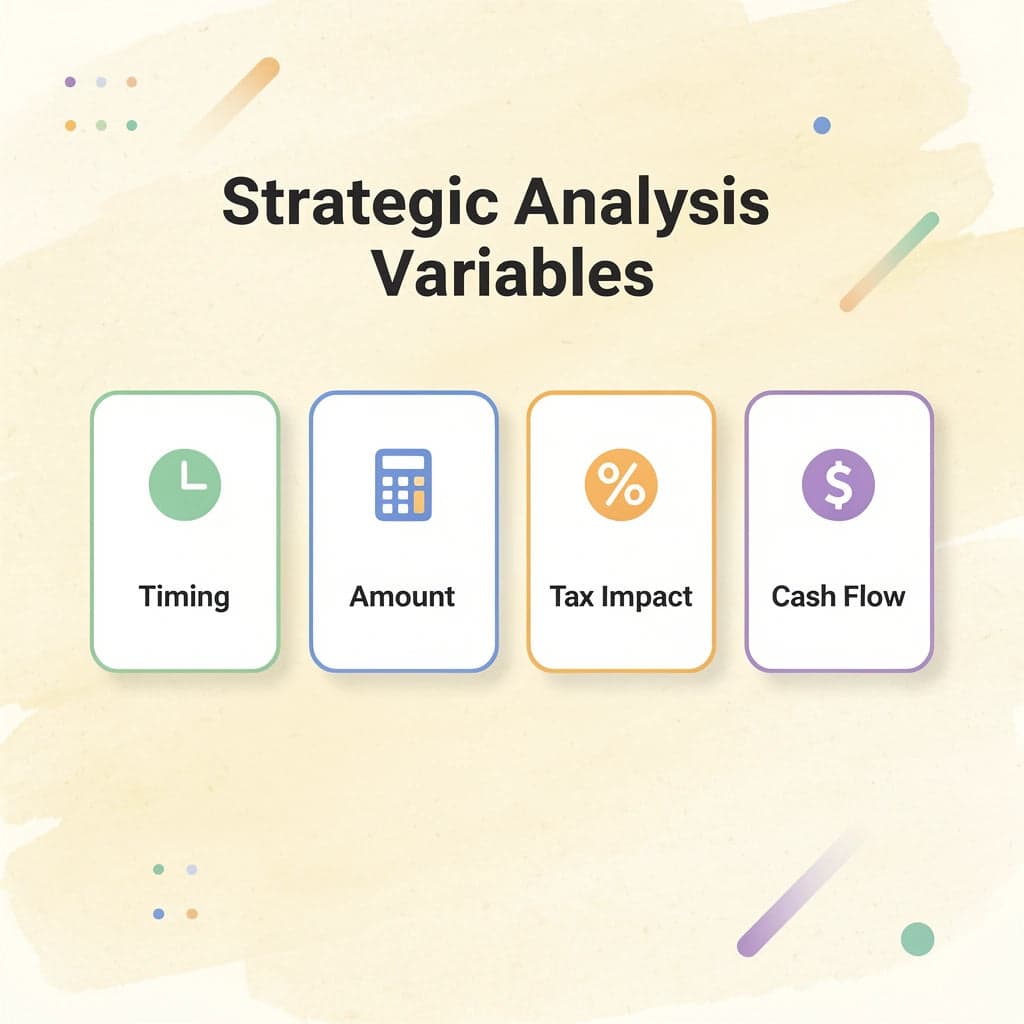
💡 Tip: Consider your current tax bracket, expected future rates, required minimum distribution timeline, and legacy planning objectives before committing to any conversion strategy. The best conversions often happen during lower-income years or market downturns when asset values are temporarily depressed.
Tax arbitrage, not tax elimination
The main idea behind any Roth conversion is tax arbitrage: you pay taxes now at your current rate to avoid paying taxes later at your expected future rate. If your current rate is lower than your expected retirement rate, the conversion creates value. If your current rate is higher, it destroys value by locking in unnecessary tax costs.
According to Vanguard's analysis, determining whether a conversion improves your financial outcome requires comparing the present value of taxes paid today against the present value of taxes avoided in the future. This comparison depends on your income trajectory, retirement spending needs, and the growth period of converted assets.
Fitting conversions into the broader plan
Experienced investors treat Roth conversions as part of a comprehensive retirement income plan. A conversion affects required minimum distributions, Social Security taxation, Medicare premiums, and the flexibility of taxable income. Ignoring these ripple effects can improve one area while creating problems elsewhere. Our Smart Financial Lifestyle platform helps you model these interconnected factors to see the full impact of conversion decisions across your entire retirement picture.
For example, converting a large amount in a single year might reduce future RMDs but trigger IRMAA surcharges two years later or push Social Security benefits into higher tax brackets. Smart planning examines how conversions interact with other income sources over time, not merely the immediate tax bill.
Why do people make emotional conversion decisions?
One of the most common mistakes is converting out of fear rather than analysis. Worry about future tax increases, political uncertainty, or changes to Roth IRA rules can push investors toward conversions that don't improve their financial position. Retirement planning works best when based on your numbers, timeline, and goals, not headlines or worst-case speculation.
How can you get personalized conversion advice?
Most people struggle to evaluate these tradeoffs because the variables are connected and the stakes are high. Retirement planning involves competing priorities and personal circumstances that resist generic advice. Platforms like Smart Financial Lifestyle offer free consultations helping retirees and pre-retirees determine whether a 401(k)-to-Roth rollover suits their situation, providing obligation-free advice tailored to their family tax rate, income needs, and legacy goals.
The question isn't whether Roth conversions are good or bad, but whether a conversion improves your outcome given your broader financial situation. That answer is rarely obvious without proper modeling.
Related Reading
Kickstart Your Retirement Financial Planning Journey | Subscribe to Our YouTube and Newsletter
Start by understanding your baseline: current tax brackets, projected retirement income sources, and legacy intentions. Our personalized Roth IRA conversion consultations are tailored to your specific situation. Paul Mauro's 50-year career managing over $1 billion in assets means you're getting frameworks tested across 1,000+ families, not generic theory.

🎯 Key Point: Your retirement strategy needs personalized analysis, not one-size-fits-all advice from someone who's never managed real wealth.
"Paul Mauro's 50-year career managing over $1 billion in assets means you're getting frameworks tested across 1,000+ families, not generic theory." — Mauro Financial Services

Subscribe to our YouTube channel and newsletter for retirement planning insights beyond surface-level tips. Your first consultation is obligation-free and clarifies whether a 401(k)-to-Roth rollover improves your outcome or creates unnecessary tax friction. The goal is to help you see your retirement strategy clearly enough to make the right decision for your family.
💡 Tip: An obligation-free consultation can save you from costly mistakes that most retirees don't discover until it's too late.
What You Get | Why It Matters |
|---|---|
Baseline Assessment | Know your current tax brackets and income sources |
Personalized Strategy | 50+ years of experience across 1,000+ families |
Clear Decision Framework | Avoid unnecessary tax friction |