Tax-Efficient Withdrawal Strategies That Help Keep More Income

You've spent decades building your nest egg, but here's something most people discover too late: it's not just about how much you save, it's about how you take it out. The difference between a smart withdrawal strategy and a haphazard one can cost you tens of thousands of dollars in unnecessary taxes over your retirement years. Understanding the timing and sequencing of your retirement account distributions can help keep more income in your pocket, where it belongs.
Knowing which accounts to tap first matters enormously for your long-term financial health. Whether you withdraw from traditional IRAs, Roth accounts, or taxable brokerage accounts first affects your tax burden and spendable income for years to come. Instead of letting the IRS dictate your retirement lifestyle through poor withdrawal choices, you can coordinate Social Security benefits, required minimum distributions, and capital gains to keep more of what you've earned through strategic retirement financial planning.
Table of Contents
Why Many Retirees Pay More Taxes Than Necessary
The Costly Belief That Retirement Withdrawals Are Simple
How Taxes Quietly Reduce Retirement Income
The Framework for Building Tax-Efficient Withdrawal Strategies
Common Withdrawal Mistakes That Can Cost Thousands
How Smart Financial Lifestyle Helps Investors Think Beyond Retirement Savings
Kickstart Your Retirement Financial Planning Journey | Subscribe to Our YouTube and Newsletter
Summary
Strategic withdrawal sequencing can preserve 1% to 2% more wealth annually compared to random or single-account approaches, according to a 2023 Vanguard study. Over a 25-year retirement, that difference compounds into tens of thousands of dollars left uncollected rather than paid to the IRS. The order in which you tap accounts matters as much as the amounts you take, yet most retirees enter their 60s without a clear plan for which accounts to tap first.
Medicare premiums aren't flat for everyone. Income-Related Monthly Adjustment Amounts (IRMAA) surcharges apply to Part B and Part D premiums based on modified adjusted gross income from two years prior. A single large IRA distribution can push standard Part B premiums from $185 per month to $259, $370.90, or even $628.90 for top earners, adding thousands in unexpected healthcare costs that compound the tax damage from the withdrawal itself.
Social Security taxation follows a hidden formula that catches millions of retirees off guard. For married couples filing jointly, once combined income exceeds $32,000, up to 50% of benefits become taxable. Cross $44,000, and up to 85% of the excess becomes taxable. A retiree who withdraws heavily from a traditional IRA doesn't just pay taxes on that withdrawal; they also trigger taxation on Social Security benefits they assumed would remain untouched.
The years immediately after retirement, but before Required Minimum Distributions begin at age 73, represent some of the most valuable tax-planning opportunities most people will ever have. Yet many retirees spend this window doing nothing, leaving tax-deferred accounts untouched. When RMDs eventually arrive, those same retirees find themselves forced into higher tax brackets with little flexibility to reduce their burden because the planning window has closed.
Two retirees with identical portfolios and spending needs can end retirement with dramatically different account balances based solely on withdrawal sequencing. Both might earn 6% annual returns and spend $75,000 per year, yet one could preserve an additional $200,000 or more over three decades simply by reducing unnecessary tax leakage through coordinated withdrawals that manage taxable income and avoid IRMAA surcharges.
Retirement financial planning addresses this by helping families model withdrawal tradeoffs across decades rather than calendar years, showing how a slightly higher tax bill today often prevents a much larger one tomorrow.
Why Many Retirees Pay More Taxes Than Necessary
Most retirees pay too much in taxes because they lack a plan for withdrawing money from their accounts. They spend decades saving for retirement but reach their 60s without a strategic approach to which accounts to use first, how much to withdraw, or when to start Social Security. Our Smart Financial Lifestyle retirement financial planning approach helps you avoid unnecessary tax bills, prevents increased Medicare premiums, and preserves your savings better than waiting until your 60s to decide.

💡 Tip: Start planning your withdrawal strategy at least 5 years before retirement to maximize tax efficiency and minimize unnecessary costs.
"Without proper withdrawal planning, retirees can pay thousands more in taxes annually than necessary, significantly impacting their retirement lifestyle." — Smart Financial Lifestyle Analysis
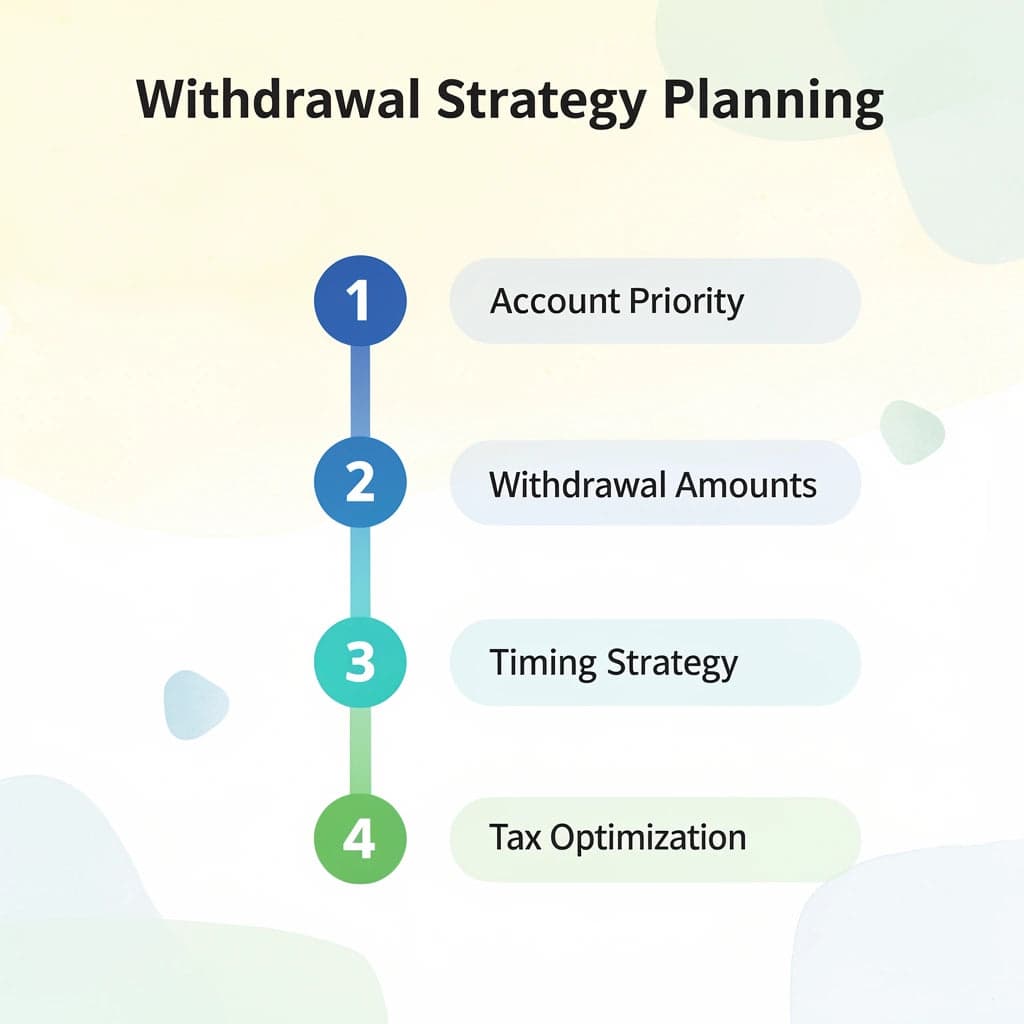
⚠️ Warning: Failing to coordinate your withdrawal strategy can trigger higher Medicare premiums and push you into elevated tax brackets unnecessarily.
Why do most retirees struggle with withdrawal decisions?
Retirement conversations rarely move past one question: how much do you need to save? Financial advisors, employer seminars, and online calculators focus on contribution limits and portfolio growth. Saving money matters, but it obscures a critical gap: building wealth and spending wealth require different skills, yet most people assume the transition will feel natural when it arrives.
What happens when you withdraw from the wrong account?
When retirees stop working, they discover their savings spread across taxable brokerage accounts, traditional IRAs, 401(k)s, and Roth IRAs. Each account follows different tax rules. Withdrawing from the wrong account at the wrong time can trigger consequences affecting your finances for years.
Why withdrawal order matters more than you think
A retiree withdrawing substantial funds from a traditional IRA increases taxable income, pushing them into a steeper tax bracket. This also makes more of their Social Security benefits taxable—up to 85% instead of 0%—and triggers Income-Related Monthly Adjustment Amounts (IRMAA), which can add thousands of dollars annually to Medicare premiums.
These effects accumulate. A single large withdrawal for a home repair or a grandchild's tuition can trigger a tax cascade lasting the entire year. Over a 20 or 30-year retirement, poor sequencing decisions cost tens of thousands, sometimes hundreds of thousands, of dollars in avoidable taxes.
Why doesn't retirement planning follow neat timelines?
Retirement planning is messy and unpredictable. Life doesn't follow neat financial timelines. Markets crash. Health emergencies happen. Tax laws change. A strategy that worked in 2015 might create problems in 2025 because Congress adjusted the rules or your income sources shifted. Generic advice fails because your situation—account balances, Social Security timing, spouse's income, state tax burden—is unique to you.
How can practitioner wisdom help with withdrawal decisions?
That's where practitioner wisdom becomes essential. Platforms like retirement financial planning translate 50 years of real-world experience into frameworks that everyday families can use. Our Smart Financial Lifestyle approach provides clear guidance rooted in what happens when retirees make these decisions, rather than guessing which account to tap or hoping your withdrawal timing works out.
But knowing you need a strategy and understanding why most people get it wrong are two different things.
Related Reading
The Costly Belief That Retirement Withdrawals Are Simple
The most dangerous assumption in retirement planning is that withdrawals work like a checking account. Retirement accounts aren't designed for simplicity; they're structured around tax rules, distribution requirements, and timing constraints that most people never consider until they've made expensive mistakes.

🚨 Warning: This dangerous belief starts during the years when you're actively saving money. For decades, the conversation has focused on how much to save, which accounts to use, and what returns to expect. Withdrawal planning gets mentioned briefly, if at all. By retirement, most people have sophisticated investment portfolios but no plan for converting those assets into income.
"Retirement accounts aren't designed for simplicity—they're structured around tax rules, distribution requirements, and timing constraints that most people never think about until they've already made expensive mistakes."
💡 Key Insight: The fundamental disconnect between accumulation and distribution phases creates a knowledge gap that can cost retirees thousands of dollars in unnecessary taxes and penalties. Smart withdrawal planning requires understanding when, how much, and from which accounts to take distributions—decisions that become irreversible once made.
How do different account types affect your tax bill?
A traditional IRA, Roth IRA, and taxable brokerage account with identical dollar amounts operate under different tax rules. Traditional IRAs are taxed as ordinary income at your marginal rate. Roth accounts distribute tax-free if you've met the five-year rule and age requirements. Taxable accounts generate capital gains taxes based on your holding period and income level. The account type determines how much you keep.
What happens when retirees miscalculate withdrawal taxes?
Most retirees discover this the hard way. They withdraw $50,000 from a traditional IRA for a major expense, only to realize they needed closer to $65,000 to cover the tax bill. That extra $15,000 withdrawal pushes them into a higher bracket, triggering additional taxes and affecting their income for years.
Why does withdrawal timing matter more than expected?
When you withdraw money, it matters more than most people realize. Large withdrawals in a single year increase your tax bill, push other income sources into higher tax brackets, and trigger higher Medicare premiums through IRMAA surcharges based on income from two years prior. Social Security becomes more taxable as well.
An $80,000 withdrawal to help a grandchild with college costs can increase your Medicare Part B premium by $2,000 annually for several years.
How do Required Minimum Distributions affect your flexibility?
Required Minimum Distributions add another layer of forced timing. According to the IRS, Americans over age 73 must withdraw a percentage of their tax-deferred accounts each year, regardless of need.
Large untouched balances grow substantially, and when RMDs arrive, they can force distributions that push you into unexpected tax brackets, eliminating your flexibility.
Where withdrawal sequencing changes outcomes
The order you withdraw from accounts matters as much as how much you take. If you withdraw heavily from traditional IRAs early in retirement while leaving Roth accounts alone, you'll pay more taxes over your lifetime than someone who plans withdrawals across different account types. A 2023 study by Vanguard found that strategic withdrawal sequencing can preserve 1% to 2% more wealth annually compared to random or single-account approaches. Over a 25-year retirement, that difference compounds into tens of thousands of dollars kept instead of paid to the IRS.
How do experienced frameworks improve withdrawal strategies?
Families who save more money for retirement often work with plans built on real-world experience. Resources like those in Smart Financial Lifestyle's retirement financial planning turn decades of expert knowledge into withdrawal strategies that account for tax brackets, RMD timing, and account coordination. Rather than reacting to expenses as they arise, you build a sequence that lowers lifetime taxes while maintaining flexibility for unexpected needs.
Where does the real tax damage occur?
But understanding that withdrawals aren't simple only matters if you know where the tax damage occurs.
How Taxes Quietly Reduce Retirement Income
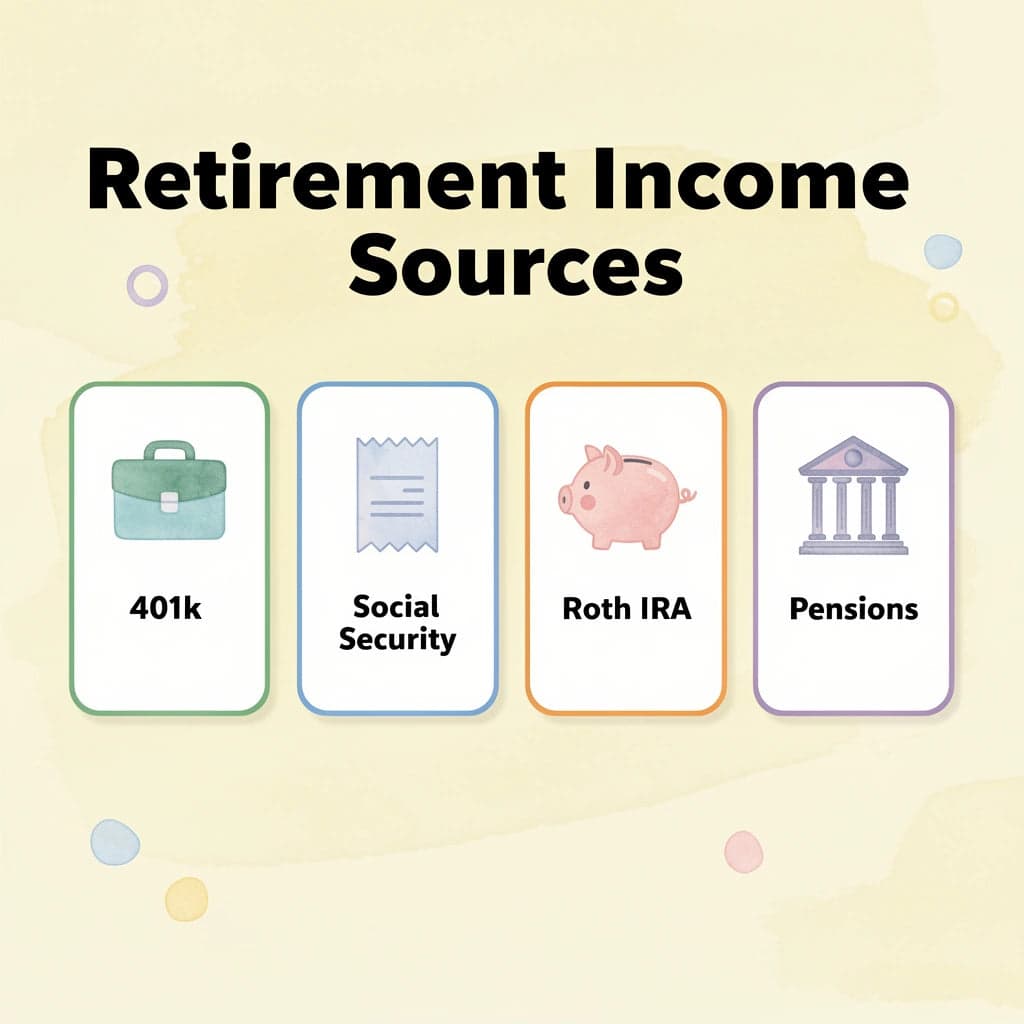
Tax damage happens through specific ways: the types of accounts you have, how much money you make, and how benefits are set up. These factors determine how much retirement money reaches your checking account each month.

🎯 Key Point: Your retirement income isn't just what you've saved—it's what you get to actually keep after taxes take their cut from every source.
"The difference between gross retirement income and net spendable income can be 30-40% or more, depending on your tax situation." — Tax Foundation, 2023

Income Source | Tax Treatment | Impact on Take-Home |
|---|---|---|
401(k) Withdrawals | Fully taxable as ordinary income | High impact - taxed at marginal rate |
Social Security | Up to 85% taxable | Moderate impact - depends on total income |
Roth IRA | Tax-free withdrawals | No impact - keeps full amount |
Pension Payments | Fully taxable as ordinary income | High impact - taxed at marginal rate |
⚠️ Warning: Many retirees are shocked to discover that their $4,000 monthly retirement income becomes closer to $2,800 after federal and state taxes, Medicare premiums, and other deductions.
How do traditional retirement account withdrawals affect your taxes?
Every dollar you withdraw from a traditional IRA or 401(k) gets added to your taxable income for that year. A $40,000 withdrawal raises your adjusted gross income, which determines eligibility for dozens of tax benefits, deductions, and credits that phase out as income increases.
What happens when you need to cover the tax bill itself?
When you withdraw $50,000 to cover yearly expenses, that entire amount gets taxed at your marginal rate. If you're in the 22% federal bracket, $11,000 disappears before you can spend it. State taxes take another bite in most places, requiring you to withdraw more from the account to cover the tax bill created by the withdrawal itself.
How does the IRS determine if Social Security benefits are taxable?
The IRS uses a formula called combined income to determine whether your Social Security benefits get taxed. Combined income includes your adjusted gross income, nontaxable interest, and half of your Social Security benefits. For married couples filing jointly, once combined income exceeds $32,000, up to 50% of benefits become taxable. Exceeding $44,000 is up to 85% taxable. Single filers face thresholds of $25,000 and $34,000.
What creates the hidden tax trap with Social Security?
This creates a hidden tax trap. A retiree receiving $30,000 in Social Security who withdraws $25,000 from a traditional IRA pays taxes not only on the $25,000 withdrawal but also on a portion of Social Security, since the withdrawal pushes combined income above the taxability threshold. According to the Social Security Administration, this taxation structure affects millions of retirees.
What are Medicare IRMAA surcharges, and who pays them?
Medicare premiums vary by income. Higher earners pay Income-Related Monthly Adjustment Amounts (IRMAA surcharges) on both Part B and Part D premiums based on modified adjusted gross income from two years prior. For 2025, individuals with income above $106,000 and married couples above $212,000 enter the first IRMAA bracket.
How much can IRMAA surcharges increase your healthcare costs?
The standard Part B premium is $185 per month in 2025. The first IRMAA bracket raises this to $259 per month, with higher brackets reaching $370.90, $482.80, or $628.90 monthly. A single large IRA distribution can trigger IRMAA surcharges for two years, adding thousands in unexpected healthcare costs alongside tax consequences from the withdrawal.
How do capital gains interact with other retirement income sources?
Taxable brokerage accounts create capital gains issues that interact with regular income in unexpected ways for most retirees. Selling appreciated stocks or mutual funds generates either short-term capital gains, taxed as ordinary income, or long-term capital gains, taxed at 0%, 15%, or 20% depending on your income level. Capital gains can push your total income over rate limits or trigger the 3.8% Net Investment Income Tax on modified adjusted gross income above $200,000 for singles or $250,000 for married couples.
What happens when capital gains push you into higher tax brackets?
A retiree sitting below the 15% capital gains tax threshold might sell investments to cover expenses, inadvertently pushing income into the 20% bracket. Combined with regular income from IRA withdrawals and taxable Social Security, the sale creates an additional tax burden. Our retirement financial planning resources help retirees coordinate withdrawals across account types and manage capital gains timing to avoid bracket creep while maintaining spending flexibility.
The Compounding Effect of Taxes Over Decades
One year of higher taxes hurts. But thirty years of paying 3% to 5% more than necessary each year can destroy your wealth. Two retirees with identical portfolios and spending needs can end retirement with vastly different account balances based solely on how they withdraw money. The first person pulls from whichever account feels easy. The second person plans withdrawals to manage taxable income, reduce Social Security taxes, and avoid IRMAA surcharges.
How much wealth can strategic withdrawals preserve over time?
Both might earn 6% annual returns and spend $75,000 per year. Yet the second retiree could preserve an additional $200,000 or more over three decades by reducing unnecessary tax leakage. This involves understanding which accounts to tap in which years, how much income to realize before crossing thresholds, and when to convert traditional IRA dollars to Roth accounts during lower-income years. Our Smart Financial Lifestyle platform provides clarity on tax-efficient withdrawal strategies to support these retirement financial planning decisions.
What retirement risk do most investors overlook?
The retirement risk many investors overlook isn't market volatility: it's the quiet, persistent drain of avoidable taxation.
The Framework for Building Tax-Efficient Withdrawal Strategies
A tax-efficient withdrawal strategy starts by identifying where your retirement money is held and how much you'll owe in taxes when you withdraw. Know how much you have in taxable brokerage accounts, traditional IRAs or 401(k)s, and Roth accounts. Without that list, every withdrawal becomes a guess rather than a planned decision.

🎯 Key Point: Your withdrawal strategy is only as good as your account inventory. Map out every retirement account with current balances and tax treatment before making any withdrawal decisions.
"The biggest mistake retirees make is not understanding the tax implications of their withdrawal sequence. A well-planned strategy can save thousands in unnecessary taxes." — Tax Planning Institute, 2023

💡 Best Practice: Create a three-bucket system to categorize your retirement assets by tax treatment. This simple framework becomes the foundation for optimal withdrawal sequencing and helps you avoid the most costly tax mistakes in retirement.
Map Your Tax Buckets First
Your retirement assets are taxed differently. Regular accounts create taxes on dividends, interest, and capital gains when you sell. Tax-deferred accounts like traditional IRAs grow without yearly tax bills, but withdrawals are taxed as regular income. Roth accounts offer qualified withdrawals that avoid federal income tax completely. Retirees who pull from whichever balance looks biggest miss the single most important tool for controlling their tax bill.
Manage Your Tax Bracket Like Income
Most retirees focus on generating enough income but ignore how it affects their marginal tax rate. A withdrawal pushing you from the 12% bracket into the 22% bracket costs more than 10% on the excess: it can trigger Social Security taxation, raise Medicare premiums, and reduce tax credit eligibility. Proactive withdrawal planning means monitoring taxable income and avoiding unnecessary spikes. In lower-income years before Social Security or required minimum distributions begin, withdrawing slightly more from a traditional IRA lets you pay tax at today's lower rate rather than waiting until future income pushes you into a higher bracket.
Coordinate Across All Accounts
The biggest mistake retirees make is draining one type of account completely before touching another. Withdrawal sequencing balances current tax obligations against future ones while preserving flexibility. Some years, pull from taxable accounts first to keep taxable income low; other years, take a controlled amount from tax-deferred accounts to prevent a massive tax bill when RMDs arrive. Roth accounts often serve as a reserve for years when unexpected expenses or higher income would push you into a higher tax bracket. Every family's situation differs based on pension income, Social Security timing, health care costs, and legacy goals. Our platform at Smart Financial Lifestyle helps retirees model these tradeoffs using real-world scenarios, showing how different withdrawal sequences affect lifetime taxes and estate values.
Why should you plan before RMDs begin?
Required minimum distributions force your hand, and once they start, your planning options shrink considerably. Many retirees wait until age 73 to think seriously about withdrawal strategy, only to discover that their tax-deferred balances have grown so large that RMDs alone push them into higher tax brackets.
Planning before RMDs begin creates opportunities to reduce future taxable income through partial Roth conversions, strategic withdrawals during lower-income years, or charitable contributions that satisfy distribution requirements without generating taxable income. Waiting until distributions become mandatory leaves little room to manage tax consequences.
What specific mistakes should you avoid?
But knowing the framework matters only if you can spot the specific mistakes that cost retirees thousands of dollars in avoidable taxes every year.
Related Reading
Common Withdrawal Mistakes That Can Cost Thousands
Most retirees lose thousands because they treat withdrawals as separate choices rather than connected decisions. Each withdrawal creates ripples beyond the current year's tax return. Pull $40,000 from a traditional IRA for a home renovation, and you might trigger higher Medicare premiums two years later. Take another $30,000 the following year for tuition, and suddenly 85% of your Social Security becomes taxable. These patterns unfold across families who thought they were making reasonable choices. Our Smart Financial Lifestyle platform helps you model these interconnected decisions before they happen, so you can see the full tax impact of your withdrawal strategy across multiple years.

"Pull $40,000 from a traditional IRA for a home renovation, and you might trigger higher Medicare premiums two years later." — Smart Financial Lifestyle Analysis, 2024
🔑 Key Takeaway: Withdrawal timing isn't just about current taxes—it's about understanding how today's decisions create cascading effects that can cost you thousands in Medicare premiums and Social Security taxation down the road.
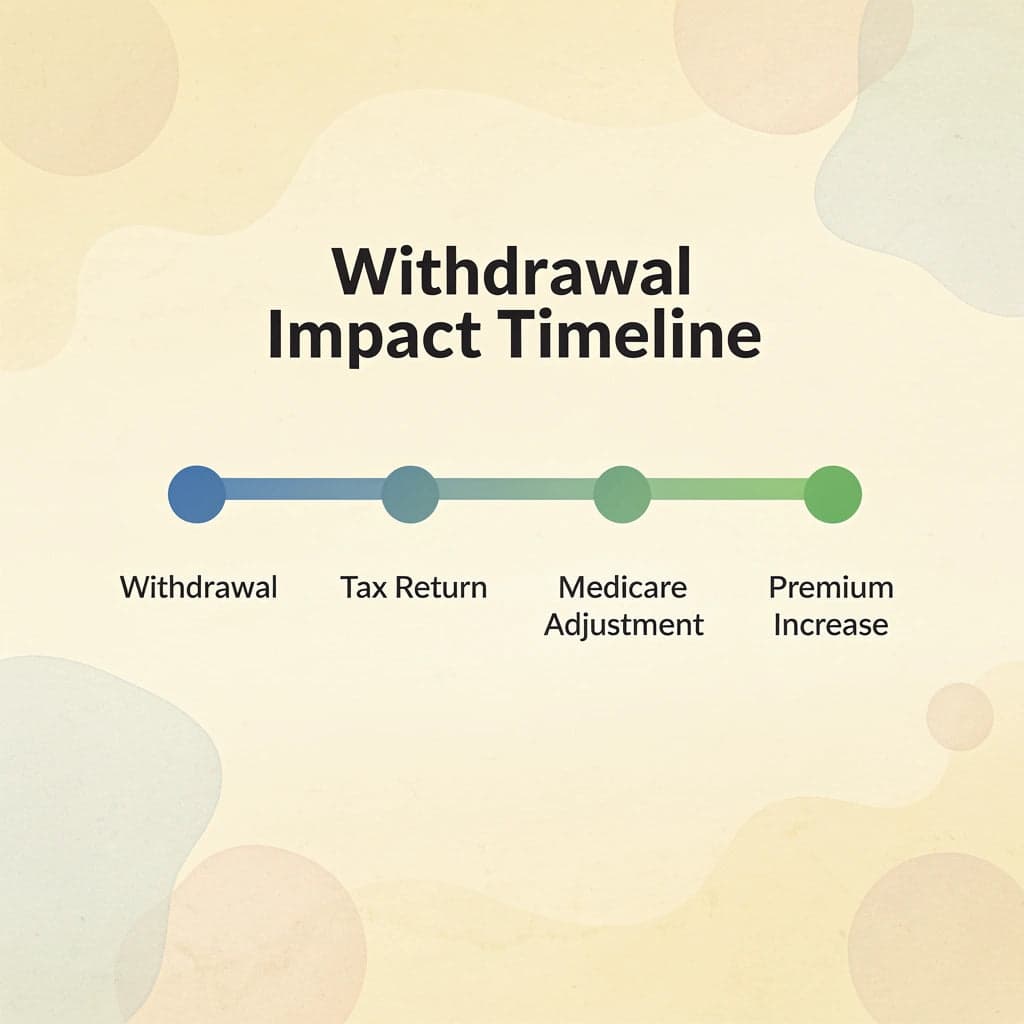
⚠️ Warning: The two-year delay in Medicare premium adjustments means many retirees don't realize their withdrawal strategy is costing them money until it's too late to reverse the damage.
Waiting Until Retirement to Think About Taxes
The years after you retire but before Required Minimum Distributions (RMDs) start at age 73 offer a valuable planning window that most people overlook. With no W-2 income, no Social Security yet, and your tax-deferred accounts untouched, retirees often take no action. When RMDs eventually start, they're forced into higher tax brackets with limited flexibility to reduce their tax burden. Our Smart Financial Lifestyle retirement financial planning approach helps you maximize this window while decisions remain optional rather than required.
Taking All Withdrawals From One Account Type
Taking money only from traditional IRAs because they have the most money creates a clear problem: each withdrawal adds to your taxable income, potentially pushing you into a higher tax bracket and triggering other tax issues. A retiree withdrawing $60,000 annually from a traditional IRA might pay 22% federal tax on much of that money, plus state taxes and extra taxes on Social Security benefits. That same $60,000 split differently—$30,000 from the traditional IRA, $20,000 from a taxable brokerage account (taxed at lower capital gains rates), and $10,000 from a Roth IRA (tax-free)—maintains your total spending while significantly lowering your tax bill. Withdrawing from only one source ignores the tax advantages built into different account types.
Ignoring Future RMD Impacts
Large tax-deferred account balances eventually become unavoidable tax liabilities. A 72-year-old with $800,000 in a traditional IRA faces required minimum distributions (RMDs) exceeding $31,000 in their first year, with the amount increasing annually as the distribution percentage rises. Combined with Social Security and other income, this can create a tax situation far worse than anything experienced during working years. Many retirees assume they'll be in a lower tax bracket during retirement, but RMDs often disprove that assumption. Postponing all withdrawals doesn't eliminate taxes; it concentrates them into years when you have the least control.
What happens when you focus only on this year's tax bill?
Paying fewer taxes this year can mean paying more taxes over your lifetime. A 65-year-old couple in the 12% tax bracket might skip withdrawals from a traditional IRA to keep current taxes low. When required withdrawals begin eight years later, they move into the 24% bracket, paying twice the rate they tried to avoid.
Taking money out strategically during years when you earn less income can lower the total taxes you pay over your lifetime by tens of thousands of dollars. Retirement financial planning with Smart Financial Lifestyle models these tradeoffs across decades, showing how a slightly higher tax bill today often prevents a much bigger one tomorrow.
Why does understanding common mistakes matter?
But knowing which mistakes to avoid only matters if you understand what you're building toward.
How Smart Financial Lifestyle Helps Investors Think Beyond Retirement Savings
What you're building toward isn't a pile of money. It's a system that delivers income, minimizes taxes, preserves wealth, and adapts to changes you can't predict today. Most financial education stops at accumulation, teaching investors how to save and invest, but leaving them unprepared for the decisions that determine whether those savings last 20 years or 35.

🎯 Key Point: The difference between 20 years and 35 years of retirement funding isn't just about having more money—it's about building a comprehensive financial system that works across multiple decades.
"The decisions that determine whether retirement savings last 20 years or 35 aren't made during retirement—they're made decades earlier during the accumulation phase." — Financial Planning Research, 2023

💡 Tip: Start thinking about your retirement strategy as a complete ecosystem rather than just a savings target. Consider tax optimization, income diversification, and wealth preservation strategies now, not when you're ready to retire.
What makes Smart Financial Lifestyle different from theoretical models?
Smart Financial Lifestyle offers frameworks built from five decades of real client work, not theoretical models. Paul Mauro spent more than 50 years managing wealth for families navigating retirement, building over $1 billion in assets under management.
The principles he teaches through Smart Financial Lifestyle come from watching thousands of retirees make withdrawal decisions, manage tax bills, and adjust plans when markets shifted or health changed. This pattern recognition stems from solving problems that only emerge after someone retires and begins living on their portfolio.
How do financial decisions connect across multiple years?
Smart Financial Lifestyle shows how financial choices affect each other over years, not months. Our platform helps you understand that withdrawing $60,000 from a traditional IRA this year might increase your Medicare premiums in two years, raise taxes on your Social Security next year, and reduce your opportunity to convert to a Roth IRA today.
Most retirees make these decisions one at a time because that's how the financial industry presents them: Medicare as a healthcare issue, Social Security as a benefit calculation, and Roth conversions as tax moves. Our Smart Financial Lifestyle approach reveals how these pieces fit together, showing you the second-order consequences before they become expensive surprises.
Why do traditional retirement courses fall short on strategy?
Retirement planning courses teach tactics (contribute to your 401(k), delay Social Security, consider a Roth conversion) without explaining when each makes sense or how they work together. Smart Financial Lifestyle helps readers understand why certain strategies work in specific situations and how to adapt them based on income sources, account balances, and future obligations.
A retiree with $800,000 in traditional IRAs and minimal Roth savings faces different tradeoffs than someone with $300,000 split evenly across account types. The goal is to build decision-making capability, not to prescribe a single path.
Personalized guidance for complex situations
Smart Financial Lifestyle offers personalized Roth IRA conversion consultations that leverage Paul's decades of experience for your specific situation. The consultations model how different conversion amounts affect taxes, required minimum distributions (RMDs), and long-term wealth preservation. A consultation might show that converting $40,000 annually for five years keeps you in the 22% tax bracket while eliminating future RMDs, or that waiting two years until pension income drops creates better conversion opportunities. The analysis is tailored to you, not a template, because retirement planning differs for each person.
But knowing what's possible matters only if you're ready to act on it.
Kickstart Your Retirement Financial Planning Journey | Subscribe to Our YouTube and Newsletter
If this article changed how you think about retirement withdrawals, explore Paul Mauro's books and free YouTube content through Smart Financial Lifestyle. You'll learn proven wealth management principles from a veteran advisor who spent decades helping clients navigate retirement income decisions. Start with a retirement withdrawal review and identify which of your accounts are taxable, tax-deferred, and tax-free to build a tax-efficient income strategy.

🎯 Key Point: Most retirees understand tax-efficient withdrawal concepts but struggle to apply them because every retirement looks different. Your Social Security claiming age, pension timing, healthcare costs, and legacy goals create a unique tax profile that generic advice can't address. Smart Financial Lifestyle provides personalized Roth conversion consultations that map your actual income sources against future tax obligations, showing you exactly where conversion opportunities exist and how much to convert each year without triggering unintended consequences.
"The next five years before RMDs begin represent your best opportunity to reduce lifetime taxes and preserve wealth for the next generation." — Smart Financial Lifestyle

Subscribe to the Smart Financial Lifestyle YouTube channel for weekly videos breaking down complex retirement tax strategies into clear, actionable steps. Paul Mauro shares real client scenarios (names changed) demonstrating how withdrawal sequencing, Roth conversions, and Social Security timing interact across different income levels and family situations. The newsletter delivers monthly insights on legislative changes affecting retirement accounts, updated tax bracket thresholds, and strategies for managing Required Minimum Distributions as rules evolve.
💡 Tip: Your retirement income strategy deserves the same attention you gave to accumulating assets. The next five years before RMDs begin represent your best opportunity to reduce lifetime taxes and preserve wealth for the next generation. Start by cataloging your accounts, estimating your future income sources, and identifying your current marginal tax bracket. Then explore whether Roth conversions, strategic withdrawal timing, or account diversification could save you tens of thousands in taxes over your retirement years.