Roth IRA Benefits and Disadvantages: Is It Right for You?

Planning for a tax-efficient retirement means making smart choices today about where you put your money and how it will grow. The Roth IRA stands out as one of the most talked-about retirement accounts, offering tax-free withdrawals in your golden years, but is it really the right fit for your financial situation? Understanding contribution limits, income restrictions, early withdrawal penalties, and how Roth accounts compare to traditional retirement options helps determine if this strategy aligns with your goals.
Evaluating whether a Roth IRA deserves a place in your portfolio requires examining real-world scenarios around tax brackets, required minimum distributions, estate planning advantages, and long-term wealth building. These accounts work alongside other investments to create the retirement you envision, but only when they match your specific circumstances. Smart Financial Lifestyle provides the framework you need for effective retirement financial planning.
Summary
Roth IRA contributions require paying taxes upfront with no immediate deduction, which means a couple earning $180,000 and contributing $15,000 to Roth accounts receives zero tax benefit that year compared to roughly $3,600 in savings from deductible Traditional IRA contributions at the 24% bracket. The decision fundamentally comes down to tax arbitrage, not account popularity, and paying higher taxes today only makes sense if you expect an even higher tax rate in retirement.
Income restrictions phase out Roth IRA eligibility once modified adjusted gross income exceeds $153,000 for single filers and $242,000 for married couples filing jointly in 2026. High earners often resort to backdoor Roth conversions, which transform straightforward retirement savings into a multi-step process requiring careful execution and sometimes professional guidance.
The 2026 contribution limit for Roth IRAs is $7,500 annually, with an additional $1,100 catch-up contribution for those 50 and older, while employer-sponsored 401(k) plans allow contributions exceeding $24,500 annually. This difference creates a real constraint for investors trying to accelerate retirement savings or catch up after a late start, making Roth IRAs better suited as a component within a diversified strategy rather than the primary savings vehicle.
Average retirement account balances reached $113,590 by late 2025, reflecting a 13% increase driven largely by employer-sponsored plan contributions and market gains, according to Bank of America's Participant Pulse report. Workers who prioritize pre-tax 401(k) contributions during peak earning years often build larger balances faster because they can shelter more income annually while reducing current taxable income.
Employer matching contributions provide an immediate return no investment can replicate, yet skipping the full match to prioritize Roth IRA contributions remains one of the costliest mistakes investors make. No Roth tax benefit can compensate for leaving free money on the table, so capturing the match should be the first priority before deciding where additional contributions go.
Retirement financial planning addresses this by helping investors over 50 evaluate Roth conversions and contribution strategies based on current tax brackets, expected future income, and coordination across multiple account types, rather than relying on generic assumptions.
Why "A Roth IRA Is Always Better" Can Be Costly
The idea that a Roth IRA is automatically the best retirement account for everyone is one of the most expensive myths in personal finance. You pay taxes today on Roth contributions in exchange for tax-free qualified withdrawals later, but that trade makes sense only if your tax rate in retirement will be higher than it is now.
🎯 Key Point: The Roth vs. Traditional IRA decision hinges entirely on comparing your current tax rate to your expected retirement tax rate — not on blanket advice.

"Choosing the wrong retirement account based on popular myths rather than personal tax situations can cost investors tens of thousands of dollars over their lifetime." — Financial Planning Research, 2023
⚠️ Warning: Many high earners fall into this trap, paying premium tax rates today (potentially 22-37%) for uncertain tax savings decades later, when their retirement income might actually put them in a lower tax bracket.
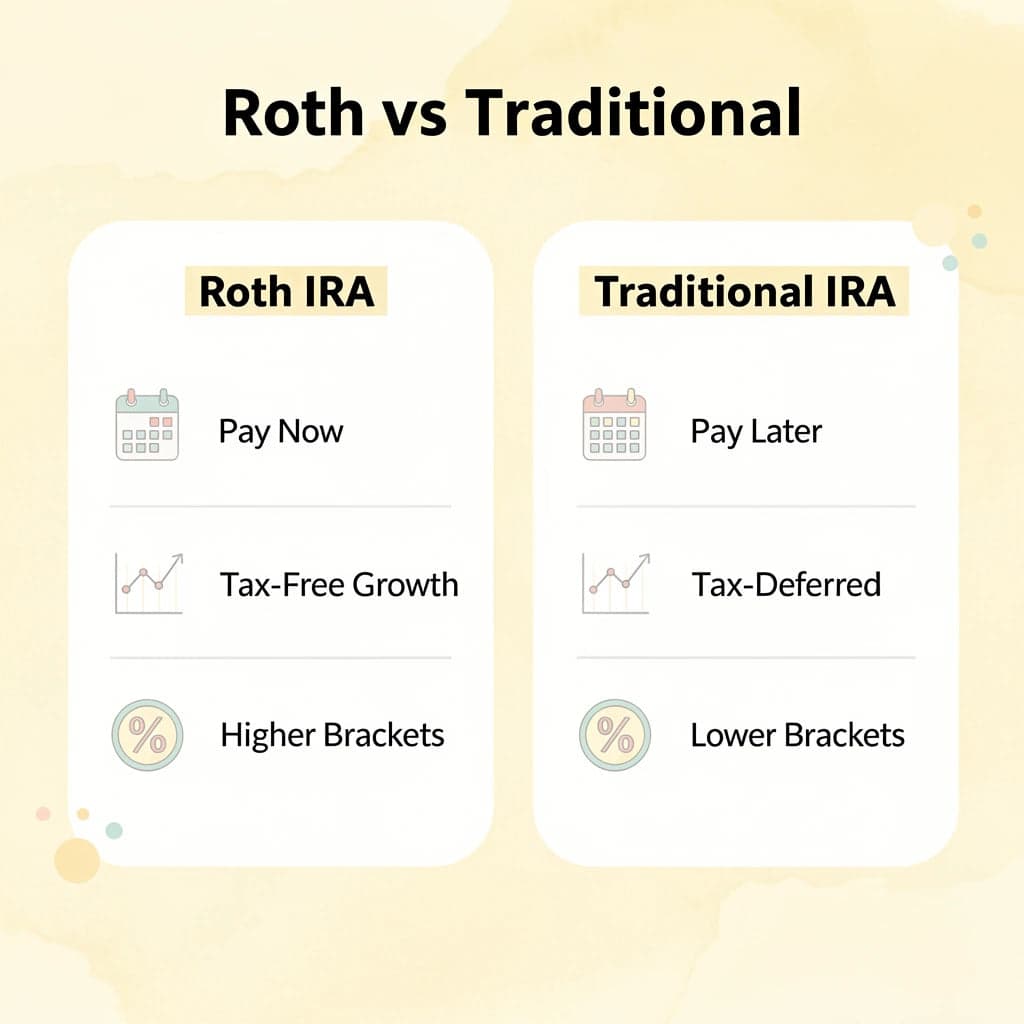
What happens when the Roth assumption is wrong?
For many investors, that assumption is wrong, and the cost surfaces decades later when they realize they paid more in lifetime taxes than necessary.
Retirement planning isn't about choosing the "best" account. It's about choosing the account that best fits your tax situation, income trajectory, and retirement timeline.
Why aren't tax brackets the same for everyone?
An investor earning $180,000 annually in the 24% federal tax bracket pays $1,680 in taxes on a $7,000 Roth IRA contribution. A deductible Traditional IRA contribution provides an immediate $1,680 tax benefit. Whether paying taxes now or later yields a better outcome depends on future tax rates and retirement income, not on generic social media advice.
How do different tax brackets affect retirement strategy?
Younger workers in the 12% or 22% tax brackets often benefit from Roth contributions due to their lower current tax rates. High earners in the 32% or 35% brackets may find Traditional IRA deductions more valuable, especially if they expect retirement income to drop significantly. The decision hinges on tax arbitrage, not account popularity.
Why do retirement income assumptions often miss the mark?
Most people assume they will pay less in taxes after retirement, but they often overlook how income works in modern times. Social Security benefits, pension payments, rental income, taxable investment distributions, required minimum distributions from Traditional IRAs and 401(k)s, and ongoing business interests can accumulate significantly, keeping taxable income surprisingly high for many decades.
How should contribution limits factor into your decision?
According to U.S. Bank, the 2026 contribution limits for Roth IRAs are $7,000 for those under 50 and $8,000 for those 50 and older. If your retirement income remains high, a Roth IRA lets you pay taxes now. If retirement income drops significantly, a Traditional IRA could save more on taxes over your lifetime. Retirement tax planning should reflect your circumstances, not general rules.
What income limits affect Roth IRA eligibility?
Roth IRAs include income restrictions that many investors overlook until they exceed them. High-income earners may face reduced contribution limits or become ineligible for direct Roth IRA contributions, requiring alternative strategies such as backdoor Roth conversions or other retirement accounts.
How do income restrictions complicate retirement planning?
As income rises, retirement planning becomes more complex. Employer-sponsored retirement plans with matching contributions, Traditional 401(k) contributions that reduce current taxable income, Health Savings Accounts with triple tax advantages, and Traditional IRAs for immediate tax deductions all compete for the same dollars. The most effective retirement plans combine multiple account types rather than relying on a single option.
The Real Cost Is Following Advice Without Context
The biggest mistake investors make is choosing a Roth IRA without understanding why. Many people build retirement plans around headlines, social media advice, or general rules of thumb, picking accounts that fit someone else's situation instead of their own. A Roth IRA can be an excellent retirement tool or the wrong choice for certain investors at certain life stages.
Understanding which situations favor Roth accounts requires knowing their advantages.
Related Reading
The Biggest Benefits of a Roth IRA
The main advantage of a Roth IRA is that your money grows without taxes in retirement. You pay taxes on contributions now, but then enjoy decades of growth without paying federal income tax when you retire, provided you meet IRS requirements.

🎯 Key Point: The tax-free growth potential of a Roth IRA becomes exponentially more valuable over time, making it an essential retirement planning tool for younger investors.
"The power of tax-free compounding in a Roth IRA can result in hundreds of thousands of dollars in tax savings over a 30-year retirement period." — Financial Planning Association
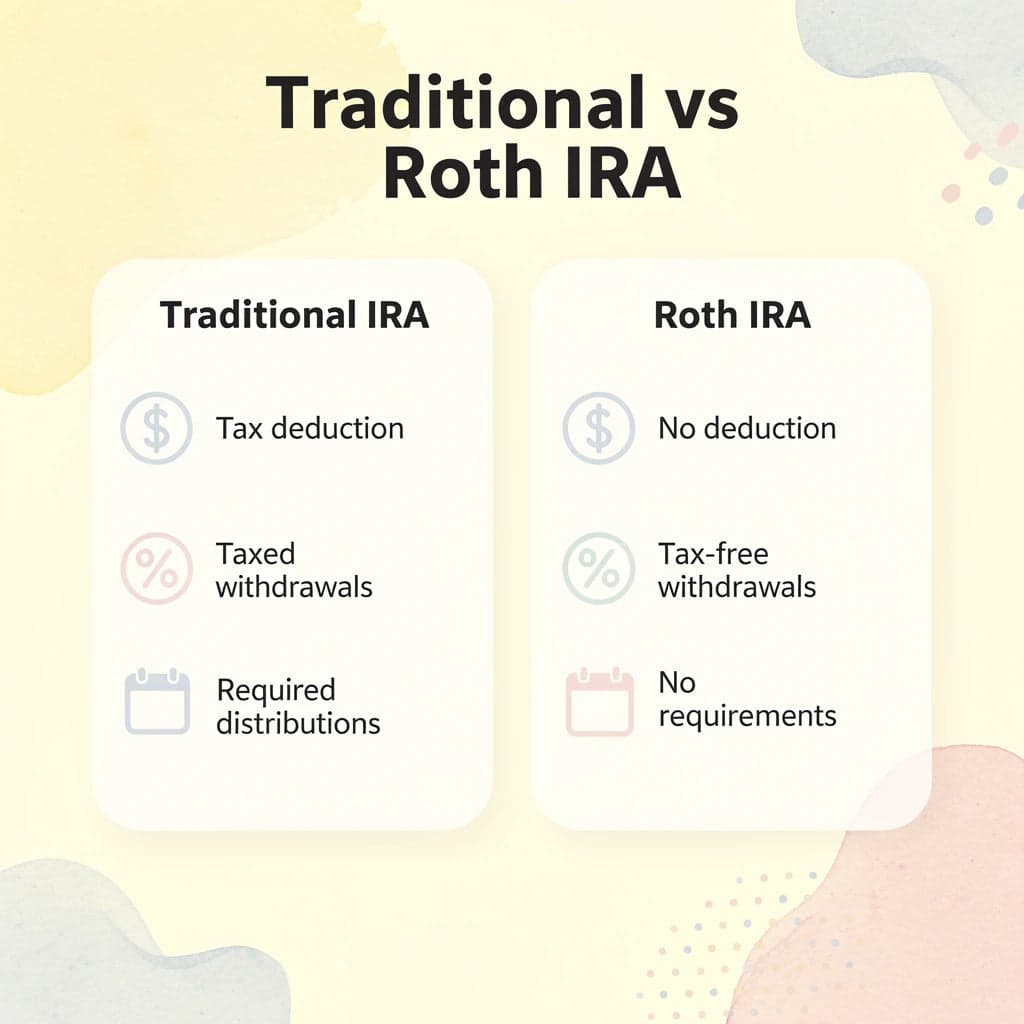
💡 Tip: Unlike traditional IRAs, Roth IRAs have no required minimum distributions during your lifetime, giving you complete control over when and how you access your retirement funds.
Tax-Free Qualified Withdrawals
Money withdrawn from a Roth IRA that meets certain rules is not subject to federal taxation, including both contributions and earnings. This allows you to predict your income precisely, knowing exactly how much buying power your balance provides, unlike regular retirement accounts, where future tax liability remains uncertain.
For retired people with income from multiple sources, Roth withdrawals offer important flexibility. They don't add to your adjusted gross income, so they won't push you into a higher tax bracket or increase your Medicare premiums based on income. This control helps when deciding how much to withdraw from different accounts to minimize your overall tax burden.
How does tax-free compounding work over time?
The power of a Roth IRA comes from compounding. Investment gains, dividends, and capital appreciation grow without yearly tax bills. If withdrawal requirements are met, those gains can be accessed tax-free in retirement.
A 30-year-old who consistently contributes for 35 years may build significantly more after-tax wealth than someone investing through a fully taxable account, since future investment growth avoids ongoing taxes.
What's the difference compared to taxable accounts?
Consider two investors who each contribute $7,000 annually for 30 years, assuming an average annual return of 7%. The person with a regular taxable account pays taxes on dividends and capital gains each year, and again upon withdrawal. The Roth IRA owner pays taxes only on the initial contributions.
Over three decades, that difference can represent tens of thousands of dollars in additional after-tax wealth.
No Required Minimum Distributions
Roth IRAs don't require withdrawals during your lifetime. Traditional IRAs and 401(k)s mandate withdrawals starting at age 73 (as of 2025), regardless of need. This flexibility allows you to optimize your tax planning and control when you access retirement funds.
How does this benefit legacy planning and Medicare costs?
For legacy planning, assets can continue to grow tax-free and pass to beneficiaries under more favorable conditions than in traditional accounts. Without RMDs, you avoid forced taxable distributions that could increase Medicare premiums or reduce Social Security benefits through income-based adjustments.
What should you consider when choosing between account types?
Most people think all retirement accounts work the same way. According to T. Rowe Price, the 2025 IRA contribution limit of $7,000 (or $8,000 for those 50 and older) applies to both Roth and Traditional IRAs, but they treat taxes differently over time.
Figuring out which account works for your tax bracket and expected future earnings requires more than general advice. Our retirement financial planning resources help investors over 50 evaluate Roth conversions and contribution strategies tailored to their situation.
Tax-free growth and flexible withdrawals matter only if a Roth IRA fits your financial situation.
The Often-Ignored Disadvantages of a Roth IRA
A Roth IRA requires you to contribute money that has already been taxed, so you cannot deduct it immediately. It also limits who can use it based on income level and caps annual contributions. For some investors, these trade-offs can undermine the tax savings they seek.

🎯 Key Point: Unlike traditional IRAs, Roth contributions offer no immediate tax relief, which can significantly impact your current tax burden and cash flow.
"The lack of upfront tax deduction with Roth IRAs means you're paying today's tax rates on contributions, which could be higher than your future retirement tax bracket." — Tax Planning Research, 2024

⚠️ Warning: High earners face a complete phase-out of Roth IRA eligibility, and even moderate earners may find their contribution limits reduced based on income thresholds that haven't kept pace with inflation.
No Immediate Tax Deduction
You pay taxes today with no break on this year's return. A married couple earning $180,000 and contributing $15,000 to Roth IRAs receives zero tax benefit for that year. With deductible Traditional IRA or 401(k) contributions instead, they could reduce their federal tax bill by roughly $3,600 at the 24% bracket.
That doesn't make the Roth wrong. It means you're betting that paying taxes now will prove cheaper than paying them later. If you retire into a lower bracket or your income drops unexpectedly, you've locked in a higher tax rate permanently, and the IRS doesn't refund the difference.
Income Limits Can Restrict Access
Roth IRAs phase out as income rises. For 2026, single filers lose eligibility once modified adjusted gross income exceeds $153,000, with full phase-out at $168,000. Married couples filing jointly face limits starting at $242,000 and a complete phase-out at $252,000, according to IRS contribution limits and phase-out ranges. Direct Roth contributions disappear entirely once income crosses these thresholds.
High earners often turn to backdoor Roth conversions, which add complexity and potential tax complications.
What makes opportunity cost so significant with Roth IRAs?
The most overlooked disadvantage isn't what a Roth IRA costs today: it's what it might cost over decades if your tax situation changes. Peak earners in the 32% or 35% bracket who retire into the 12% or 22% bracket effectively overpaid by choosing Roth contributions during high-income years.
Why do retirement income assumptions often prove wrong?
Most investors assume tax rates will rise or retirement income will remain high. Both assumptions can prove wrong. Social Security may replace less income than expected, required minimum distributions might fall short of projections, and retirement spending often declines with age. When retirement income drops below peak working-year earnings, every dollar paid in Roth taxes becomes a permanent loss compared to the deduction you could have claimed.
How do contribution limits affect your wealth-building potential?
You can contribute only $7,500 each year to a Roth IRA in 2026, with an extra $1,100 catch-up contribution if you're 50 or older, based on IRS 2026 IRA contribution limits. Employer-sponsored plans allow contributions of over $23,000 annually, providing significantly more room to build wealth. For investors seeking to accelerate retirement savings, these limits can feel restrictive.
Why should Roth IRAs be part of a diversified strategy?
This makes Roth IRAs better suited as one part of a diversified retirement strategy rather than the main savings vehicle. Determining your current tax bracket and expected future income requires more than general advice. Frameworks like those in retirement financial planning help investors over 50 assess Roth conversions and contribution strategies based on specific circumstances rather than generic assumptions, particularly when balancing multiple account types and income sources. Our Smart Financial Lifestyle platform simplifies evaluating these decisions across your entire financial picture.
The most effective retirement strategies match account types to tax situations, income levels, and long-term goals. A Roth IRA can be powerful, yet the wrong choice for certain households.
Related Reading
When a Roth IRA Makes the Most Sense
A Roth IRA creates the most value when you're currently paying lower taxes than you'll face in retirement—typically for younger workers, early-career professionals, or anyone expecting significant income growth. The decision hinges on one question: will your tax rate be higher or lower when you withdraw the money?

🎯 Key Point: If you're in a low tax bracket now but expect to earn significantly more later in your career, paying taxes upfront with a Roth IRA can save you thousands of dollars in retirement.
"The power of tax-free growth becomes most apparent for younger investors who have decades for their investments to compound without tax drag." — Financial Planning Association, 2024

Ideal Roth IRA Candidates | Why It Makes Sense |
|---|---|
Recent graduates | Currently in low tax brackets, high earning potential |
Early-career professionals | Income growth expected over the next 10-20 years |
Young entrepreneurs | Variable income, potential for significant wealth building |
Military personnel | Often in lower tax states, a steady promotion track |
⚠️ Warning: If you're already in a high tax bracket and don't expect your income to grow substantially, a traditional IRA might offer better immediate tax savings than a Roth IRA's future tax-free withdrawals.

Younger Investors and the Power of Time
Time is the advantage no one else can copy. A 25-year-old contributing to a Roth IRA has 30 to 40 years for tax-free growth. For someone making $45,000 a year in the 12% tax bracket, paying $840 in taxes on a [$7,000 contribution limit for 2025] costs far less than paying 22% or 24% on decades of accumulated retirement funds.
Workers Expecting Higher Future Earnings
Many professionals spend their early years in lower tax brackets before promotions, bonuses, and salary increases push them into higher rates. A recent college graduate earning $55,000 today may face a steeper tax burden ten years later after advancing into management or a specialized profession. Locking in today's lower tax rate makes future tax-free withdrawals more valuable than deferring taxes and paying higher rates later.
Which career paths see the greatest advantage from early Roth contributions?
This pattern applies across careers: young physicians in residency, attorneys building practices, entrepreneurs launching companies, and business owners in growth phases benefit from Roth contributions during lean years, paying taxes when income is low and withdrawing tax-free when needs are substantially higher.
Tax Diversification in Retirement
Most retirees keep their retirement money in tax-deferred accounts like Traditional IRAs and 401(k)s. Every withdrawal increases your taxable income, potentially moving you into a higher tax bracket or raising your Medicare premiums. A Roth IRA works differently: withdrawals taken correctly incur no taxes. This means retirees can access Roth funds without increasing their federal tax liability. This flexibility—called tax diversification—gives retirees more control over annual spending in retirement. Our Smart Financial Lifestyle platform helps you model different withdrawal strategies to optimize your retirement tax situation.
But what happens when your current tax bracket is already high, or when other retirement accounts offer better benefits?
When Other Retirement Accounts May Be Better
A Roth IRA isn't the best choice for every retirement dollar. If you're in a high tax bracket now, expect lower income in retirement, have access to employer matching, or qualify for a Health Savings Account, other retirement accounts may provide better after-tax results. The best strategies use multiple account types rather than concentrating funds in a single account.

🎯 Key Point: High earners who expect to be in a lower tax bracket during retirement should prioritize traditional 401(k)s and traditional IRAs for the immediate tax deduction.
"Diversifying across multiple retirement account types can reduce overall tax burden by 20-30% compared to using just one account type." — Tax Planning Research Institute
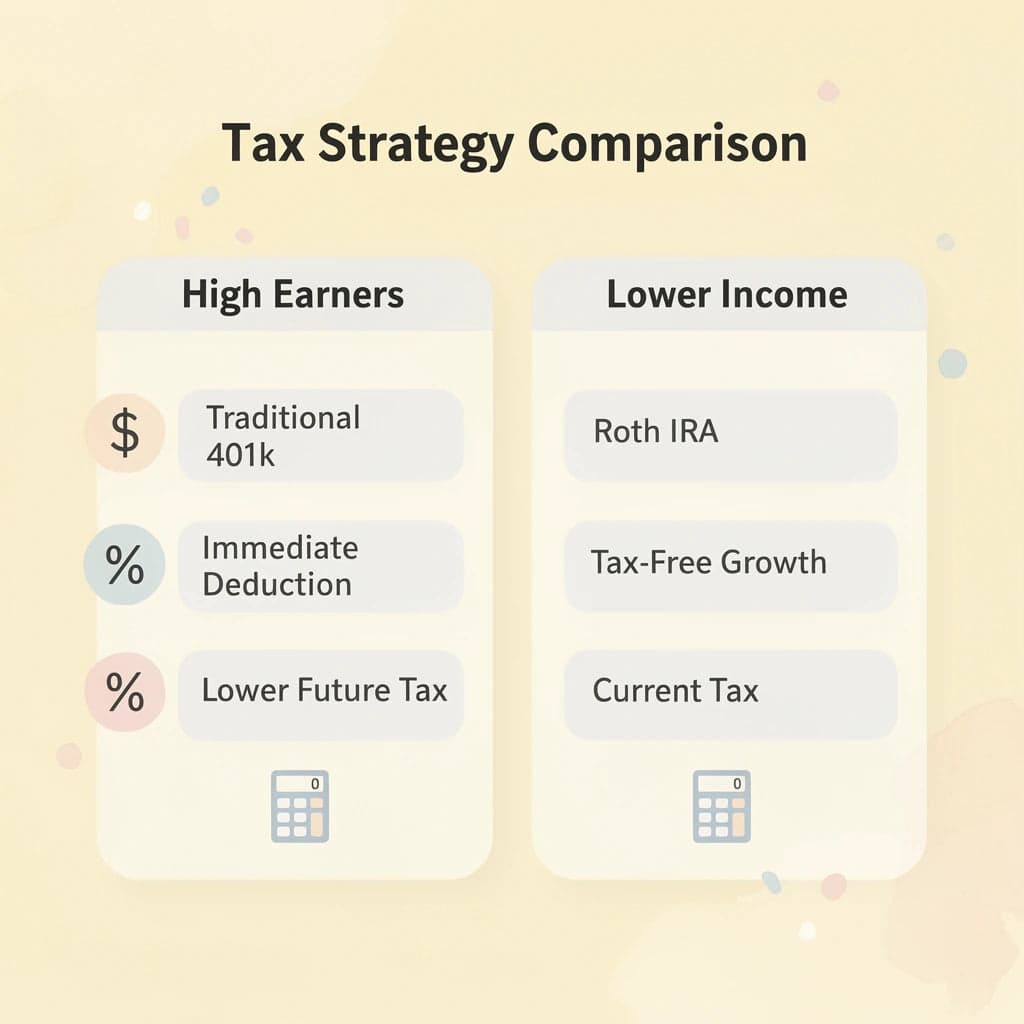
⚠️ Warning: Don't ignore employer 401(k) matching – it's an instant 100% return on your contribution that typically beats any Roth IRA advantage.
How do traditional IRAs provide immediate tax relief?
If you're earning $150,000 and sitting in the 24% federal bracket, a $7,000 Roth IRA contribution costs you $1,680 in taxes paid upfront. A Traditional IRA contribution returns that $1,680 as an immediate deduction, reducing your current-year tax bill and freeing up cash for other priorities.
When does paying taxes now make little sense?
This advantage matters most when you expect retirement income to drop. If you plan to live on $60,000 annually in retirement (putting you in the 12% bracket), paying 24% now to avoid 12% later makes no mathematical sense. You've locked in a higher tax rate when waiting would have saved you money.
The decision comes down to tax arbitrage: deferring taxes through a Traditional IRA works better for long-term wealth if your retirement tax rate is lower than your current one.
How do employer contribution limits compare to Roth IRA limits?
For 2026, you can contribute up to $24,500 each year to a 401(k), compared with $7,500 for an IRA—a significant difference for investors seeking to maximize retirement savings through Roth accounts alone.
Why do employer plans help build larger balances faster?
According to Bank of America's Participant Pulse report, the average retirement account balance reached $113,590 by late 2025, reflecting a 13% increase driven by employer-sponsored plan contributions and market gains.
Workers who prioritize pre-tax 401(k) contributions during peak earning years build larger balances faster by sheltering more income annually while reducing current taxable income.
If you're earning $200,000 and want to save aggressively, a Roth IRA alone won't suffice. Traditional 401(k) contributions let you defer taxes on a much larger amount, which can matter more than tax-free withdrawals decades later.
Employer Matching Contributions Deserve Priority
An employer match gives you an immediate return that no investment can match. If your company matches 100% of contributions up to 5% of salary, you're doubling that portion of your retirement savings with no market risk. Skipping the full employer match to prioritize Roth IRA contributions is one of the biggest mistakes investors make—no Roth tax benefit compensates for leaving free money on the table. Get the match first, then decide where additional contributions should go.
How do HSAs compare to Roth IRAs for tax advantages?
For investors with access to a qualifying high-deductible health plan, an HSA offers three tax benefits: tax-deductible contributions, tax-free growth, and tax-free qualified withdrawals. This compares to the Roth IRA's two benefits: tax-free growth and withdrawals, but no upfront deduction.
What makes HSAs better for high earners?
HSAs have no income limits, unlike Roth IRAs. If you earn too much to contribute to a Roth IRA, an HSA offers a better tax-saving option. Many financial professionals view HSAs as hidden retirement accounts because unused funds remain in the account indefinitely and can be invested for growth.
Deciding which accounts to focus on first requires finding a plan suited to your situation. Smart Financial Lifestyle can help you evaluate your retirement financial planning options and create a tailored strategy.
How Smart Financial Lifestyle Helps Investors Build Better Retirement Strategies
Retirement planning fails when people follow advice designed for someone else's situation. The difference between a strong outcome and a costly mistake often comes down to understanding the principles behind each decision. Smart Financial Lifestyle teaches those core principles so investors can evaluate their own circumstances rather than guessing.

🎯 Key Point: Generic retirement advice can be dangerous because it doesn't account for your unique financial situation, risk tolerance, or timeline.
"The biggest retirement planning mistakes happen when investors follow one-size-fits-all strategies without understanding the underlying principles." — Financial Planning Research, 2024

💡 Best Practice: Focus on learning the fundamental concepts behind asset allocation, risk management, and withdrawal strategies rather than copying someone else's portfolio.
Why do investors struggle with retirement account decisions?
Investors often make retirement account choices based on what sounds appealing in theory. A 28-year-old software engineer earning $95,000 might open a Roth IRA for its "tax-free growth" without considering whether their current 22% tax bracket makes that optimal. A 52-year-old consultant in the 32% bracket might skip their Traditional 401(k) entirely, not realizing they could be locking in unnecessarily high tax rates today.
What causes suboptimal retirement planning outcomes?
The challenge isn't a lack of information: it's the absence of a framework for making sense of it. When retirement decisions become isolated choices (Should I contribute to a Roth? Max out my HSA? Increase my 401(k)?), investors lose sight of how these pieces work together, resulting in suboptimal tax planning, missed contribution opportunities, or misaligned accounts. Smart Financial Lifestyle helps you see the complete picture by connecting these decisions into a cohesive retirement financial planning strategy.
Education That Builds Decision-Making Confidence
After building over $1 billion in assets under management across a 50-year career, Paul Mauro created Smart Financial Lifestyle to help individual investors make informed decisions about retirement accounts, tax efficiency, and wealth building without selling strategies or managing portfolios.
The approach centers on practical education. Through books, a free 5-step wealth-building checklist, weekly insights, and free Roth IRA conversion consultations, Smart Financial Lifestyle helps people over 50 understand the nuances of retirement planning. Rather than generic advice, our education emphasizes situation-specific frameworks: a 55-year-old business owner approaching retirement faces different tax considerations than a 30-year-old teacher starting to save.
What Matters More Than Account Type
The best retirement strategy focuses on understanding current versus future tax rates, maximizing employer contributions when available (the $23,000 contribution limit for 401(k) plans in 2025 offers more capacity than IRA limits), and coordinating multiple account types to create tax diversification. For investors 50 and older, the $7,500 catch-up contribution provides an additional opportunity when prioritized strategically.
Smart Financial Lifestyle provides the education needed to evaluate these tradeoffs. When investors understand tax arbitrage, contribution sequencing, and account coordination, they stop relying on generic advice and build strategies tailored to their income, timeline, and goals.
Kickstart Your Retirement Financial Planning Journey | Subscribe to Our YouTube and Newsletter
Start by examining your current tax bracket, contribution limits, and income trajectory. Ask whether your existing strategy reflects those realities or merely follows default advice that has been repeated for years.

Subscribe to Smart Financial Lifestyle and gain access to the principles Paul Mauro used throughout his 50-year career managing over $1 billion in assets. His free books, YouTube content, and weekly insights provide practical frameworks for evaluating Roth IRAs, Traditional IRAs, 401(k)s, and tax-efficient retirement strategies. You'll learn how to prioritize accounts based on your actual financial situation, not generic assumptions.
When you understand tax arbitrage, contribution sequencing, and account coordination, you stop second-guessing every choice and start making progress toward retirement with clarity and purpose.