
How to Start Over Financially and Rebuild Your Life

Starting over financially can feel like you’re standing at the bottom of a mountain, whether you're navigating life after a divorce, dealing with a sudden career change, or trying to rebuild your retirement savings after a major setback. The path forward can seem overwhelming, but this guide is your compass.
Forget about fear and uncertainty. We're going to focus on clear, actionable steps that build real momentum. This isn’t about quick fixes; it's about making smart, sustainable decisions that lead to lasting peace of mind and a stronger, more intentional future.
Your Fresh Start Begins with a Clear Plan
A successful financial comeback isn't a single event. It’s a process. It starts with an honest look at where you are right now, followed by a smart plan for your immediate future, and finally, building the systems you'll need for long-term security.
The Core Pillars of Your Comeback
Here’s how we’ll break it down:
- Get a Lay of the Land: The first step is to get a complete, judgment-free picture of your finances. This means calculating your net worth, tracking where your money is actually going, and listing out every single debt and asset. No sugarcoating.
- Create Your Roadmap: Once you have the data, you can build a strategic plan. This includes a realistic budget that you can actually stick to, a debt-reduction strategy that makes sense for you, and clear goals for saving and investing.
- Build a Resilient Future: The final phase is all about growth. This is where we’ll focus on creating a solid emergency fund, exploring ways to increase your income, and making your money work for you through smart investing.
This simple visual breaks down the three core stages of your financial restart.
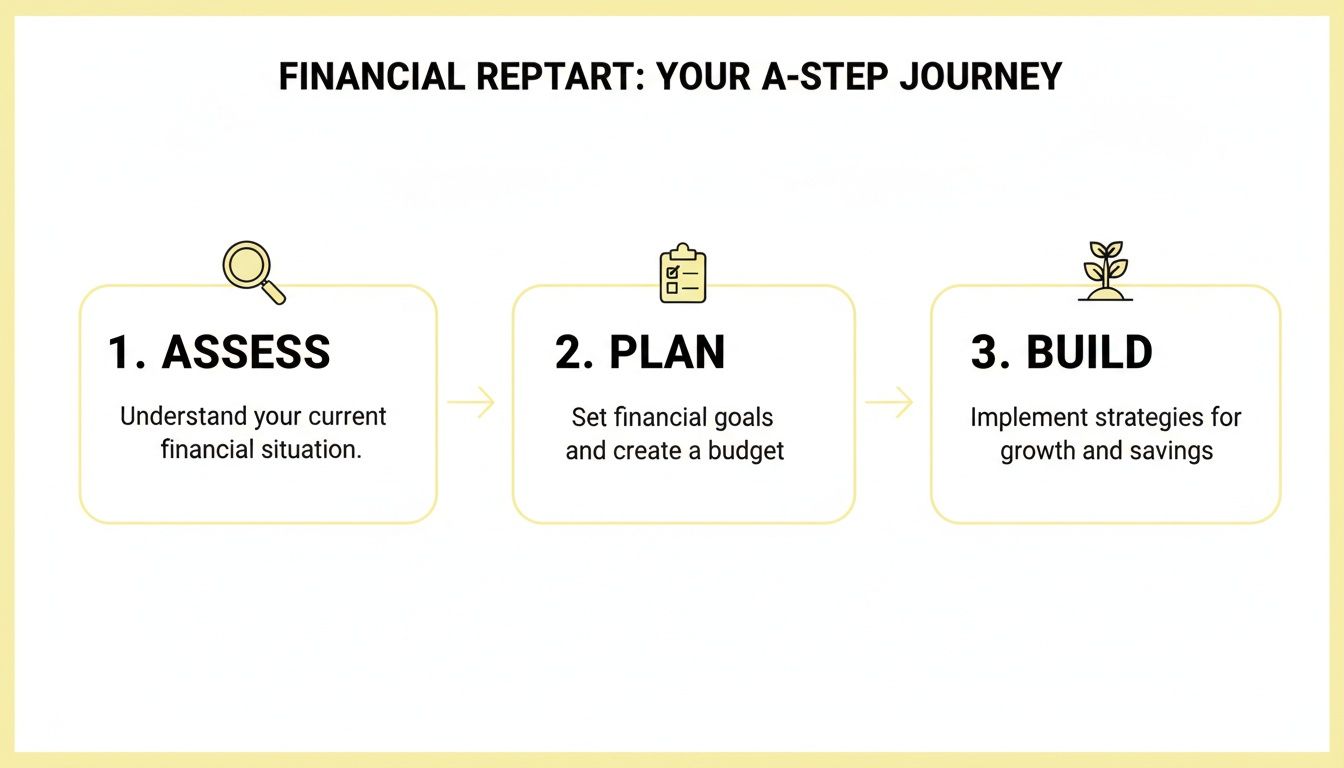
Each phase builds on the one before it, turning what feels like a massive challenge into a manageable journey toward stability and growth.
To give you a bird's-eye view, here's a quick summary of the key pillars that will guide your financial restart. Think of this as the high-level framework for the journey ahead.
The 5 Pillars of Your Financial Restart Plan
| Pillar | Core Action | Why It Matters for Your Family |
|---|---|---|
| Pillar 1: Assessment | Get a brutally honest snapshot of your finances—income, expenses, debts, and assets. | You can't plan a new route without knowing your starting point. This brings clarity and ends the guesswork. |
| Pillar 2: Strategy | Create a realistic budget and a focused debt-repayment plan. | This puts you back in the driver's seat, ensuring every dollar has a job and every debt has an end date. |
| Pillar 3: Income | Explore and secure additional income streams, whether small or large. | More income accelerates your progress on debt repayment and savings, creating breathing room faster. |
| Pillar 4: Rebuilding | Focus on repairing your credit and building a robust emergency fund. | A good credit score opens doors, while an emergency fund acts as a financial firewall against future setbacks. |
| Pillar 5: Growth | Plan for long-term goals like retirement and legacy building. | This shifts the focus from survival to thriving, ensuring your hard work builds a secure future for you and yours. |
Each of these pillars is a critical step in rebuilding not just your finances, but your confidence and security for the long haul.
Learning from Past Recoveries
History has shown us time and again that rebuilding works best when you prioritize security. Take the Global Financial Crisis of 2008. The small and medium-sized businesses that form the backbone of so many family livelihoods saw their recovery rates plummet.
But here’s the key takeaway: those who managed to bounce back stronger were the ones who saved aggressively.
Fast-forward to today, and we see this lesson in action. The World Bank's Global Findex Database shows that 40% of adults in developing economies now save in a financial account. That's a 16-percentage-point jump since 2021.
This trend proves a timeless principle: starting over is entirely possible when you make an emergency fund a top priority. You can dig into these historical recovery trends in the World Bank's full report.
Gaining an Honest Picture of Your Finances

Before you can map out a new path, you have to know exactly where you're standing. The first, most empowering step in any financial reset is to get a completely honest, judgment-free look at your numbers.
This isn’t about dwelling on the past. It’s about gathering the facts you need to build a stronger future.
Facing the details can feel intimidating, especially after a major life change like a divorce or job loss. I've seen so many people avoid this step out of fear, but information is the antidote to anxiety. Clarity turns that vague financial stress into a concrete starting point for smart, powerful decisions.
Your Financial Fact-Finding Mission
Think of this as a fact-finding mission, not a test. Your only goal is to collect all the puzzle pieces that make up your current financial reality. Take a deep breath and start gathering the essential documents.
- Bank Statements: Pull the last three months of statements from all your checking and savings accounts.
- Loan Agreements: Find the most recent statements for your mortgage, car loans, student loans, and any personal loans.
- Credit Card Bills: Grab the latest statements for every single credit card you hold.
- Investment Summaries: Collect statements from your retirement accounts (like a 401(k) or IRA) and any brokerage accounts.
- Pay Stubs: Get your last two pay stubs to see your gross income, taxes, and other deductions.
Tuck these into a folder—either a physical one or a digital one on your computer. Just having everything in one place makes the next steps feel so much less overwhelming.
Calculate Your Net Worth
Your net worth is the single most important number for understanding your financial health. It’s a simple calculation that gives you a high-level snapshot of where you stand today. The formula is straightforward: Assets - Liabilities = Net Worth.
Assets are everything you own that has monetary value. This includes things like:
- Cash in your bank accounts
- The market value of your home
- The current value of your car (think Kelley Blue Book)
- Retirement and investment account balances
Liabilities are simply what you owe to others. This includes:
- Your mortgage balance
- Car loan balances
- Credit card debt
- Student loan debt
Add up all your assets, then subtract the total of all your liabilities. The result might be positive or negative, and that’s perfectly okay. This number is your baseline—the starting line from which you'll measure all your future progress. It’s also important to understand how this differs from your liquid net worth, which we break down in our guide on liquid net worth vs net worth.
A Real-World Scenario
Meet Sarah, a single parent starting over after a divorce. She spent a Saturday afternoon gathering all her documents. She discovered her assets (a small savings account, her 401(k), and her car) totaled $45,000. Her liabilities (credit card debt and a car loan) came to $20,000. Her starting net worth was $25,000. For the first time, she had a real number to work with, replacing fear with a tangible goal.
Follow the Money Trail
Once you know your net worth, the next step is to understand your cash flow—where your money comes from and where it goes each month. This is more than just budgeting; it’s about uncovering spending patterns you might not even be aware of.
Go through your last three months of bank and credit card statements with a highlighter. Categorize every single expense: housing, utilities, groceries, transportation, debt payments, subscriptions, entertainment, you name it.
You might be surprised by what you find. Many people discover they're spending hundreds on subscriptions they forgot they had or on daily coffee runs that add up to a shocking amount. This isn’t about shaming yourself. It's about seeing the reality of your habits so you can start making intentional changes. This detailed cash flow analysis is the foundation for the realistic budget that will guide your comeback.
Charting Your Course Out of Debt
Debt can feel like an anchor, holding you back just when you're trying to move forward. But with a clear strategy, that anchor becomes a series of manageable links you can break one by one. This isn't about wishing the debt away; it's about creating a smart, actionable playbook for eliminating it.
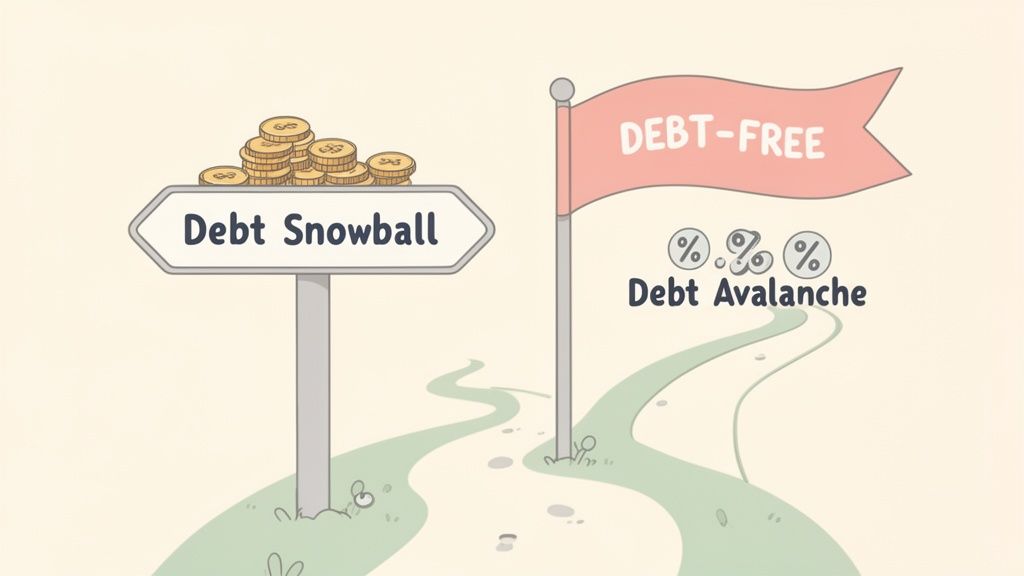
The goal here is to shift your mindset. Instead of feeling controlled by debt, you’ll be in complete control of your plan to get rid of it. That control comes from choosing a method that fits both your financial reality and your personality.
Choose Your Debt-Tackling Method
Two proven strategies stand out when you're figuring out how to start over financially: the Debt Snowball and the Debt Avalanche. They approach the problem from different angles—one focuses on motivation, the other on math.
The Debt Snowball Method
This method is all about building momentum through quick wins. You'll throw all your extra money at your smallest debt first, regardless of the interest rate, while just making minimum payments on everything else.
- How it works: Once that smallest debt is gone, you roll the entire payment you were making into the next-smallest debt.
- The psychological benefit: Paying off a debt in full, even a small one, provides a powerful mental boost. These early victories build confidence and keep you motivated for the long haul.
The Debt Avalanche Method
This approach is purely mathematical. You'll direct all your extra funds toward the debt with the highest interest rate, making minimum payments on the rest.
- How it works: By tackling the most expensive debt first, you save the most money on interest over time.
- The financial benefit: This is the most efficient way to pay off debt and will cost you less in the long run.
A Real-World Scenario: The Right Choice for Rebuilders
Consider Mark and Lisa, who are rebuilding after their small business failed, leaving them with a mix of high-interest credit cards and a small personal loan. They chose the debt snowball method. Paying off a tiny $500 medical bill in two months gave them the psychological fuel they needed to stay committed to tackling their larger, more intimidating credit card balances. The win was small, but the motivation was huge.
Comparing the Two Main Strategies
| Feature | Debt Snowball | Debt Avalanche |
|---|---|---|
| Primary Focus | Smallest balance first | Highest interest rate first |
| Key Advantage | Quick motivational wins | Saves the most money on interest |
| Best For | Individuals who need to see progress quickly to stay motivated. | Those who are disciplined and focused on the most cost-effective path. |
Taking Proactive Steps with Creditors
Sometimes, even the minimum payments are a stretch, or the interest rates are just crushing your progress. Don't be afraid to pick up the phone. Many creditors are willing to work with you, especially if you're proactive and honest about your situation.
You might be able to negotiate a lower interest rate, a temporary forbearance, or a more manageable payment plan. The key is to communicate before you start missing payments. This shows responsibility and a genuine desire to repay what you owe.
Getting even a temporary reduction on a high-interest credit card can free up hundreds of dollars to accelerate your debt plan. For more strategies on this, check out our guide on how to pay off debt faster without making more money.
Globally, debt is a massive issue. Following the 2008 financial crisis, household debt recovery was slow. Today, the International Monetary Fund reports that 35 of 68 low-income countries are facing debt distress. It's a stark reminder to get control of your own situation. Americans currently hold a staggering $1.08 trillion in credit card debt, with average rates hovering around 21%.
Think about this: refinancing a $20,000 balance from 21% down to 10% could save you $2,200 in interest in just one year. That's a powerful reason to consolidate and attack high-interest debt first. You can discover more insights about these global debt trends on oecd.org.
When a Balance Transfer Card Makes Sense
A zero-percent introductory APR balance transfer card can be a fantastic tool, but only if you use it correctly. It allows you to move high-interest debt onto a new card and pay it down without accumulating new interest for a set period, typically 12-21 months.
However, this strategy comes with critical rules:
- You must have a plan. Calculate if you can realistically pay off the entire balance before the introductory period ends.
- Avoid new purchases. Do not use the new card for any other spending. This can complicate payments and lead you deeper into debt.
- Factor in the fee. Most cards charge a balance transfer fee, usually 3-5% of the amount transferred. Make sure the interest savings outweigh this initial cost.
A balance transfer isn’t a magic wand. But for someone with a solid repayment plan, it can be a strategic move that saves thousands in interest and significantly speeds up their journey to becoming debt-free.
Rebuilding Your Financial Foundation
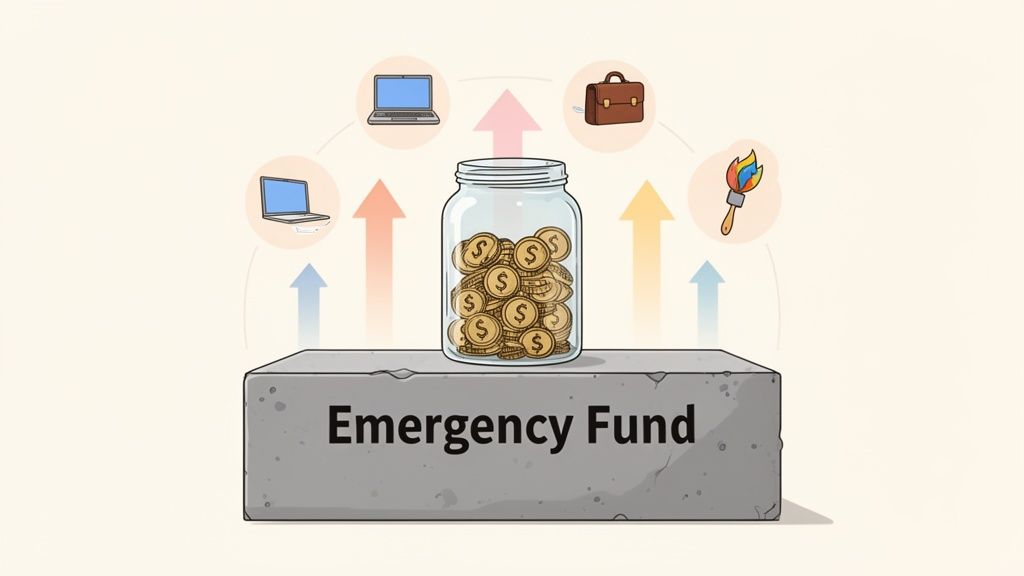
Okay, you've got a plan to tackle your debt. That’s huge. Now we get to shift from playing defense to playing offense. This is where you start building a rock-solid financial foundation—one that not only protects you from future curveballs but also starts creating real momentum for growth.
This phase all comes down to two critical pillars: building a serious emergency fund and strategically boosting your income. Think of these not as boring budget items, but as the power moves that buy you real security and the freedom to make choices that aren't dictated by financial stress.
Create Your Financial Firewall
An emergency fund is your buffer against life’s inevitable surprises. It's the cash that keeps a sudden car repair or an unexpected medical bill from completely derailing your progress and throwing you right back into debt. The gold standard is to have 3-6 months of essential living expenses saved up.
I know, that number can sound intimidating. But you don't build it overnight. The trick is to start small and, most importantly, make it automatic.
- Open a Separate Account: Your emergency fund needs its own home, preferably a high-yield savings account (HYSA). This keeps the money accessible but out of sight from your daily checking account, which seriously cuts down on the temptation to use it for non-emergencies.
- Automate Your Savings: Set up a recurring transfer from your checking to your HYSA. Even $25 a week adds up to $1,300 in a year. When you "set it and forget it," you're consistently building that safety net without even thinking about it.
- Bank Your Windfalls: Get a small bonus at work, a tax refund, or sell something on Facebook Marketplace? Funnel that cash directly into your emergency fund. This one habit can dramatically speed up your progress.
Starting over after a major life event like a divorce really highlights how crucial this financial cushion is. For anyone navigating that specific challenge, we offer more detailed advice in our article on rebuilding finances after divorce.
The Power of a Starter Emergency Fund
Don't let that 3-6 month goal paralyze you into inaction. Your immediate target should be what many of us in finance call a "starter" emergency fund of $1,000. Just having that small buffer in place provides an incredible psychological boost and is often enough to handle common minor emergencies, giving you the confidence to keep going.
Boost Your Earning Power
Cutting expenses is a fantastic tool for getting back on your feet, but let's be real—there's a limit to how much you can cut. Increasing your income, on the other hand, has virtually unlimited potential. It's the other essential piece of starting over with real strength.
Boosting your earnings doesn't have to mean finding a brand-new, higher-paying job (though it could!). It's more about creating multiple streams of income to diversify your financial life and reduce your dependence on a single paycheck.
Identify Your Monetizable Skills
First, take an inventory of the skills you already have. Are you a great writer? A whiz with spreadsheets? An incredible organizer? These are all things people and businesses will pay for.
I once worked with a teacher who had a knack for graphic design. She started creating and selling her custom lesson plans on platforms like Teachers Pay Teachers. It started out as an extra $200 a month but eventually grew into a major secondary income stream that let her pay off her car loan two years ahead of schedule.
Here are a few places to start exploring:
- Freelancing: Offer your professional skills on sites like Upwork or Fiverr.
- Consulting: If you have deep expertise in a certain field, you can offer consulting services to small businesses.
- Tutoring: Your knowledge in almost any subject is valuable to students who need help.
Turn a Hobby into a Side Business
Don't forget about your passions—they can be profitable, too. A weekend woodworker could sell custom pieces on Etsy. A talented home baker might start taking cake orders for local parties.
The key is to just start small and test the waters. You don't need a huge business plan to get going. Create your first product or offer your first service and see what the response is. This approach keeps the risk low while you figure out what really connects with people.
By focusing on these two missions—building your emergency savings and increasing your income—you’re not just stabilizing your finances. You're building a launchpad that will accelerate your entire journey toward long-term financial health and security.
Investing to Secure Your Future and Legacy
Alright, you've put in the hard work. You have an emergency fund that’s starting to look respectable, and you've got a solid plan to tackle your debt. Now it’s time for the exciting part—shifting your focus from defense to offense. This is where your money truly starts working for you, building a sense of security that goes way beyond just covering next month's bills.
Investing might sound intimidating, especially when you're starting over. But forget what you see in the movies. We're not talking about chasing hot stocks or trying to outsmart Wall Street. For rebuilders, smart investing is all about steady, intentional growth. It’s about making your money reflect your long-term goals and values, creating a future that’s not just secure, but meaningful for you and the people you care about.
Embracing the Power of Compound Growth
If there's one "secret weapon" in building wealth, it’s compound growth. The concept is simple, but its impact is incredible. Think of it like a snowball rolling downhill. It starts small, but as it picks up more snow, it gets bigger and moves faster. Your investments work the same way: the returns you earn start earning their own returns.
This is exactly why it's so critical to start investing as soon as you're on stable ground, even if it's just with small, consistent amounts. Thanks to the magic of compounding, a modest investment made today can blossom into a surprisingly large sum over the years. Time truly is your greatest ally here.
Your Simple Investing Strategy
When you’re learning how to start over financially, complexity is the enemy. Your goal is simple: capture the broad growth of the market without taking wild risks. The best way to do this? Low-cost index funds and diversification.
- Low-Cost Index Funds: These are a game-changer. Instead of picking individual stocks, these funds let you own a tiny piece of hundreds or even thousands of companies at once by tracking a major market index like the S&P 500. It's the simplest, most effective way to get in the game.
- Diversification: This is just a fancy way of saying, "don't put all your eggs in one basket." By mixing different types of assets, like stocks and bonds, you cushion your portfolio if one part of the market hits a rough patch.
The last few years have taught us a lot about resilience. We've seen global disaster costs soar and economic shocks become more common. Yet, savers who stayed diversified have managed to do well even as national deficits ballooned. It’s a timeless lesson that always holds true. You can learn more about the importance of global resilience and financial stability from the UNDRR.
A Guiding Principle for Rebuilders
An effective investment strategy doesn't have to be complicated. A simple, diversified portfolio of low-cost index funds, held for the long haul, has proven to be one of the most reliable paths to building wealth.
Investing for Your Family and Legacy
Your financial comeback isn’t just about you. It’s about creating a foundation of opportunity for the next generation. Investing is one of the most powerful ways to build generational wealth and help your family achieve their dreams.
For a child's college fund, an account like a 529 plan gives you tax advantages that help your money grow more efficiently. When it comes to leaving a lasting legacy, a straightforward investment portfolio with clearly named beneficiaries ensures that your efforts continue to support your loved ones long after you're gone.
If retirement is your main focus, the aim is to build a portfolio that can one day provide a reliable stream of income. This might involve a mix of dividend-paying stocks and bonds that produce a steady cash flow, so you can live comfortably without having to sell off your core investments.
Sample Diversified Portfolio for Rebuilders
So, what does this look like in practice? Below is a simplified model showing how you might allocate your investments based on your comfort with risk. A younger person might lean toward a growth-oriented portfolio, while someone closer to retirement would naturally shift toward a more conservative mix to protect what they’ve built.
| Asset Class | Conservative Allocation | Moderate Allocation | Growth-Oriented Allocation |
|---|---|---|---|
| U.S. Stocks (Index Funds) | 30% | 50% | 70% |
| International Stocks (Index Funds) | 10% | 15% | 20% |
| Bonds (Index Funds) | 50% | 30% | 10% |
| Cash/High-Yield Savings | 10% | 5% | 0% |
Ultimately, investing is the final, crucial step that cements your financial comeback. It’s the move that transforms your situation from one of stability to one of lasting strength, securing not only your own future but also the legacy you want to leave behind.
Of course. Here is the rewritten section, formatted to match the style of the provided examples.
Common Questions About Starting Over Financially
Taking those first steps to rebuild your financial life is a huge win, but let's be honest—it's natural for questions and a bit of uncertainty to creep in. This is where doubt can really start to take hold. Getting straight, honest answers to the most common worries can keep you focused, motivated, and confident in your plan.
Let’s tackle the big questions head-on. Think of this as your personal FAQ for the road ahead, designed to turn those overwhelming obstacles into small, manageable steps.
How Long Does It Realistically Take to Recover Financially?
This is usually the first thing people ask, and the answer is deeply personal. Financial recovery is a marathon, not a sprint. The timeline depends entirely on your unique starting point—how much debt you're carrying, what your income looks like, and how aggressively you can afford to save.
For someone with moderate credit card debt and a steady job, you could see significant progress in 18-24 months of disciplined effort. For others facing bigger hurdles, like rebuilding after a business failure or a divorce, the journey might be closer to five to seven years.
Focus on Progress, Not Perfection
The most important thing is to measure your success against where you were yesterday, not where someone else is today. Your journey is your own. Celebrate the small but meaningful wins, like paying off that first credit card or hitting your first $1,000 in savings. These milestones are the fuel that will keep you going.
My Credit Score Is Very Low. Where Do I Even Begin?
A low credit score can feel like a major roadblock, shutting doors to better interest rates or even rental applications. But it's a door you can absolutely reopen, and the process is simpler than you might think. You don't need complex credit repair schemes; you just need to build a new history of reliability.
Start with two powerful actions that tackle the single biggest factor in your score: your payment history.
- Get a Secured Credit Card: This is a fantastic tool for rebuilding. You make a small cash deposit—say, $300—which then becomes your credit limit. This makes it a very low-risk option for lenders.
- Use It Strategically: Charge a small, recurring bill to the card each month, like your Netflix subscription. Then, pay the balance in full and on time. Every single time.
This simple, consistent habit sends a powerful new message to the credit bureaus: you are a reliable borrower. Over six to twelve months, these small, steady actions can start to meaningfully improve your score, laying a solid foundation for your financial comeback.
What if I Feel Too Overwhelmed to Start?
Financial paralysis is real, and it's incredibly common. That feeling of being completely swamped usually comes from looking at the entire mountain you have to climb all at once. The trick is to break it down and focus only on the very first step right in front of you.
Don't worry about your five-year plan or your retirement goals today. Your only job for this week is to accomplish one small, manageable task.
What could that one task be?
- Find your last two bank statements.
- Make a simple list of what you owe, without judgment.
- Open a high-yield savings account online.
- Cancel one subscription you no longer use.
Just choose one thing that feels doable. Completing it will give you a small but crucial sense of accomplishment. That feeling builds momentum, making it easier to tackle the next small task, and then the next. You don't have to solve everything at once; you just have to start.
At Smart Financial Lifestyle, we believe that every family can build a secure future with the right guidance. Our approach is built on Paul Mauro’s 50+ years of experience, helping people make smart financial decisions that create lasting peace of mind. To continue your journey with practical tools and timeless wisdom, explore more resources at https://smartfinancialifestyle.com.


