How to Make Money Work for You Instead of Working Longer

Most people spend their entire lives trading time for money, never learning the wealth-building habits that could break this exhausting cycle. Working harder rarely translates to meaningful financial growth when paychecks disappear into expenses each month. The key lies in shifting from earning active income to creating systems where money generates more money. Smart strategies can transform how dollars work, building momentum that compounds over time.
Building wealth requires establishing systems where income flows in without constant effort. Strategic investing, passive income streams, and disciplined savings create financial momentum that grows stronger each year. These principles work regardless of current income level, but they require intentional planning and consistent execution. Starting with solid retirement financial planning provides the foundation for long-term financial independence.
Table of Contents
Why Most People Trade Time for Money Forever
What It Really Means to Make Money Work for You
The Assets That Historically Create Wealth
Why Time Is the Most Powerful Wealth-Building Asset
A Practical Framework for Making Money Work for You
How Smart Financial Lifestyle Helps Investors Build Wealth With Proven Principles
Kickstart Your Retirement Financial Planning Journey | Subscribe to Our YouTube and Newsletter
Summary
According to Ryan Twomey's analysis, 99% of people trade time for money throughout their working lives, never escaping the fundamental constraint that income ends when work ends. This pattern persists even among high earners. Research published by Step shows that a majority of Americans continue living paycheck to paycheck in 2025, with meaningful percentages of high-income households reporting the same experience despite earning six figures. The difference between financial fragility and resilience isn't the size of the paycheck; it's what happens to the money after it arrives.
Historical data compiled by New York Life using the Ibbotson SBBI database show U.S. stocks have delivered roughly 10% average annual returns over periods dating back to the 1920s, while cash equivalents like Treasury bills have historically produced 3% to 4%. A dollar invested in stocks in 1926 would have grown to over $10,000 by recent years, while that same dollar in Treasury bills would have reached only about $21. The gap widens because productive assets multiply through economic activity and reinvested earnings, while cash sits idle and vulnerable to the erosion of inflation.
Research from IPX1031 indicates that 90% of millionaires have built their wealth through real estate. Property ownership delivers two simultaneous benefits: rental income from tenants and potential appreciation of the underlying asset. This dual income stream creates resilience that pure appreciation or pure income assets lack, allowing owners to cover expenses, reinvest in additional properties, and build equity while capturing both cash flow and long-term value growth.
Time transforms modest contributions into substantial wealth through compounding, where investment gains begin generating gains of their own. An investor contributing $500 monthly at an 8% average annual return would reach approximately $91,000 after 10 years, but after 40 years, that same monthly contribution exceeds $1.7 million. The final decade produces more wealth than the first three decades combined because every additional year gives compounding another opportunity to build upon previous gains.
According to DALBAR's Quantitative Analysis of Investor Behavior, individual investors consistently underperform the investments they own because they buy and sell at emotionally driven moments. Poor timing hurts returns more than poor investment selection. Fidelity's analysis of high-performing retirement accounts found that some of the best results were achieved by investors who had forgotten they owned the accounts or had passed away, demonstrating that investors who leave money invested and avoid constant trading often benefit most from long-term compounding.
Retirement financial planning helps people over 50 translate wealth-building principles into specific decisions about tax-efficient withdrawals, Roth conversion timing, and legacy planning tailored to their circumstances, rather than relying on generic advice.
Why Most People Trade Time for Money Forever
The Trap Most Never Escape
According to Ryan Twomey's analysis, 99% of people trade time for money throughout their working lives. It's the default path because it's the only model most people learn, and everyone around you follows the same pattern, making it feel normal.
The problem: time has limits that income does not. A professional can double their expertise, triple their productivity, or negotiate a 40% raise, but cannot create a 25th hour in the day. Income stops when work stops.
When High Income Doesn't Equal Financial Freedom
Many people who earn six figures still say they are living paycheck to paycheck. According to research published by Step, most Americans experienced this in 2025, with estimates ranging from roughly half to over 60% depending on the method used.
Why do high earners still struggle financially?
High-income households report the same experience: salary increases, yet the need to keep working remains.
What's the difference between income and wealth?
Income and wealth are not the same thing. A household earning $150,000 annually but spending $145,000 stays financially fragile. Another household earning $80,000 but regularly putting money toward assets that generate independent value slowly builds financial strength. The difference isn't the paycheck; it's what happens to the money after it arrives.
The Hidden Cost of Trading Time Forever
People facing unexpected responsibilities discover this fragility fast. When a young person suddenly becomes responsible for a four-year-old sibling, the immediate calculation isn't "how do I build wealth?" but "can I keep working enough hours to survive this week?" The options narrow to selling assets, abandoning education, or restructuring life around maintaining active income.
There's no financial system in place to provide breathing room: only the relentless need to keep trading time for money or face collapse.
Why does hard work alone lead to financial exhaustion?
That exhaustion isn't laziness. It's what naturally happens in a system where every dollar of progress depends on your next shift, your next project, your next paycheck. The trap is building a financial life where hard work is the only engine, and stopping means everything stops.
What matters more than how much you earn?
But what if the real problem isn't how hard you work or how much you earn, but what you do with the money? Our Smart Financial Lifestyle resources help you make strategic decisions about retirement financial planning to maximize what you keep.
What It Really Means to Make Money Work for You
Making money work for you means turning your earnings into assets that create value without direct effort. You move beyond depending on your next paycheck and build a portfolio of investments that grow as the economy grows. Your money creates wealth alongside your work, building financial momentum that compounds over time rather than resetting with each paycheck.

🎯 Key Point: The fundamental shift from active income to passive wealth creation is what separates those who build lasting financial security from those who remain paycheck-dependent.
"Building financial momentum that grows over time instead of starting over with each paycheck is the essence of wealth creation." — Financial Independence Principle
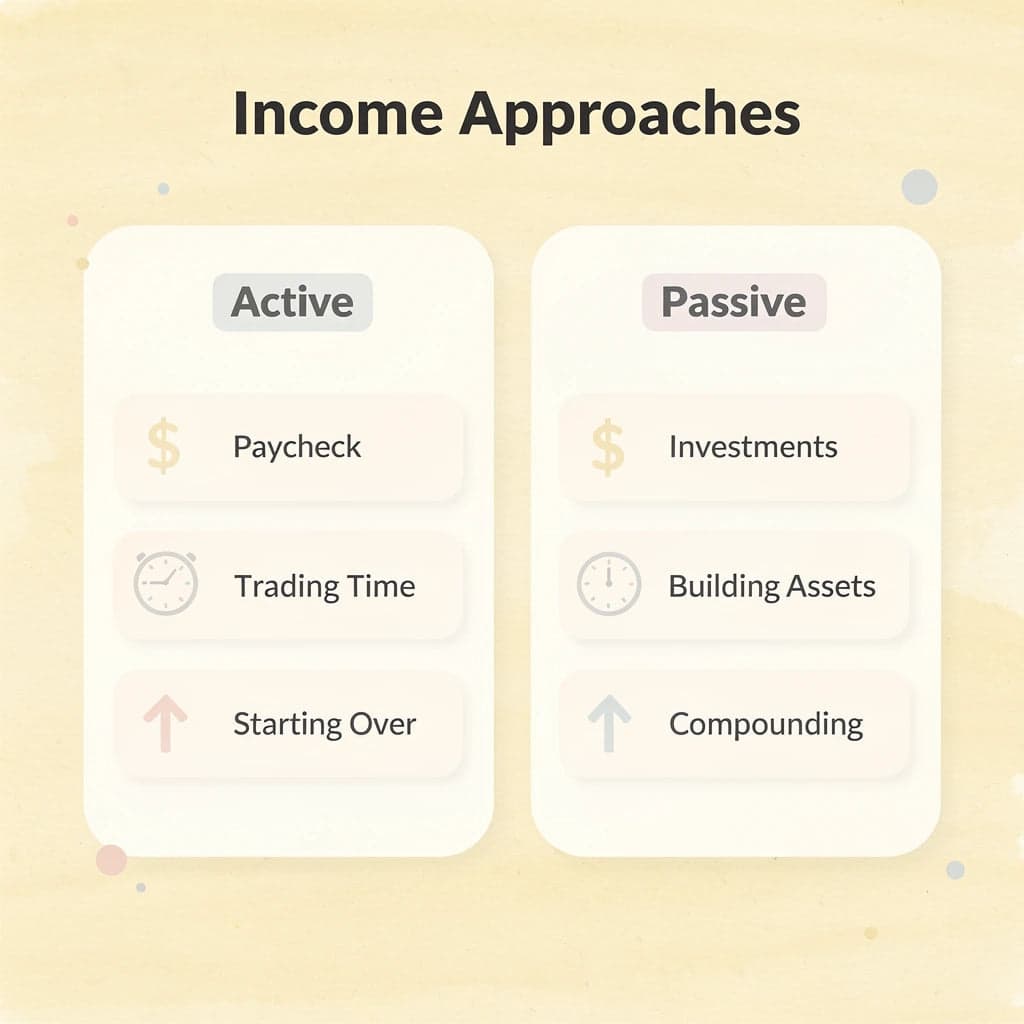
💡 Tip: Start viewing every dollar you earn as a potential wealth-building tool rather than just money to spend - this mindset shift is the first step toward making your money work for you.
Why do most people never make this transition?
This difference matters because most people never make the change. They spend decades improving their earning ability through education and promotions, yet never use those earnings to build ownership. Every dollar earned gets spent. The financial engine remains dependent on future work, which means retirement planning becomes a race against time rather than a natural progression supported by decades of accumulated assets.
The Two Types of Income
Active income requires your presence. Salaries, consulting fees, commissions, and business revenue depend on continued work. Stop working, and the income stops.
Asset-generated income works differently. Dividends, rental income, business distributions, and investment appreciation create value without depending on your daily schedule. They continue working whether you work forty hours this week or take a month off. Research from First Citizens Bank's 2025 wealth survey shows that high-net-worth Americans focus on turning income into assets that grow in value rather than spending immediately, a pattern that separates long-term wealth building from earning a high income alone.
From Consumption to Productive Capital
Most financial advice focuses on earning more: get promoted, switch jobs, start a side business. These strategies increase income but don't change the underlying structure—you're still trading time for money, just at a better rate.
Wealth acceleration happens when earned income funds asset purchases. Instead of spending every dollar on lifestyle, you direct a portion toward ownership: shares in companies, tax-advantaged retirement accounts, property generating rental income, and businesses creating value beyond your labor.
How does productive capital create lasting value?
Each purchase converts currency into productive capital: money put to work in assets that can participate in economic growth.
A dollar in your checking account stays a dollar. A dollar invested in a productive asset gives you exposure to business growth, market expansion, and compounding returns over decades. Invested capital creates value while you sleep, work, or vacation. Your money contributes to your financial future instead of sitting idle.
What structured approach works for wealth building?
Many people over 50 feel overwhelmed by conflicting advice about Roth conversions, tax-efficient withdrawals, and legacy planning. Platforms like retirement financial planning provide structured approaches built on decades of practitioners' experience, translating broad wealth-building principles into actionable decisions tailored to your circumstances.
Wealth grows when assets produce value on your behalf. The sooner you move money from spending to productive capital, the sooner it starts contributing to long-term financial security. This is what making money work for you means: building a second engine of wealth creation through ownership rather than relying exclusively on future paychecks.
Which assets actually build generational wealth?
But which assets build lasting wealth, and why do some investments grow over time for generations while others remain static?
Related Reading
Why Is Investing A More Powerful Tool To Build Long-term Wealth Than Saving?
How To Build Wealth In Your 30s
Personal Finance Investing
The Assets That Historically Create Wealth
What makes ownership different from saving?
Assets that create lasting wealth share one thing in common: they generate value beyond your initial investment. Stocks give you ownership in companies that produce profits, create products, and expand their operations. Real estate provides rental income while property values appreciate. Businesses generate profits that owners can reinvest or withdraw. These assets work independently, producing economic value regardless of your involvement.
How do ownership returns compare to savings over time?
Keeping cash is important for emergencies, but according to research compiled by New York Life using the Ibbotson SBBI database, U.S. stocks have delivered an average annual return of approximately 10% since the 1920s, compared to 3–4% for Treasury bills. With inflation averaging 3%, this gap compounds significantly over time. A dollar invested in stocks in 1926 would have grown to over $10,000 by recent years, while the same dollar in Treasury bills would have reached only about $21.
Why productive assets outperform cash
Wealth-building assets create value for their owners. Company shares let you participate in growth without employment. A rental property generates monthly tenant payments and potential appreciation. A business generates customer revenue, which becomes profit. These assets generate economic activity independent of your working hours.
Many people save cash for safety, but years of careful saving produce smaller results than investing in appreciating assets. The gap widens because cash doesn't grow through productive activity—it sits idle, eroded by inflation—while productive assets grow through reinvested earnings and market appreciation.
How does real estate provide dual wealth-building advantages?
Owning property builds wealth through two mechanisms: rental income from tenants and property appreciation. This combination allows owners to cover expenses, reinvest in additional properties, or fund other investments while building equity. The dual income streams create strength unavailable from appreciation or income alone.
Why do most millionaires choose real estate investing?
Research from IPX1031 shows that 90% of millionaires have built their wealth through real estate. Property ownership enables leverage, tax benefits, and simultaneous income and appreciation.
Unlike stocks that depend solely on market value or businesses that require hands-on work, real estate offers physical assets with multiple avenues for value creation.
What happens when timing and allocation are wrong?
But owning the right assets is only half the equation if you start too late or invest too little.
Why Time Is the Most Powerful Wealth-Building Asset
The most powerful advantage available to any investor is time. Time transforms modest contributions into substantial wealth through compounding, where investment gains generate gains of their own. The longer money remains invested, the more powerful this effect becomes.

🎯 Key Point: Time is your ultimate wealth-building multiplier - even small amounts invested early can outperform large amounts invested late due to the exponential power of compound growth.
"Time is the most valuable asset in investing - it's the one thing that can turn modest savings into generational wealth through the magic of compounding." — Investment Principle
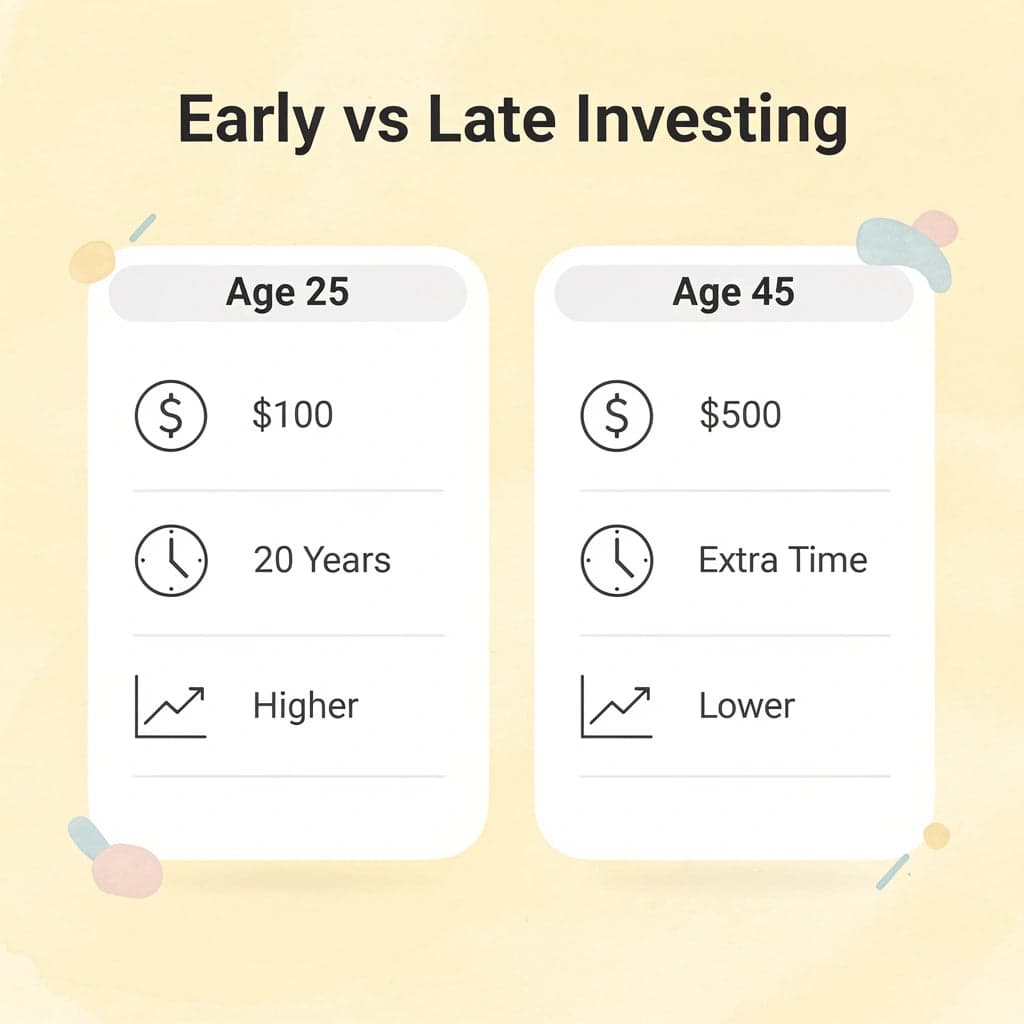
💡 Tip: Start investing immediately, even with small amounts. A $100 monthly investment started at age 25 will typically outperform a $500 monthly investment started at age 45 due to the extra 20 years of compound growth.
Why compounding accelerates over time
An investor contributing $500 monthly at an 8% average annual return reaches approximately $91,000 after 10 years (one-third from investment growth), $295,000 after 20 years, $745,000 after 30 years, and $1.7 million after 40 years. The monthly contribution remains constant, yet the account grows dramatically as returns compound on previous returns.
This uneven growth surprises people who expect steady increases. The final decade produces more wealth than the first three decades combined, which is why starting earlier matters more than most people realize.
Why does starting early matter more than the contribution amount?
Consider two investors. The first starts at age 25, contributes $500 monthly until age 35, then stops, but leaves the money invested. The second waits until age 35, then contributes $500 monthly until age 65. Though the second investor contributes more overall, the first may accumulate equal or greater wealth because their investments had an extra ten years to grow.
What happens when you wait for the perfect investment strategy?
This reality challenges a common assumption: finding better investments matters more than starting sooner. Many people delay investing while searching for the perfect strategy or waiting for market conditions to improve. Time spent waiting cannot be recovered. The investor who starts with a reasonable strategy today typically outperforms the investor who waits for a perfect one tomorrow.
Why does investor behavior matter more than stock selection?
According to DALBAR's Quantitative Analysis of Investor Behavior, individual investors consistently underperform because they make buying and selling decisions based on emotions. Poor timing hurts returns more than poor selection.
The difference between successful and unsuccessful investors is rarely intelligence or stock-picking ability: it's behavior. A disciplined investor with a reasonable strategy frequently outperforms an undisciplined investor pursuing a perfect one.
What do the best-performing accounts have in common?
Fidelity's study of high-performing retirement accounts found that some of the best results were achieved by investors who had forgotten they owned the accounts or had passed away.
Investors who leave money invested and avoid constant trading benefit most from long-term growth. They contribute regularly, reinvest gains, stay invested through market cycles, and let time work for them.
How does time create extraordinary wealth from ordinary actions?
Extraordinary wealth typically comes from ordinary actions repeated over long periods. Time and discipline have proven far more reliable drivers of financial success than finding the next great investment.
The key is giving compounding enough years to operate, which requires starting sooner rather than waiting for perfect conditions. But knowing this doesn't make it simple to execute consistently when markets fluctuate and emotions run high.
A Practical Framework for Making Money Work for You
Most people never build wealth because they lack a system for it. The framework that works starts with stability, removes obstacles, and then directs money toward assets that grow independently of your labor.

🎯 Key Point: Building wealth isn't about market timing or finding secret opportunities—it's about creating a systematic approach that works regardless of external conditions.
"The framework that works starts with stability, removes obstacles, then directs money toward assets that grow independently of your labor." — Wealth Building Fundamentals

This is about building a repeatable process regardless of economic conditions, not predicting markets or finding hidden opportunities.
💡 Best Practice: Focus on creating sustainable systems rather than chasing temporary market gains or get-rich-quick schemes that depend on perfect timing.
Build Financial Stability First
Before investing, build a foundation to handle life's surprises. Medical bills, car repairs, and home emergencies arrive without warning. Without cash saved, these events force you into high-interest debt or into selling assets early.
Emergency savings don't grow at an impressive rate, but they provide the stability that allows long-term investing to work. Three to six months of expenses in an accessible account lets you stick to investment plans without worrying about needing that money soon. The goal is to remove the pressure that causes people to abandon their wealth-building strategy when something goes wrong.
Eliminate Debt That Works Against You
High-interest debt works against building wealth. Every dollar you pay in credit card interest is a dollar that could have been working for you instead. At 18% or 22% interest rates, you guarantee yourself a negative return on future income.
Paying down this debt creates an immediate, risk-free improvement to your financial position. Once that interest expense disappears, the money previously used for monthly payments becomes available to build assets rather than service obligations.
Invest With Consistency, Not Perfection
The biggest mistake is waiting for ideal conditions. Markets feel uncertain, headlines create anxiety, and there's always a reason to delay. Consistent investment contributions matter far more than perfect timing.
How does systematic budgeting support consistent investing?
According to AfroTech, the 50-30-20 budgeting rule allocates 50% of your income to needs, 30% to wants, and 20% to savings and debt repayment. This structured approach helps you build wealth regardless of market conditions.
The process becomes automatic rather than emotion-driven, letting you build ownership of productive assets over decades rather than predict quarterly outcomes.
Why do people approaching retirement need specialized strategies?
Many people approaching or in retirement struggle with this change because general financial advice rarely addresses their specific situation. Tax-efficient withdrawal strategies, Roth conversion timing, and legacy planning require frameworks built on real-world experience, not academic theory alone.
Smart Financial Lifestyle provides educational resources developed over 50 years of managing more than $1 billion in assets, helping people over 50 make informed decisions about retirement income, tax optimization, and wealth transfer.
Reinvest What Your Assets Generate
Compounding accelerates when you reinvest dividends, interest, and capital gains instead of spending them. Your existing assets generate additional assets without requiring more of your time or effort.
Over long periods, reinvested earnings become the biggest driver of portfolio growth. Your existing assets work continuously, generating returns that, in turn, produce future returns.
Knowing when and how to apply this to your specific circumstances determines whether it produces the results you need.
Related Reading
How To Grow Your Money
How to Stop Living Paycheck to Paycheck
How Much Money Should I Have Saved by 30
How Smart Financial Lifestyle Helps Investors Build Wealth With Proven Principles
Building wealth requires more than understanding investment concepts: it demands a framework grounded in decades of real-world experience. Smart Financial Lifestyle provides clarity for investors overwhelmed by conflicting advice, offering a straightforward path built on proven principles rather than speculation.

🎯 Key Point: The difference between successful wealth building and financial struggle often comes down to following tested strategies rather than chasing the latest investment trends.
"The most successful investors don't rely on speculation—they build wealth through proven principles and disciplined execution over time." — Smart Financial Lifestyle Framework

💡 Tip: Focus on time-tested strategies that have worked across multiple market cycles rather than getting distracted by short-term market noise and speculative opportunities.
What Separates Principles From Predictions
Most financial content focuses on market forecasts, economic predictions, and investment trends, creating a constant cycle of reaction and adjustment that rarely produces lasting results.
Smart Financial Lifestyle draws from Paul Mauro's 50-year career managing over $1 billion in assets and working directly with investors through market cycles, retirement transitions, and wealth-building challenges. This experience reveals a critical insight: successful wealth creation depends less on predicting market movements and more on developing sound behaviors that compound over time.
Why Experience Matters More Than Theory
According to Bristol Financial, 78% of Americans live paycheck to paycheck, including many high earners who lack a plan to convert income into lasting wealth. Conflicting advice leaves people stuck or causes them to abandon strategies before they take hold.
Platforms like Smart Financial Lifestyle help by focusing on education grounded in real experience. Rather than promoting specific investments or timing the market, they teach investors how to approach retirement planning, tax-efficient withdrawals, Roth conversions, and legacy building through frameworks developed by managing real money through real market conditions.
Building Wealth That Lasts Generations
Building wealth that lasts beyond one lifetime changes how investors think about spending, giving gifts, paying taxes, and planning their estate. When helping grandchildren or creating security for multiple generations, short-term market changes matter less than long-term structural decisions.
Smart Financial Lifestyle offers easy-to-understand education through books and free YouTube content without overwhelming technical language. The focus is on helping investors over 50, especially those who are retired or nearing retirement, make smarter choices about their specific situations rather than providing general advice.
Understanding principles is useful only if you know where to find ongoing guidance to keep you moving forward.
Kickstart Your Retirement Financial Planning Journey | Subscribe to Our YouTube and Newsletter
Subscribe to Smart Financial Lifestyle's YouTube channel and newsletter for practical frameworks built from five decades of real wealth management experience. You'll receive guidance on specific decisions you're facing now, whether navigating Roth conversions, structuring withdrawals, or building a legacy that extends beyond one generation, delivered without generic advice.

🎯 Key Point: Paul Mauro's books and free consultations translate 50 years of managing over $1 billion in assets into actionable steps you can use this month. Making money work for you requires building systems where your assets generate value independently of your time.
"Building systems where your assets generate value independently of your time is the foundation of true wealth creation." — Smart Financial Lifestyle Framework

💡 Tip: Subscribe today and begin converting what you've learned into decisions that compound over time. The real difference between financial success and stagnation lies in taking consistent action on proven strategies.
Resource | What You Get | Time Investment |
|---|---|---|
YouTube Channel | Weekly practical frameworks | 10-15 minutes per video |
Newsletter | Actionable decision guidance | 5 minutes per issue |
Free Consultations | Personalized wealth strategies | 30-60 minutes per session |
Related Reading
How Much Should I Save Each Month
How To Invest 1000 Dollars
Retirement Income Strategies
Retirement Planning Mistakes
What Happens If You Run Out Of Money In Retirement
Ira Pros And Cons
How Much Money Should I Have Saved By 30
Early Retirement Strategies
How To Stop Living Paycheck To Paycheck
Best Investment For Retirement Income
Are Index Funds Good For Retirement
Long-Term Stock Investments
Low-Risk Investment Options