
Long-Term Financial Planning: How Small Decisions Build Wealth

Small financial decisions made consistently over time carry more weight than most people realize. Wealth-building habits and long-term financial planning are not reserved for high earners or financial experts. They are practical patterns that anyone can develop, regardless of where they start.
Understanding how everyday choices connect to larger goals like savings growth, investment returns, and retirement income makes the path forward much clearer. Smart Financial Lifestyle offers straightforward guidance to help readers turn that understanding into action, starting with retirement financial planning.
Table of Contents
-
Why Most People Struggle With Long-Term Financial Planning
-
What Long-Term Financial Planning Actually Means
-
The Hidden Cost of Delaying Financial Decisions
-
The Core Habits That Support Long-Term Wealth Building
-
How to Build a Long-Term Financial Plan That Survives Real Life
-
How Smart Financial Lifestyle Helps You Think Like a Long-Term Wealth Builder
-
Kickstart Your Retirement Financial Planning Journey | Subscribe to Our YouTube and Newsletter
Summary
-
Most investors underperform the market, not because of poor fund selection but because of emotional decision-making. According to DALBAR's 2025 Quantitative Analysis of Investor Behavior, the average equity investor underperformed the S&P 500 by 8.48 percentage points in 2024, driven primarily by poor timing decisions. Over a 20-year period, that behavioral drag translated into an annual gap of 1.11 percentage points between market returns and what investors actually kept.
-
Long-term financial planning functions as a coordination system rather than a single goal. Only 33% of Americans have a long-term financial plan, according to United Advisor Group, which means the majority are likely optimizing one area (such as investments) while other areas like debt, taxes, or cash flow quietly work against them. The real cost of uncoordinated decisions rarely shows up all at once; it accumulates across decades.
-
The math behind delayed action is concrete and unforgiving. A $10,000 investment earning 7% annually grows to roughly $76,123 over 30 years. Wait five years to start, and that same amount grows to approximately $53,865, a difference of more than $22,000 from a decision that felt harmless at the time. Larger contributions later can help, but they cannot fully replace the compounding effect of early action.
-
Delaying financial decisions is still the norm for most Americans. The AICPA and CIMA's 2026 Financial Literacy Month Survey found that 55% of Americans delayed major decisions for financial reasons, down from 61% the prior year. That pattern, waiting for conditions to improve before starting, carries a structural cost that extends beyond the individual to what families ultimately inherit.
-
Financial literacy remains a significant gap in household decision-making. Only 57% of adults in the United States are financially literate, according to First Port City Bank, which means nearly half the population makes retirement, tax, and estate-planning decisions without a reliable framework. Understanding specific concepts like Roth conversions, sequence-of-returns risk, and how beneficiary designations interact with estate documents determines how much wealth actually transfers intact across generations.
-
Consistent, automated habits outperform willpower-based approaches to saving. The 401(k) contribution limit for 2025 is $23,500, with additional catch-up contributions available for adults over 50. Those who consistently reach that ceiling tend to do so through automation rather than discipline alone. Separately, limiting total debt payments to no more than 36% of gross monthly income is identified as the threshold beyond which debt begins crowding out savings and long-term financial flexibility.
-
Smart Financial Lifestyle's retirement financial planning addresses this by giving adults over 50 a structured, practitioner-tested framework that replaces reactive decision-making with a clear sequence of actions designed to coordinate savings, taxes, debt, and legacy goals over time.
Why Most People Struggle With Long-Term Financial Planning
Most people struggle with long-term financial planning because they underestimate how much their own behavior shapes the outcome. The gap between knowing what to do and consistently doing it is where most financial plans fall apart. Our Smart Financial Lifestyle approach helps bridge this gap by focusing on sustainable habits rather than rigid rules.
"The gap between knowing what to do and consistently doing it is where most financial plans fall apart — and behavior, not knowledge, is the real culprit."
⚠️ Warning: The biggest threat to your financial future isn't a lack of information — it's the behavioral gap between planning and actually following through.
💡 Tip: Focus on building sustainable financial habits rather than chasing perfect strategies. Consistency over time is the true driver of long-term financial success.
|
Common Struggle |
Root Cause |
Smart Financial Lifestyle Fix |
|---|---|---|
|
Inconsistent saving |
Rigid budgeting rules |
Flexible, habit-based systems |
|
Emotional spending |
Behavioral blind spots |
Awareness + accountability tools |
|
Abandoned financial plans |
Unrealistic expectations |
Sustainable, gradual goal-setting |
🎯 Key Point: Long-term financial planning succeeds or fails at the behavioral level — which is exactly why the Smart Financial Lifestyle method prioritizes habits over rigid rules.

The behavior gap nobody talks about
According to DALBAR's 2025 Quantitative Analysis of Investor Behavior, the average stock investor underperformed the S&P 500 by 8.48 percentage points in 2024, not due to poor fund selection but to emotional timing decisions. Over 20 years, this behavioral drag created an annual gap of 1.11 percentage points. Compounded across decades, this difference can mean hundreds of thousands of dollars in lost retirement income.
Lifestyle inflation consumes salary increases before they reach savings accounts. Emotional reactions to market downturns cause people to sell at exactly the wrong moment. Inconsistent contribution habits interrupt compounding at its most productive stages. These are behavioral problems, not investment selection problems.
Why does delayed planning create a compounding disadvantage?
Research published in the Journal of Family and Economic Issues found that people struggling to make ends meet were significantly less likely to plan for retirement. This compounds the problem: delayed planning means fewer years for money to grow, smaller savings, and reduced capacity to handle unexpected costs.
Building wealth is not one big decision but a series of small, repeated choices made over years, often when stressed and without clear signs of progress. When the process is clear and you know what to do next, your behavior becomes steady. When the path feels unclear, people stop moving forward or react to circumstances.
Is knowing enough, or is the real problem a systems gap?
Retirement financial planning resources built on real-world experience rather than academic theory close this gap more effectively. Most people know they should save consistently and avoid panic-selling during downturns. What they need is a structured framework that converts knowledge into specific, step-by-step actions. Our approach at Smart Financial Lifestyle provides this systematic planning. The difference between knowing and doing is a systems problem, not an intelligence problem.
That realization points toward something most financial planning conversations never reach.
What Long-Term Financial Planning Actually Means
Long-term financial planning is a system that connects every money decision you make today with the life you want to have ten, twenty, or thirty years from now. Treating it as a single goal like "retire comfortably" loses the structural advantage that makes wealth actually compound.
"A single vague goal like 'retire comfortably' is not a plan — it's a wish. True long-term financial planning is a structured system where every decision compounds toward a defined future."
💡 Tip: Think of long-term financial planning as a living system, not a one-time goal. Every spending, saving, and investing decision you make today is either working for or against your future self.
🔑 Takeaway: The structural advantage of a proper financial plan is that it forces your daily money decisions to align with your 10-, 20-, and 30-year outcomes — turning small, consistent actions into compounding wealth.
|
Planning Approach |
What It Looks Like |
Long-Term Impact |
|---|---|---|
|
Single vague goal |
"Retire comfortably someday" |
Low — no actionable structure |
|
Structured system |
Linked savings, investing & spending targets |
High — decisions compound over time |
|
Milestone-based plan |
Goals set at 10, 20, 30-year intervals |
Highest — tracks and adjusts continuously |

Why is long-term financial planning a coordination problem?
A household can have a strong investment portfolio yet fall behind due to unmanaged spending. Another saves consistently but carries high-interest debt that erodes every dollar saved. Neither is an investment problem; both are coordination problems. According to United Advisor Group, only 33% of Americans have a long-term financial plan, revealing how many people improve one part while the rest of the system works against them.
What does a real financial plan actually coordinate?
A financial plan connects eight interdependent areas: goal-setting, cash flow management, emergency reserves, debt strategy, retirement planning, tax efficiency, investment allocation, and risk management. Remove anyone, and the others falter. Strong investment returns cannot compensate for a tax strategy that leaves significant wealth on the table over decades. Retirement contributions cannot build momentum when high-interest debt consumes the same income. The system works only when the parts work together.
Why does handling each area separately create costly gaps?
Most people handle each area separately when it becomes urgent, a reactive pattern where costs accumulate. Many adults over 50 seeking a multigenerational legacy discover too late that decades of uncoordinated decisions have created gaps that are now harder to close. Resources like retirement financial planning built on practitioner experience exist for this moment: to provide a structured, sequenced framework that replaces reactive decision-making with a clear system to follow and adjust over time.
Why coordination beats optimization
The critical difference between people who build lasting wealth and those who stall is whether their financial decisions reinforce one another or work against one another. Tax-efficient account choices strengthen the effect of consistent contributions. A funded emergency reserve protects investment positions during market downturns, removing pressure to sell at the wrong time. Estate planning ensures that what took a lifetime to build transfers according to your intentions rather than default legal outcomes. Each layer strengthens the next.
That compounding effect across financial decisions, not financial assets alone, is what long-term planning produces. The cost of lacking such coordination does not appear all at once.
Related Reading
- How To Make Money Work For You
- How To Increase Net Worth
- Ways To Save Money In Retirement
-
Why Is Investing A More Powerful Tool To Build Long-term Wealth Than Saving?
- How To Save Money On A Fixed Income
- Types Of Savings Plans
- How To Build Wealth In Your 30s
The Hidden Cost of Delaying Financial Decisions
The cost adds up quietly in the gap between what you plan to do and what you actually do. By the time you notice it, years of compounding have passed. According to Experian, nearly 50% of Americans regret financial decisions due to insufficient knowledge, meaning delay often occurs because people don't understand what the delay costs.
"Nearly 50% of Americans regret financial decisions because they didn't have enough knowledge — meaning the real cost of delay is often invisible until it's too late." — Experian
🔑 Takeaway: The gap between intention and action is where financial damage quietly compounds. Most people don't realize it until years of opportunity have slipped by.
⚠️ Warning: Waiting until you feel "ready" or "informed enough" is itself a costly financial decision. Inaction carries a price tag as real as any bad investment.
What gets lost when you wait
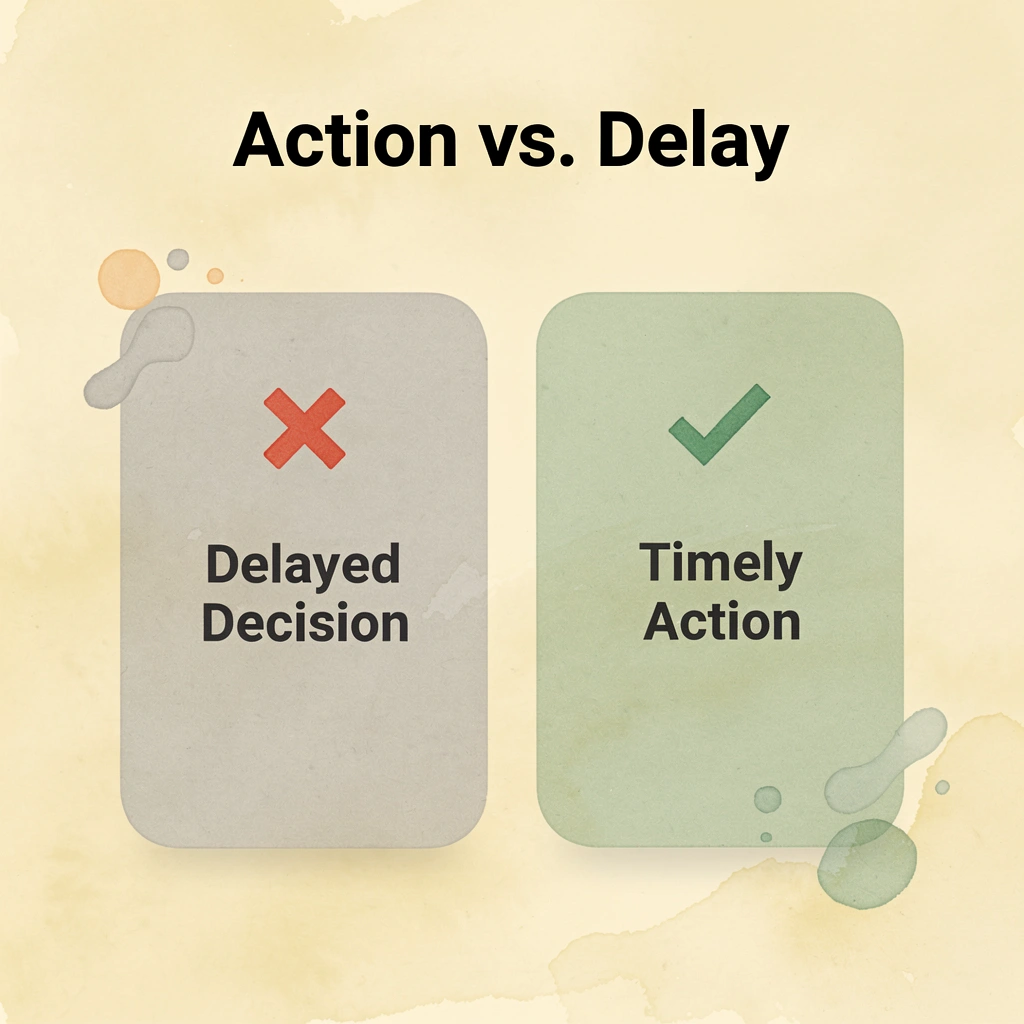
A $10,000 investment earning 7% annually grows to roughly $76,123 over 30 years. If you wait five years before starting, that same amount grows to approximately $53,865. You didn't spend the money or lose it in a bad trade—you simply waited. The difference exceeds $22,000. That gap is not a mere number; it's a choice that seemed harmless at the time.
Can larger contributions later make up for starting late?
Most people believe that larger contributions later can compensate for starting late. While bigger contributions help, they cannot fully replace the decades of compounding that early action creates. Time is the one financial resource you cannot buy, borrow, or recover once it is gone.
The delay pattern most people don't recognize
Many people treat financial planning as something to prepare for rather than as something to start now. They wait until they have less debt, earn more money, or feel more stable. This approach seems responsible but carries real costs. The AICPA and CIMA's 2026 Financial Literacy Month Survey found that 55% of Americans delayed major decisions for financial reasons, down from 61% the year before. Yet more than half the country waits for conditions that rarely materialize on schedule.
Where do people turn when they finally recognize the pattern?
Adults over 50 who recognize this pattern often turn to retirement financial planning frameworks developed by practitioners who have observed this pattern across thousands of client situations. Our Smart Financial Lifestyle approach provides a clear, step-by-step structure that removes the paralysis of not knowing where to start.
Why does the cost of delay extend beyond your own lifetime?
The hidden cost of waiting affects multiple generations. Every year, a retirement account grows and shapes what a family eventually inherits; every year, high-interest debt compounds and shrinks the legacy you intended to leave. The decisions made today determine what your children and grandchildren receive and whether the wealth you spent a lifetime building transfers intact or diminished. Our Smart Financial Lifestyle approach helps you align these decisions with your long-term wealth transfer goals.
The habits that separate those who close that gap from those who don't are more specific and surprising than most people expect.
The Core Habits That Support Long-Term Wealth Building
The habits that close the gap between intention and inherited legacy are specific, repeatable behaviors that compound quietly over decades, the same way interest does.
"The secret of getting ahead is getting started — small, consistent habits are the real engine behind every lasting fortune." — Financial Planning Wisdom
🎯 Key Point: Long-term wealth isn't built through single dramatic decisions — it's built through specific, repeatable behaviors practiced consistently over time.
💡 Tip: Think of your financial habits the way you think about compound interest — small actions taken daily and weekly are worth far more than occasional bursts of effort.
|
Habit Type |
Short-Term Impact |
Long-Term Impact |
|---|---|---|
|
Consistent saving |
Modest cash reserve |
Generational Wealth Foundation |
|
Intentional spending |
Reduced waste |
Decades of redirected capital |
|
Repeatable investing |
Small portfolio growth |
Compounding legacy assets |
Why does automating contributions matter more than willpower?
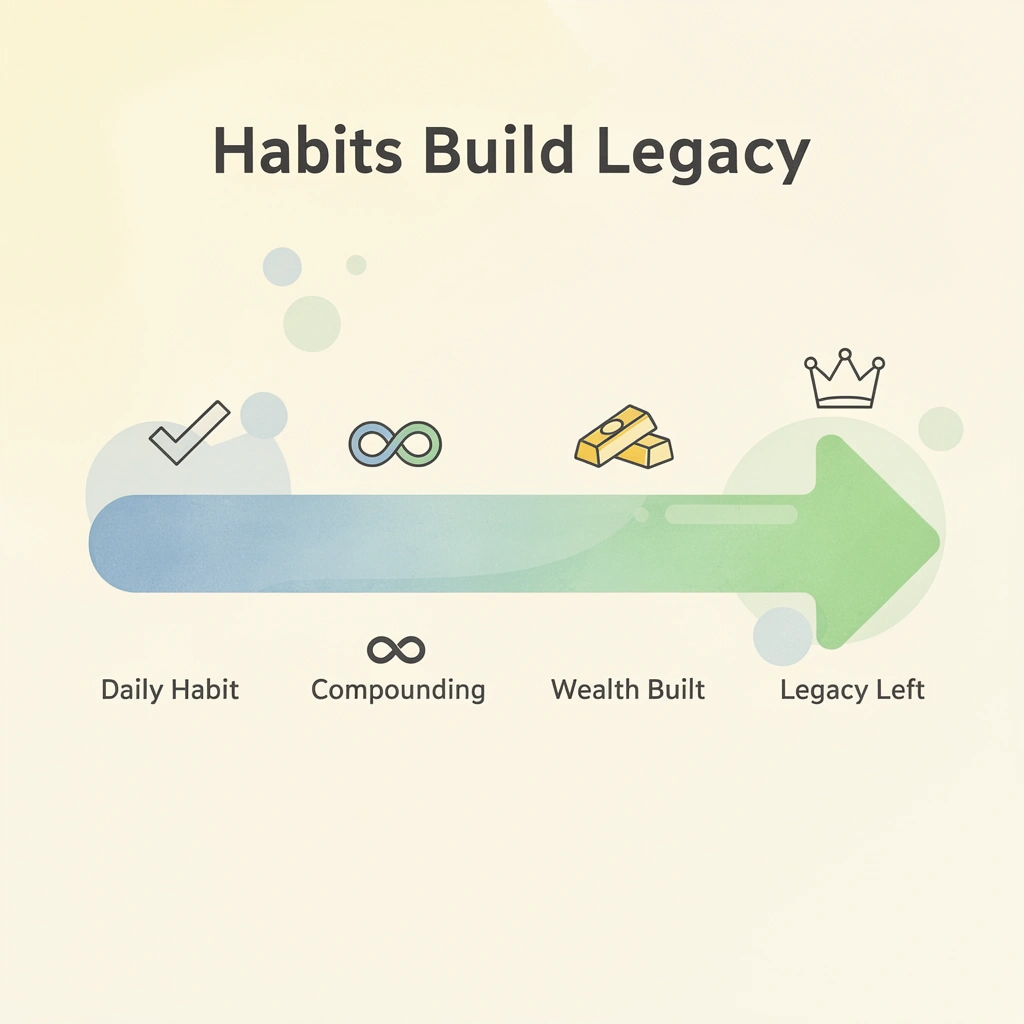
The first habit is paying yourself before you pay anyone else—a structural rule, not a motivational one. Automatic contributions to retirement accounts remove the decision entirely, since willpower is unreliable and financial discipline is a system design problem. Liberty Group, LLC reports that the 401(k) contribution limit for 2025 is $23,500, with catch-up contributions available for adults over 50. Those who consistently reach that limit don't necessarily earn more; they automated the behavior early and stopped treating contributions as optional.
How does keeping debt in its lane protect long-term wealth?
The second habit is keeping debt in its lane. Most people manage debt reactively, paying it down when money is left over—which rarely happens. According to LSC LongSchaefer CPA, smart money management means limiting total debt payments to no more than 36% of gross monthly income. Beyond that threshold, debt crowds out savings, investment contributions, and the financial flexibility needed when life gets unpredictable.
The literacy gap nobody talks about
The third habit is continuous financial education. First Port City Bank notes that only 57% of adults in the United States are financially literate, meaning nearly half the population makes decisions about retirement, taxes, and estate planning without a solid foundation.
What does financial literacy actually require you to know?
Financial literacy means understanding how a Roth conversion affects your taxable income in retirement, how sequence-of-returns risk can damage a portfolio in the first five years of withdrawal, and how beneficiary designations override what a will says. These levers determine what transfers to the next generation intact.
How can adults over 50 stay current without a finance degree?
Most people rely on a single advisor or annual review, but financial complexity doesn't pause between appointments. Our retirement financial planning draws on 50 years of practitioner experience to give adults over 50 a structured way to stay current without a degree in finance. Weekly insights, conversion consultations, and step-by-step checklists replace the guesswork that costs families money they never realize they lost.
How does rebalancing on a schedule protect your portfolio?
The fourth habit is to review and rebalance on a schedule, not based on how you feel. Markets change. Life changes. A portfolio that was 70% stocks at 55 may be 85% stocks at 62 without any intentional decision, simply because growth assets performed better. Rebalancing keeps your risk profile aligned with your actual timeline and legacy goals. In investing, skipping this step carries a measurable cost.
Why is tax efficiency a year-round strategy, not a seasonal one?
The fifth habit is treating tax efficiency as an ongoing strategy, not a once-a-year event. Roth conversions, asset location across taxable and tax-advantaged accounts, and charitable giving structures reduce the tax burden passed to heirs. These decisions become available to anyone who plans ahead rather than waiting until the last minute. The families who preserve the most wealth across generations are not necessarily the ones who earned the most, but those who lost the least to taxes, fees, and avoidable mistakes.
But knowing the habits is only half the equation. Building a plan that holds up when careers shift, markets drop, and life refuses to cooperate is where the real test begins.
Related Reading
- Passive Income For Retirement
- How To Maximize Retirement Savings
- Wealth Creation Plan
- How To Catch Up On Retirement Savings In Your 50s
- How to Invest 1000 Dollars
- How To Grow Your Money
- How to Stop Living Paycheck to Paycheck
-
How Much Money Should I Have Saved by 30
How to Build a Long-Term Financial Plan That Survives Real Life
Understanding long-term financial planning principles is one thing; putting them into practice successfully is another. Life rarely follows a straight line. Most financial plans assume steady income growth, predictable expenses, cooperative markets, and scheduled life events — but reality looks very different. Careers change, families grow, health issues arise, economic conditions shift, and priorities evolve in ways no spreadsheet can fully anticipate. A plan that only works under perfect circumstances won't survive decades of real-world turbulence.
"The most successful long-term financial plans are flexible enough to adapt while remaining anchored to clear long-term objectives." — Core Principle of Resilient Financial Planning
|
Life Event |
Impact on Plan |
Adaptation Required |
|---|---|---|
|
Career change |
Income disruption |
Revisit savings rate & timeline |
|
Family growth |
Higher expenses |
Adjust budget & insurance coverage |
|
Health issues |
Unexpected costs |
Emergency fund & coverage review |
|
Market shifts |
Portfolio volatility |
Rebalance & reassess risk tolerance |
|
Evolving priorities |
Goal realignment |
Update long-term objectives |
💡 Tip: Review your financial plan at least once per year — and immediately after any major life event. Flexibility isn't a weakness in a financial plan; it's its greatest survival mechanism.
⚠️ Warning: A financial plan built only for ideal conditions is a plan built to fail. Rigid, assumption-heavy plans are among the most common reasons people abandon their financial goals entirely — build in buffers, contingencies, and review checkpoints from day one.

Why do specific goals matter more than general ones?
Every financial plan needs a destination. Without clear goals, it becomes difficult to determine how much to save, how aggressively to invest, or which financial decisions deserve priority. The most effective goals are specific and measurable. Rather than saying you want to "build wealth" or "retire comfortably," define what those outcomes mean:
-
Accumulate a six-month emergency fund within three years.
-
Save 15% of annual income toward retirement.
-
Eliminate high-interest debt within five years.
-
Purchase a home within seven years.
-
Reach a specific retirement portfolio target by age 65.
Research shows that people who establish specific goals are more likely to take consistent action than those pursuing vague objectives.
One reason long-term planning feels overwhelming is that many financial goals take decades to achieve. Milestones solve this by creating smaller checkpoints along the way. A retirement plan might include milestones such as saving the first $10,000, building a three-month emergency reserve, contributing enough to receive a full employer match, reaching six figures in invested assets, and increasing retirement contributions after major raises. Milestones provide regular evidence of progress and create opportunities to make course corrections before small problems become large ones.
How does planning for uncertainty protect your financial progress?
One of the biggest reasons financial plans fail is that they assume nothing will go wrong. According to Bankrate's 2026 Emergency Savings Report, only 46% of Americans have enough emergency savings to cover at least three months of expenses, while 24% have no emergency savings at all. Unexpected costs are inevitable. A strong financial plan expects uncertainty rather than ignoring it. Emergency funds, adequate insurance coverage, and financial reserves prevent temporary setbacks from becoming long-term financial problems.
Career paths are rarely straight. Over a working lifetime, many people experience promotions, layoffs, career changes, entrepreneurial ventures, industry disruptions, or periods of reduced income. A financial plan must accommodate these changes. A promotion may allow you to increase your retirement contributions and accelerate progress toward long-term goals. A career transition may require temporarily reducing savings while protecting core financial priorities. The goal is to keep making progress despite changing circumstances.
How should major life events fit into a long-term financial strategy?
Many financial plans fail because they focus heavily on retirement while underestimating the impact of major life events that occur beforehand. Marriage, children, homeownership, caregiving responsibilities, education expenses, divorce, and health-related challenges significantly affect financial priorities. Successful planners incorporate these events into their long-term strategy rather than treating them as disruptions. Someone planning for children may gradually increase emergency savings and review insurance needs. Someone approaching retirement may begin shifting from wealth accumulation toward income planning years in advance.
One of the most common mistakes in financial planning is assuming every available dollar should be directed toward future goals. While saving and investing are essential, an overly restrictive plan becomes difficult to sustain. Research on behavioral finance shows that people are more likely to stick with financial strategies they can maintain over long periods. A successful plan should support both present enjoyment and future security: taking vacations while investing consistently, or spending intentionally on experiences that matter while avoiding lifestyle inflation in less meaningful areas. Long-term success comes from creating a sustainable system.
Is adjusting your financial plan a sign of failure or strength?
Many people believe that changes to a financial plan signal failure. In reality, flexibility often indicates a strong plan. Economic conditions, tax laws, personal goals, and family circumstances all change.
The purpose of a financial plan is not to predict every future event, but to give you a framework for making decisions as those events happen. A person who adjusts contribution rates during a temporary setback, changes retirement timelines after a career change, or updates financial priorities following a major life event is not abandoning their plan—they are adapting it.
The most successful long-term financial plans evolve over time. Goals may be refined, timelines may shift, savings rates may increase or decrease, and investment strategies may change as circumstances evolve. What remains constant is the long-term objective.
The people who achieve lasting financial success rarely follow a perfect plan from beginning to end. More often, they make thoughtful adjustments while staying committed to their broader financial goals. In long-term financial planning, flexibility is not the opposite of discipline—it is what makes discipline possible.
How Smart Financial Lifestyle Helps You Think Like a Long-Term Wealth Builder
Building wealth is not about finding the perfect investment, timing the market, or chasing trends. Long-term financial success is driven by consistent behavior repeated over many years.
💡 Tip: The most powerful wealth-building tool isn't a hot stock or market prediction: it's the discipline to repeat smart financial behaviors day after day, year after year.
Understanding these principles and applying them consistently are two very different things. Most people know they should save more, avoid unnecessary debt, invest for the future, and maintain a long-term perspective. Yet behavior remains one of the biggest obstacles to financial success.
"The average equity investor lagged the S&P 500 by 8.48 percentage points in 2024, largely because of behavioral decisions rather than investment availability." — DALBAR's 2025 Quantitative Analysis of Investor Behavior
🔑 Takeaway: An 8.48 percentage point gap is not a small difference — compounded over decades, that shortfall can represent hundreds of thousands of dollars in lost wealth. The problem isn't access to good investments; it's controlling the behaviors that sabotage them.
|
What Investors Know |
What Investors Actually Do |
|---|---|
|
Save more consistently |
Delay saving until "the right time" |
|
Avoid unnecessary debt |
Take on lifestyle debt impulsively |
|
Invest for the future |
React emotionally to market swings |
|
Maintain long-term perspective |
Chase short-term trends and timing |
⚠️ Warning: Knowing the right financial behaviors and executing them under pressure are entirely different skills. Behavioral gaps — not knowledge gaps — are what derail most long-term wealth plans.
Maintaining a long-term wealth-building mindset requires perspective, discipline, and a clear framework for making decisions when uncertainty arises. Without a structured approach, even well-intentioned investors fall back on emotional reactions that erode long-term gains.
🎯 Key Point: A decision-making framework acts as your financial anchor: it replaces reactive choices with principled, consistent action, especially during the volatile moments that matter most.
What is Smart Financial Lifestyle, and who is it for?
Smart Financial Lifestyle was created to help people develop that framework. It draws on the experience of Paul Mauro, who spent more than 50 years in wealth management and oversaw more than $1 billion in assets under management. The platform focuses on principles that support sustainable wealth creation rather than short-term speculation.
Through books, educational resources, and free YouTube content, readers can learn long-term wealth-building principles, investment strategies, retirement planning, risk management, financial decision-making frameworks, and behavioral habits that support wealth accumulation.
Why do so many people abandon their long-term financial plans?
Many financial mistakes occur when people abandon long-term plans due to short-term events. Market declines trigger panic selling, while rising markets encourage excessive risk-taking. Economic uncertainty causes decision paralysis. Financial media amplifies these reactions by emphasizing daily changes over long-term results.
How does thinking like a long-term wealth builder change your outcomes?
Smart Financial Lifestyle teaches financial education by helping people think like long-term wealth builders. This means understanding how compounding works over decades, why behavior often matters more than prediction, how to manage risk, and how financial decisions fit into a broader life strategy.
Rather than treating financial planning as a series of separate decisions, the content encourages readers to view wealth building as a lifelong process rooted in consistent habits, disciplined decision-making, and patience.
The goal is to help readers build the mindset required to stay committed to a sound financial plan through changing markets, economic cycles, and life circumstances.
Kickstart Your Retirement Financial Planning Journey | Subscribe to Our YouTube and Newsletter
If this article helped you see that long-term financial planning is more about behavior than investment selection, explore Smart Financial Lifestyle today. Start with Paul Mauro's free YouTube content and educational resources to learn wealth-building principles from a career spanning more than five decades and over $1 billion in assets under management. Your first session can help you identify the behavioral habits and planning principles with the greatest impact on your long-term financial future.
"Long-term financial planning is more about behavior than investment selection — and the right guidance can help you identify the habits with the greatest impact on your financial future." — Smart Financial Lifestyle
🎯 Key Point: Behavioral habits and planning principles — not just investment picks — are the real drivers of long-term financial success.
💡 Tip: Start with Paul Mauro's free YouTube content to access five decades of wealth-building expertise and over $1 billion in assets under management — completely free of charge.
|
Resource |
What You Get |
|---|---|
|
Free YouTube Content |
Wealth-building principles from 50+ years of experience |
|
Educational Resources |
Actionable planning principles and behavioral strategies |
|
First Session |
Identify your highest-impact financial habits |

Related Reading
- Low Risk Investment Options
- Early Retirement Strategies
- How To Grow Your Money
- How Much Should I Save Each Month
- How To Invest 1000 Dollars
- What Happens If You Run Out Of Money In Retirement
- Retirement Income Strategies
- How Much Money Should I Have Saved By 30
- Long-Term Stock Investments
- Retirement Planning Mistakes
-
Best Investment For Retirement Income
- Are Index Funds Good For Retirement
-
Ira Pros And Cons


