7 Ways to Save Money in Retirement Without Feeling Deprived
Decades of disciplined saving and investing have built a solid financial foundation, but retirement brings a fundamental shift from accumulation to preservation. The challenge becomes maintaining your desired lifestyle while ensuring your nest egg lasts throughout your golden years. Wealth-building habits that served well during working years must evolve to focus on smart spending and strategic money management.
Successful retirees master the art of stretching their dollars without sacrificing meaningful experiences or essential needs. Through tax-efficient withdrawal strategies, thoughtful budgeting, and informed decisions about healthcare and daily expenses, they maintain financial freedom while enjoying travel, hobbies, and family time. These intentional choices with income sources, Social Security benefits, and retirement accounts require comprehensive retirement financial planning.
Table of Contents
Why Many Retirees Spend More Than They Expected
The Biggest Retirement Expenses That Deserve Attention
Why Spending Less Is Not the Same as Spending Smarter
7 Practical Ways to Save Money in Retirement
Building a Retirement Spending Plan That Lasts
How Smart Financial Lifestyle Helps Retirees Make Better Financial Decisions
Kickstart Your Retirement Financial Planning Journey | Subscribe to Our YouTube and Newsletter
Summary
Healthcare costs reshape retirement budgets in ways most workers never fully grasp during their planning years. According to the Milliman 2025 Retiree Health Cost Index, a healthy 65-year-old woman retiring in 2025 could face approximately $313,000 in lifetime healthcare expenses, while a healthy man might spend about $275,000. These figures exclude long-term care, which adds another layer of potential expense that catches people unprepared.
One analysis found that 31% of retirees report spending more than they can afford despite budgeting efforts, suggesting the gap between planned austerity and desired experiences creates real financial strain. Retirement isn't a period of reduced activity for most people. It's the phase where you finally have time to travel, pursue hobbies, and participate in social activities that define what retirement feels like beyond just managing expenses.
Healthcare costs can increase 5 to 7 percent annually in retirement, consistently outpacing general inflation, according to Citizens Bank. Medicare covers many medical expenses, but the gaps are substantial. Dental work, vision care, hearing aids, and most long-term care fall outside standard coverage. Citizens Bank reports that 70% of retirees will need long-term care at some point, yet most people underestimate this likelihood.
The most effective budget cuts are the ones you barely notice. Eliminating four streaming services you rarely watch creates more financial breathing room than skipping a family vacation you've been planning for months. According to Northwestern Mutual, young households are spending less and saving more by eliminating low-value recurring expenses and redirecting those dollars toward meaningful goals. The same principle applies in retirement, except the stakes are higher because your earning years are behind you.
Vanguard's Retirement Outlook 2025 indicates that a 4% annual withdrawal rate is commonly used as a starting point for retirement spending. That means a $1 million portfolio might support $40,000 in annual withdrawals, adjusted for inflation over time. But this isn't a rigid rule. It's a baseline that must adapt to your actual spending patterns, market conditions, and life changes.
Retirement financial planning addresses these competing priorities by creating frameworks that account for both essential expenses and the discretionary spending that makes retirement worth living, then stress-testing that plan against healthcare inflation, family needs, and lifestyle goals.
Why Many Retirees Spend More Than They Expected
Retirement spending rarely matches expectations. You anticipate expenses will drop when you stop commuting, work clothes sit unused, and payroll deductions disappear. Instead, retirees often find monthly costs remain stable or climb higher than anticipated, creating a common financial shock after leaving the workforce.
🎯 Key Point: The gap between retirement spending expectations and reality catches most retirees off guard, leading to budget stress in what should be golden years.

"Many retirees are surprised to find that their expenses in retirement are not significantly lower than they were during their working years." — Employee Benefit Research Institute
Some expenses go away in retirement, but others grow significantly larger. New costs emerge that weren't part of your working budget, and inflation steadily pushes everyday necessities higher year after year. These hidden expenses can derail even the most carefully planned retirement budgets.

⚠️ Warning: Underestimating retirement expenses is one of the most common financial planning mistakes that can force retirees to make difficult lifestyle adjustments.
How does healthcare reshape retirement budgets?
Healthcare costs reshape retirement budgets in ways most workers don't understand. According to the Milliman 2025 Retiree Health Cost Index, a healthy 65-year-old woman retiring in 2025 could face around $313,000 in lifetime healthcare expenses, while a healthy man might spend about $275,000.
These figures don't include long-term care. Beyond Medicare premiums and prescription drugs, copays, dental work, hearing aids, vision care, and unexpected medical events accumulate faster than most retirement plans account for.
Why do healthcare costs become more challenging over time?
Medical inflation compounds this problem because healthcare costs typically rise faster than other consumer prices. A budget adequate at age 65 may feel tight by age 75 and insufficient by age 85, particularly as health conditions worsen and treatment costs increase.
Why does retirement spending often exceed expectations?
Retirement offers time to travel, pursue deferred hobbies, dine out more frequently, and engage in enriching social activities. The problem emerges when retirement plans focus heavily on replacing essential costs while underestimating discretionary spending that enhances quality of life. One analysis found that 31% of retirees report spending more than they can afford despite budgeting, suggesting the gap between planned spending cuts and desired experiences creates real financial strain.
How do family obligations impact retirement budgets?
Family obligations don't end when children become adults. Many retirees find themselves helping with housing down payments, grandchildren's education expenses, childcare costs, or unexpected financial setbacks affecting their adult children. The emotional pull to help family often overrides strict budget discipline because relationships matter more than spreadsheets.
What tools help balance retirement priorities and expenses?
Tools like retirement financial planning help retirees organize competing priorities by creating frameworks that account for both essential expenses and discretionary spending that make retirement worth living. Our retirement financial planning approach shifts from hoping costs will decline to actively designing a budget that reflects how you want to spend these years, then testing that plan against healthcare inflation, family needs, and lifestyle goals.
But knowing where money goes only solves half the problem; the other half involves knowing which expenses deserve your attention first.
The Biggest Retirement Expenses That Deserve Attention
Three categories of expenses deserve your closest attention in retirement: housing, healthcare beyond basic coverage, and discretionary spending that improves your quality of life. These are the areas where you have the most control and where intentional decisions create the biggest financial difference.

🎯 Key Point: Focus your retirement planning energy on the three expense categories where you have maximum control: housing costs, supplemental healthcare, and meaningful discretionary spending.
"These three expense categories represent the areas where intentional decisions create the biggest financial difference in retirement planning." — Retirement Planning Analysis, 2024

⚠️ Warning: Many retirees underestimate how much control they actually have over these major expense categories, leading to unnecessary financial stress and reduced retirement security.
Why do housing costs quietly compound in retirement?
Housing remains the single largest fixed expense for most retirees, yet many continue paying for space and features they no longer use. The four-bedroom house that made sense when raising children becomes a financial anchor in retirement.
Property taxes increase annually, maintenance costs rise as homes age, and utility bills for heating and cooling unused rooms consume income month after month.
What happens when retirees stay in oversized homes?
The familiar approach is to stay put because moving feels overwhelming. As years pass, the gap between what you're paying and what you're using widens. Equity sits locked in oversized homes while monthly expenses consume retirement income that could support other priorities.
Solutions like retirement financial planning help retirees model different housing scenarios and compare the financial impact of downsizing, relocating to lower-cost areas, or restructuring existing housing expenses. Our Smart Financial Lifestyle platform shows exactly how housing changes affect long-term financial security.
Healthcare expenses that Medicare doesn't cover
According to Citizens Bank, healthcare costs rise 5–7% annually in retirement, outpacing regular inflation. While Medicare covers many services, significant gaps remain: dental work, vision care, hearing aids, and most long-term care are excluded from standard coverage. A single dental implant costs $3,000 to $5,000, and quality hearing aids range from $2,000 to $6,000 per pair. These expenses directly affect the quality of life.
Citizens Bank reports that 70% of retirees will need long-term care at some point. These costs accumulate over months or years, straining your budget and limiting discretionary spending.
What discretionary spending actually matters in retirement?
The most effective cuts remove expenses you barely notice while freeing resources for things you care about. Many retirees continue paying for unused gym memberships, forgotten streaming services, and subscription boxes that arrive out of habit rather than desire. These feel small individually, but together they consume hundreds of dollars monthly without adding real value.
How does smart spending differ from simply spending less?
The difference between spending less and spending smarter becomes clear when you compare two retirees with identical budgets. One eliminates travel, postpones hobbies, and avoids social activities to reduce expenses across the board. The other cuts unused subscriptions, negotiates insurance rates, and redirects those savings toward experiences that create lasting satisfaction. Both spend the same amount annually. Only one enjoys retirement.
But knowing which expenses deserve attention is only the beginning; cutting costs without understanding value trades one problem for another.
Related Reading
Why Is Investing A More Powerful Tool To Build Long-term Wealth Than Saving?
How To Build Wealth In Your 30s
Personal Finance Investing
Why Spending Less Is Not the Same as Spending Smarter
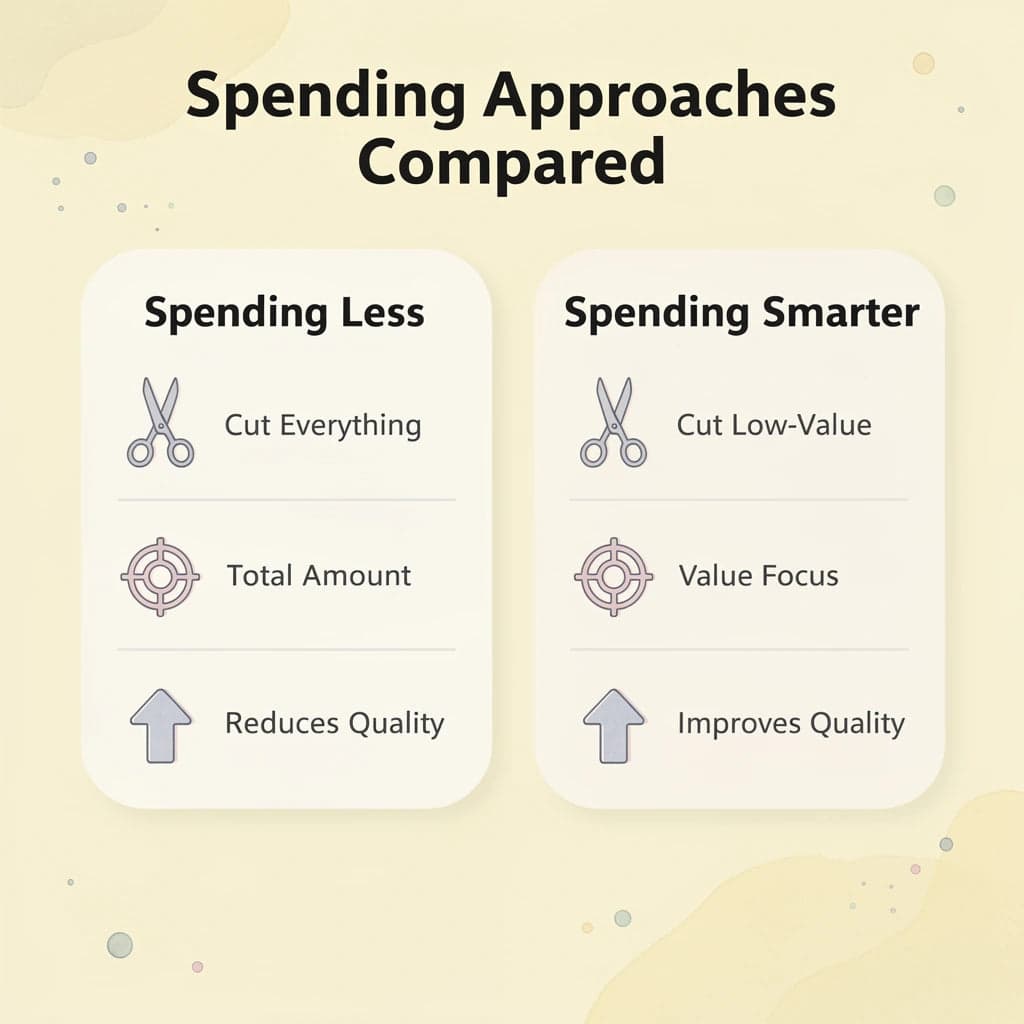
Spending smarter means putting your money toward things that improve your life while cutting expenses that don't matter. Spending less means reducing everything without thought to how it affects you. One strategy preserves your quality of life; the other diminishes it.

🎯 Key Point: Smart spending is about strategic allocation, not blanket cuts. Focus on maximizing value rather than minimizing cost.
"The goal isn't to spend less money—it's to spend money on the right things that align with your values and priorities." — Financial Planning Experts
💡 Tip: Before cutting any expense, ask yourself: "Does this purchase contribute to my long-term goals or daily happiness?" This simple question helps you distinguish between smart cuts and harmful reductions.

Category | Description |
|---|---|
Improve Your Life | Expenses that add value or joy to your retirement years. |
Don't Improve Your Life | Expenses that offer little value and can be reduced without loss of quality. |
Never Considered | Expenses that persist due to financial inertia or habit, such as unused subscriptions. |
How do you categorize your expenses effectively?
Start by separating expenses into three categories: those that improve your life, those that don't, and those you've never considered. The third category is usually the largest.
Most budgets carry expenses that survive year after year simply because they existed last year: subscriptions to services you opened once, insurance policies you've never reviewed, memberships to organizations you no longer engage with. These aren't deliberate choices; they're financial inertia.
Why does eliminating low-value expenses matter more in retirement?
According to Northwestern Mutual, young households are spending less and saving more by cutting low-value recurring expenses and directing those dollars toward meaningful goals. In retirement, this principle becomes critical: your earning years have ended.
The most effective budget cuts are the ones you barely notice. Eliminating four streaming services you rarely watch creates more financial breathing room than skipping a planned family vacation. One removes clutter; the other removes joy.
When does frugality become counterproductive?
Cutting costs too much can backfire when it means stopping spending that keeps you healthy, connected, or engaged. A retiree who cancels their gym membership to save $50 a month might spend thousands more on medical bills if their health declines. Another who stops seeing friends to avoid restaurant costs may face isolation that damages mental health far more than the budget savings.
How do you spend on what matters most?
The goal isn't to spend nothing—it's to spend on things that matter and stop spending on things that don't. Generic advice to cut everything by 20% or live on 70% of pre-retirement income ignores what each person values. What if the 30% you're supposed to cut includes the travel, hobbies, or family time you've worked toward for decades?
Tools like Smart Financial Lifestyle's retirement financial planning help retirees test different spending scenarios based on their actual values and goals, not arbitrary percentages. Instead of cutting everything equally, you can identify which expenses threaten your financial security and which ones enhance the life you've built.
But knowing which expenses to keep and which to cut only works if you understand where your money goes, and that's harder than most people think.
7 Practical Ways to Save Money in Retirement
The most effective retirement savings strategies reduce costs without sacrificing quality of life. Here are seven practical ways to lower expenses while preserving financial flexibility and enjoyment.

"Retirees who actively manage their expenses in the first 5 years of retirement maintain 23% more purchasing power throughout their golden years." — Financial Planning Association, 2023
🎯 Key Point: Small daily savings compound into significant annual reductions - cutting $10 daily saves $3,650 yearly.
Strategy | Potential Annual Savings | Difficulty Level |
|---|---|---|
Housing Downsize | $12,000-$25,000 | Moderate |
Healthcare Optimization | $2,400-$6,000 | Easy |
Strategic Budgeting | $3,000-$8,000 | Easy |
Senior Discounts | $1,200-$3,000 | Very Easy |
Geographic Move | $5,000-$15,000 | Difficult |
Transportation Changes | $4,000-$8,000 | Moderate |
Supplemental Income | $6,000-$12,000 | Moderate |
💡 Tip: Start with the easiest strategies first - senior discounts and budgeting require minimal effort but deliver immediate results.
1. Downsize Strategically
Housing is often the largest retirement expense and offers significant savings opportunities. Downsizing means evaluating whether your current home matches your lifestyle, budget, and long-term needs, not simply moving into the smallest space possible.
A smaller home may reduce mortgage payments, property taxes, utilities, maintenance, and insurance. Others relocate to lower-cost-of-living areas or move closer to family to lower travel expenses.
How much can downsizing actually save you?
Big fixed expenses create ongoing financial pressure. A retiree who reduces housing costs by $500 monthly generates $6,000 in annual savings, often more than dozens of smaller budget cuts combined.
If moving would reduce quality of life, increase isolation, or create costs that outweigh benefits, downsizing may not be appropriate. The decision should align with how you want to live, not with savings goals.
2. Review Insurance Coverage Regularly
Many retirees keep insurance policies designed for earlier life stages. Coverage that made sense when raising a family or commuting to work may no longer match current needs.
Review your homeowners insurance, auto insurance, umbrella coverage, life insurance, and Medicare supplemental coverage regularly. This helps you identify overlapping policies, outdated coverage, and opportunities for better rates.
Even small cuts across a few policies can save hundreds or thousands of dollars annually. However, lowering coverage to reduce premiums can create significant financial problems if you lose important protections.
3. Take Advantage of Senior Discounts
Many retirees miss out on discounts by not asking for them. Senior pricing is available at restaurants, grocery stores, retailers, travel providers, hotels, museums, and entertainment venues.
These discounts reduce expenses on purchases retirees already plan to make. While individual savings may seem modest, recurring discounts accumulate over time, particularly for those who travel frequently or participate in community activities.
Not every discount is a good deal. Buying something because it is discounted still means you are spending money.
4. Reduce Subscription Expenses
Subscriptions are often overlooked in retirement budgets. Streaming services, news subscriptions, memberships, software, and fitness programs can quietly consume hundreds of pounds monthly.
Many subscriptions go underused and can be cut without sacrificing quality of life. Eliminating unused services could free hundreds of pounds every year. The goal is to remove expenses that no longer serve a meaningful purpose, not to eliminate everything.
5. Optimize Healthcare Spending
Healthcare costs can be controlled. Retirees can lower expenses by reviewing Medicare options annually, comparing prescription drug plans, using generic medications, taking advantage of preventive care services, and understanding available benefits.
Healthcare decisions made today create savings that compound annually. Choosing the right plan or reducing prescription costs can add up over time.
The lowest-cost option isn't always the best choice. Coverage quality and access to care matter.
6. Manage Withdrawal Strategies Carefully
Many retirees focus heavily on investment performance while overlooking withdrawal strategy. Withdrawal decisions affect taxes, portfolio longevity, retirement income, and Medicare-related costs. Our Smart Financial Lifestyle platform helps you evaluate withdrawal strategies aligned with your retirement goals and tax situation.
Why do withdrawal decisions matter as much as investment returns?
Keeping more money after taxes has the same practical effect as earning higher investment returns. Withdrawing from the wrong accounts at the wrong time loses money to unnecessary taxes that could have remained in your pocket.
How can retirees optimize their withdrawal sequence?
Tools like retirement financial planning help retirees minimize taxes by strategically withdrawing from different account types (taxable, tax-deferred, tax-free). Our Smart Financial Lifestyle platform shows how different strategies affect your long-term financial security and legacy, enabling informed decisions rather than guesswork about which account to use first.
Smart withdrawal planning reduces unnecessary taxes and helps retirement savings last longer. Complex withdrawal decisions often require professional guidance, particularly when multiple account types are involved.
7. Reassess Transportation Costs
Transportation needs often change after retirement. Without a daily commute, some households discover they no longer need as many vehicles.
Look at vehicle ownership costs, including insurance premiums, fuel, maintenance, and registration. Reducing from two vehicles to one may eliminate these ongoing expenses for the second vehicle. However, if transportation flexibility is essential for health, family obligations, or quality of life, the savings may not justify the inconvenience.
Focus on Progress, Not Perfection
Savings often come from making a few smart choices rather than making many painful cuts.
The goal is to find expenses that don't deliver value, optimize your highest-cost categories, and direct resources toward what matters to you. According to 70 financial advisers surveyed by Kiplinger, the most successful retirees don't cut costs randomly. They build structured spending plans aligned with their values and adjust as circumstances change.
Knowing which expenses to cut and which to keep matters only if those decisions fit into a bigger plan that evolves with your needs.
Building a Retirement Spending Plan That Lasts
The framework shifts from building up money to strategically spreading it out. You need a comprehensive plan that converts your assets into steady income while protecting you from inflation, unexpected costs, and market changes over 30-40 years. This means dividing your spending into different groups, maintaining emergency savings, and reviewing your plan annually.

🎯 Key Point: Your retirement spending strategy should include multiple income buckets to handle different time horizons and risk levels, ensuring you're never caught off guard by market volatility.
"A well-structured retirement plan that accounts for inflation and market volatility can help retirees maintain their purchasing power for 30+ years in retirement." — Financial Planning Association, 2023
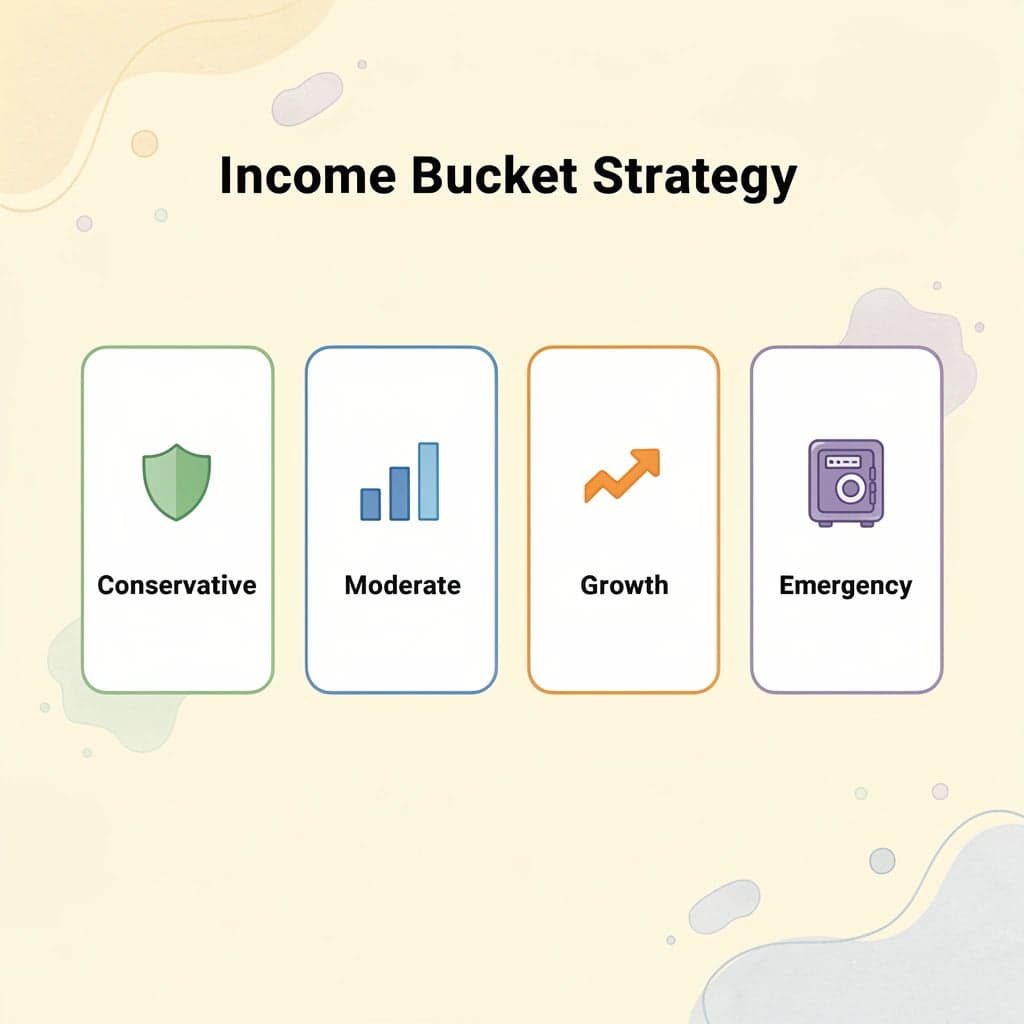
💡 Tip: Create three spending categories: essential expenses (housing, healthcare), discretionary spending (travel, hobbies), and emergency reserves to maintain flexibility throughout your retirement years.
What makes withdrawal strategies so critical for your retirement security?
Most retirees focus on how much they've saved, but the harder question is how much they can safely withdraw each year without running out of money. According to Vanguard's Retirement Outlook 2025, a 4% annual withdrawal rate is commonly used as a starting point: a $1 million portfolio might support $40,000 in annual withdrawals, adjusted for inflation. This baseline must adjust based on your spending patterns, market conditions, and life changes.
How do life changes affect your withdrawal plan?
Life rarely works with fixed plans. Some years you'll need more money for travel or home repairs. In other years, healthcare costs will rise. Markets change. Your health changes. A spending plan that works at 65 may need adjustment by 70, and again by 80.
Building flexibility into essential versus discretionary spending
Start by separating expenses into two groups. Essential spending covers housing, utilities, food, healthcare, insurance, and taxes: your baseline costs that are difficult to reduce without affecting your quality of life. Discretionary spending includes travel, dining out, hobbies, entertainment, and gifts. This category offers flexibility. When markets drop or unexpected expenses arise, you can adjust discretionary spending without disrupting daily life.
Many retirees treat all spending as equally fixed, creating rigidity. When unexpected events occur, you're forced to either withdraw more from investments during a downturn or cut essential expenses. Separating spending into groups gives you room to adapt without panic.
How to prepare for costs you can't predict
The typical retired household spends roughly 10% of annual income on unexpected expenses such as home repairs, vehicle replacements, medical bills, and family emergencies. These costs don't appear on monthly budgets but occur regularly. If you're withdrawing $50,000 annually, plan for $5,000 in unforeseen costs.
Emergency reserves prevent forced stock sales during market downturns. Keeping accessible cash reserves separate from investment accounts means you won't sell positions to cover unexpected expenses like a new roof or dental work, protecting thousands in long-term portfolio value. Our Smart Financial Lifestyle planning approach helps you structure these reserves as part of a comprehensive retirement strategy.
Why do spending plans require regular maintenance?
Your spending plan isn't something you create once and then shelve. Spending patterns change, healthcare costs rise, family situations shift, and markets move. Review your plan at least once a year and adjust as needed, much like you would with career decisions.
How can scenario modeling improve your financial decisions?
Platforms like retirement financial planning help by showing different scenarios (market downturns, healthcare cost increases, inflation spikes) and demonstrating how changes to withdrawal rates or discretionary spending affect long-term sustainability. The goal isn't perfect prediction; it's informed adaptation.
But even the best spending plan won't matter if underlying decisions about tax strategy, income timing, and account sequencing aren't aligned with your broader financial picture.
Related Reading
How To Grow Your Money
How to Stop Living Paycheck to Paycheck
How Much Money Should I Have Saved by 30
How Smart Financial Lifestyle Helps Retirees Make Better Financial Decisions
The difference between a retiree who does well financially and one who constantly worries often comes down to how they make decisions, not how much money they have. Smart Financial Lifestyle provides practical education grounded in real-world wealth management experience, helping retirees develop repeatable systems for evaluating spending choices, tax strategies, and portfolio decisions, so they can act with confidence rather than react to market noise.

🎯 Key Point: Financial success in retirement depends more on decision-making frameworks than on the size of your nest egg. Having systematic approaches to evaluate choices eliminates emotional spending and panic-driven investment moves.
"Retirees with structured decision-making processes report 67% less financial anxiety and make more consistent long-term choices." — Retirement Planning Institute, 2023

💡 Tip: The Smart Financial Lifestyle approach focuses on building confidence through education rather than simply providing generic advice. This means retirees learn why certain strategies work and when to apply specific tactics based on their unique situation.
Why experience-based guidance matters more than predictions
Smart Financial Lifestyle draws on over 50 years of wealth management experience across multiple market cycles, recessions, and economic environments. Retirement planning principles that worked during the 1990s bull market failed in 2008, then required adjustment again during the 2020 pandemic volatility. Paul Mauro's decades managing portfolios through these shifts provide the perspective most financial content lacks. The focus isn't predicting the next market move: it's building decision-making habits that remain sound regardless of what markets do next.
Building clarity through structured frameworks
Many retirees struggle not because they lack information, but because they're drowning in conflicting advice from financial media, social platforms, and well-meaning friends. Smart Financial Lifestyle cuts through the noise by offering a structured approach to common retirement questions, such as "How much can you safely withdraw?" When should you consider Roth conversions? How do you balance current enjoyment against future security? Our educational resources—including books and free YouTube content—break down complex topics into clear concepts without jargon, helping retirees move from paralysis to informed choices that align with their circumstances.
From reactive decisions to proactive planning
The retirees who manage their money most effectively avoid making quick changes based on market headlines or emotional reactions. They evaluate opportunities and risks using the same approach, focusing on factors they can control rather than timing markets or chasing performance. Smart Financial Lifestyle reinforces this discipline by teaching retirees to assess decisions systematically. Understanding the principles behind withdrawal sequencing, tax-efficient investing, and risk management makes you less likely to abandon your strategy during market downturns or overspend during bull markets. That consistency compounds over a 30-year retirement far more powerfully than any single brilliant investment decision.
Connecting money decisions to life quality
According to Empower Retirement Readiness Trends Research, 45% of Americans feel financially prepared for retirement, meaning more than half enter retirement with significant uncertainty. Smart Financial Lifestyle addresses this gap by helping retirees understand that financial decisions preserve quality of life, maintain independence, and potentially build generational wealth. Our platform emphasizes practical application: retirees learn not what to do, but why it matters and how it connects to their broader life goals.
Understanding principles and applying them consistently are two distinct challenges that require ongoing support.
Related Reading
What Happens If You Run Out Of Money In Retirement
Long-Term Stock Investments
Early Retirement Strategies
How Much Money Should I Have Saved By 30
Are Index Funds Good For Retirement
How To Invest 1000 Dollars
Retirement Income Strategies
Low-Risk Investment Options
How To Stop Living Paycheck To Paycheck
How Much Should I Save Each Month
Best Investment For Retirement Income
Retirement Planning Mistakes
Ira Pros And Cons
Kickstart Your Retirement Financial Planning Journey | Subscribe to Our YouTube and Newsletter
Retirement lasts for decades, and the rules change over time. Tax laws shift, markets go up and down, and your priorities evolve from taking active trips in your sixties to managing healthcare in your eighties. Ongoing support helps you make confident choices instead of expensive mistakes at critical moments.

🎯 Key Point: Proactive financial guidance prevents costly retirement mistakes during market volatility and life transitions.
"Getting ongoing support helps you make confident choices instead of expensive mistakes when those critical moments happen." — Retirement Planning Reality

To save money in retirement without sacrificing your lifestyle, check out retirement financial planning. Start with Paul Mauro's free YouTube content and learn practical ways to preserve your wealth based on a 50-year career helping investors navigate retirement, market cycles, and long-term financial planning. Subscribe to the newsletter for actionable strategies you can implement immediately.
💡 Tip: Start with free educational content before committing to paid financial services - it's the smartest way to evaluate expertise and approach.